Gemini 4 Carbon Takes the Crown, ChatGPT’s Dot Learns to Text & Grok Bot Goes Shopping
Dispatches of the past four-and-twenty hours from the laboratories of artificial intelligence
Google DeepMind · Models
Gemini 4 Carbon Takes the Top Spot, Two Weeks After Argon
Google’s new frontier model leads the rebuilt Artificial Analysis index and aims at cyber defence, but goes to security experts first
By Our Correspondent at the Leaderboard
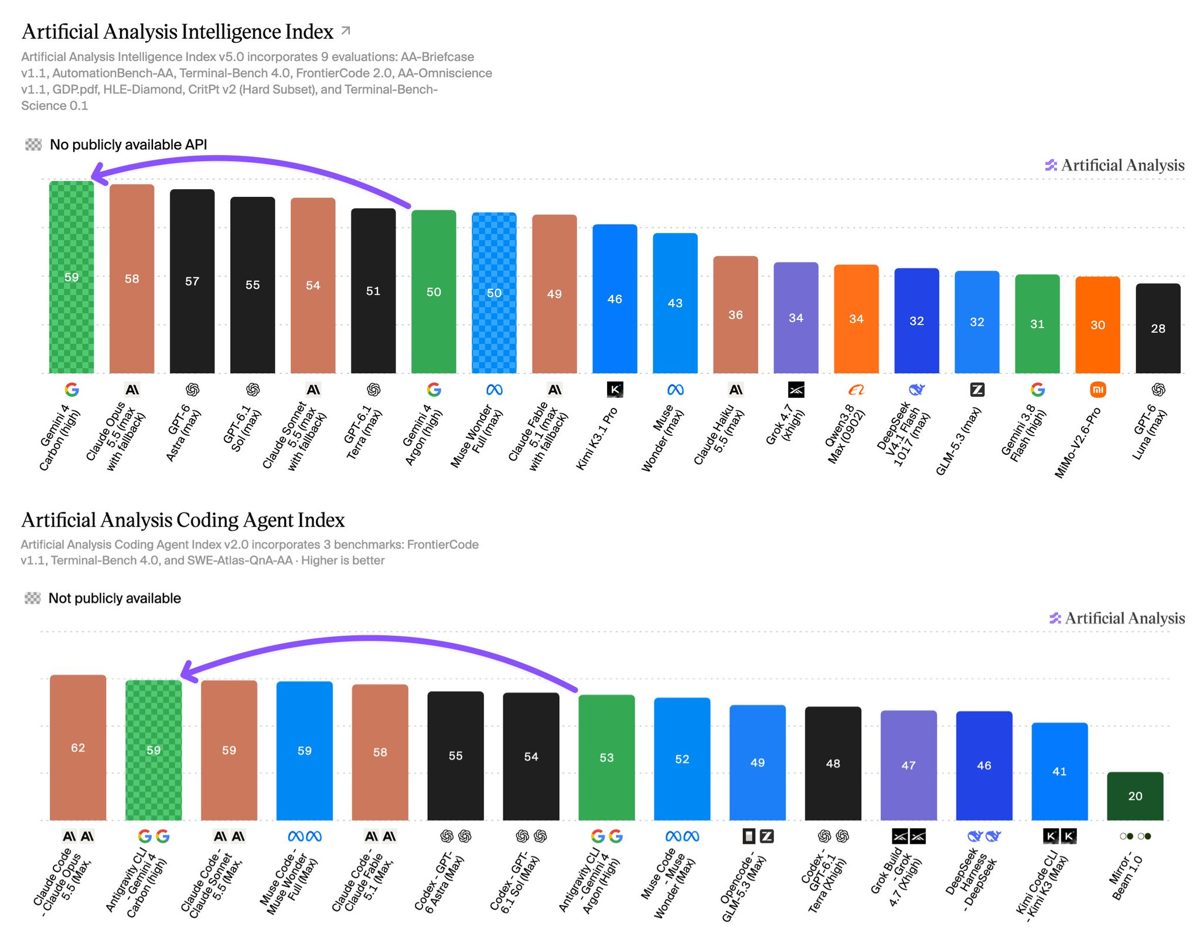
Carbon takes first place on the Intelligence Index v5 and second on the Coding Agent Index.Carbon במקום הראשון במדד האינטליגנציה v5 ובמקום השני במדד סוכני הקוד.Image: תמונה: @ArtificialAnlys on X
Google DeepMind unveiled Gemini 4 Carbon on Wednesday and called it its strongest model yet, state of the art in cybersecurity and long-horizon work. It came just two weeks after Gemini 4 Argon. “I did say we’d be releasing our models periodically,” Sundar Pichai wrote.
Artificial Analysis puts Carbon first on its new Intelligence Index v5 with 59 points, one ahead of Claude Opus 5.5 and two ahead of GPT-6 Astra. It leads 4 of the 9 tests. On the Coding Agent Index it scores 59 in Google’s Antigravity CLI, three points behind Claude Code with Opus 5.5. A separate test, FrontierSWE, has it fourth at 61.2 per cent.
It is also cheaper to run than its nearest rival: about $7.76 per index task, roughly 23 per cent less than Opus 5.5. Standard pricing is $4 in and $20 out per million tokens, with a 50 per cent launch discount and a context window of a million tokens.
The catch: you probably cannot use it yet. Google is rolling it out to cyber defenders first, with wider access to follow. And its hallucination rate rose from 4 to 11 per cent, though that is still the second lowest measured. @scaling01 said he worries about its cyber skills for exactly that reason.
You Can Now Text Your Dot, and Pro Users Get $500 a Month to Build
ChatGPT’s personal agent arrives in iMessage and RCS, while subscribers get API credits for apps and agents
By Our Correspondent on Read Receipts
ChatGPT’s dot, its always-on personal agent, now takes text messages. Send it a task, a photo or a voice note over iMessage or RCS and it will text you back with updates on its own. Only you can text your dot, and it can only text you. It is a preview for Pro users in the US.
Separately, eligible ChatGPT Pro and Business subscribers can now claim up to $500 a month in API credits to build apps and agents. Codex keeps spreading too: Runway shipped a Codex plugin that builds its video API into your app, and US companies can now buy the API, Codex and ChatGPT Work through Oracle’s marketplace.
And a rumour got a polite correction. Codex lead Thibault Sottiaux said merging ChatGPT’s Chat and Work modes is not rolling out yet. The plan is to bring them together “at some point this year,” carefully.
Grok Bot 0.78.1 Goes Shopping, and Friends Get Two Weeks Free
Product cards, subscription templates and Shop Pay in the vault, plus a referral programme and new rules for the Grok API
By Our Correspondent at the Checkout
Grok Bot 0.78.1 is now stable and rolling out. Shopping results now appear as product cards, there are new subscription templates, and you can connect Shop Pay in the vault. Shopify’s @tobi noted the timing on X.
SpaceX also started a referral programme. A friend you refer gets a two-week free trial of Premium, and when they become a paying subscriber you get a free usage reset, valid for six months. Referrers must be in the US on a paid Premium, Super or Ultra plan.
For developers, the Grok API now accepts “guidelines” in text requests, so apps can steer how it handles specific content categories. And in Claire Vo’s new How I AI personal agent bench, nine tasks across four agents, Grok Bot came first “by a lot,” ahead of Meta’s Muse, ChatGPT’s dot and Claude.
Claude Gets a Legal Toolkit, and Opus 5.5 Learns What Fun Is
Ready-made artifacts for lawyers, and Simon Willison calls October an inflection point for vibe-coded games
By Our Correspondent Between the Court and the Arcade
Claude for Legal now has a gallery of ready-made artifacts for contract review, regulatory horizon scans, cite checks and more. You start from a built-in example, add your own documents and connectors, and share it with anyone in the business.
Meanwhile Simon Willison argues that October is a turning point for building games with AI. Claude Opus 5.5, he writes, can now make video games that are actually fun. He built four, from a gentle spot-the-difference game about trees to a multiplayer real-time strategy game, without looking at the code.
His favourite trick: telling the model to “Make it a LOT more fun.” It worked.
Two Models, One Robot Arm, and Very Different Handwriting
Artificial Analysis shows Claude dabbing “hello world” dot by dot while GPT-6 draws it in strokes
By Our Correspondent at the Whiteboard
In a clip from its new AA-Robotics v0.1 tests, Artificial Analysis gave two models the same robot and the same job: write “hello world.” Claude Opus 5.5 dabbed it out dot by dot, 3,270 arm moves over 34 minutes. GPT-6 Astra wrote in continuous strokes, 514 moves in 13 minutes.
The same group also measured personality. GPT-6 Sol and Grok models came out the most direct and the likeliest to put the answer first. Meta’s Muse models were the friendliest of all, with Muse Spark 1.3 scoring a perfect 100.
Same robot, same word: Opus 5.5 dabs, GPT-6 Astra draws.אותו רובוט, אותה מילה: Opus 5.5 מנקד, GPT-6 Astra משרטט.Image: תמונה: @ArtificialAnlys on X
GitHub’s Copilot Fusion Mixes Claude and GPT at Half the Price
An orchestrator picks the model for each step and lands two points short of Opus 5.5
By Our Correspondent in the Switchboard
GitHub released Copilot Fusion, which picks between Anthropic and OpenAI models, including Claude Opus 5.5, Sonnet 5.5, GPT-6 Astra and GPT-6 Sol, for each task. Artificial Analysis found it scores two points below Claude Code with Opus 5.5 at about half the cost: $5.59 a task against $11.42.
It leads Terminal-Bench 4.0 with 71 and uses about half the tokens of Opus 5.5 in Claude Code. You pay for whichever models it calls.
Meta’s assistant tops ChatGPT on the iPhone free chart in four countries, and five universities get its models
By Our Correspondent on the Charts
Meta’s Muse app is now live in four countries and sits above ChatGPT on the iPhone free chart in each, according to Appfigures figures shared by an analyst: first in Singapore, Japan and Canada, and third in the US. Alexandr Wang called it a “global tour going pretty well.”
Meta also announced support for research at Caltech, Ohio State, LSU, Indiana University and UTHealth Houston, including access to its latest Muse models. Developers can join a live session on coding and agents with Muse Wonder and Muse Spark 1.3 on Thursday at 9:30 a.m. Pacific.
Answers, reasoning and tool calls come back as separate pieces; ML4 launch parties are set for Thursday
By Our Paris Correspondent
Mistral introduced a Responses API in public preview, built for agents. Each response returns the model’s answer, its reasoning and its tool calls as separate items, which Mistral says is easier to handle than Chat Completions.
Its small Voxtral Mini Transcribe 3 ranked second of nine on Voice Arena’s diarization leaderboard, ahead of its bigger sibling. And co-founder Guillaume Lample invited people to events in San Francisco, New York and London on Thursday to celebrate the launch of ML4.
Half a Trillion for Alphabet, a Byte-Sized Language Model, and Work on a Plane
Short items from the rest of the feed
By Our Roving Correspondent
Sundar Pichai said Alphabet is now on a half-trillion-dollar annual revenue run rate, growing 25 per cent, and that AI is driving Search query growth to its fastest pace in five years. The Gemini app added immersive explorations, interactive scenes you can dig into, and can now turn your Strava logs into a coaching plan. NotebookLM’s Live Chat voice mode reached all mobile users.
Albert Gu’s team showed a new version of H-Nets, language models that learn straight from raw bytes, with 3 to 5 times efficiency gains in controlled tests. @Suhail launched Particle, whose first model, particle-1, matches performance with about 45 per cent fewer tokens. NVIDIA’s open Nemotron 3.5 Transcribe tied for first among open speech-to-text models with just 4 billion active parameters.
HeyGen’s Voice STS copies your own delivery onto your avatar, pauses and whispers included. OpenClaw’s web UI now works offline, and @steipete got plenty done on spotty plane wifi. And Anthropic’s Thariq noticed something odd: technical people fear their skills are useless, while non-technical people wish they were more technical to use agents better.
Wren & Robin read you this morning's dispatches, with banter.
Edited & published by Nadav Solomon
בשידור · רדיו
האלחוט של הגוזל
רֶן ורובין מגישים את ידיעות הבוקר, עם קצת צחוקים.
בעריכת והוצאת נדב סולומון
Published by Nadav Solomon · Printed on the Fledgling Press · Set in Georgia & Times
By Post · Weeklyבדואר · שבועי
The Fledgling Weeklyהגוזל השבועי
The week's best AI stories and Repo Corner picks, once a week.מיטב ידיעות ה-AI של השבוע ובחירות פינת הריפו, פעם בשבוע.
Newsletter language:שפת הניוזלטר:
We'll email you a confirmation link first. Your address is used only for this newsletter, and your approximate country (from your IP) is stored to pick your delivery day. Never shared; every issue has a one-click unsubscribe.קודם נשלח לך קישור לאישור. הכתובת משמשת רק לניוזלטר הזה, ונשמרת גם מדינה משוערת (לפי כתובת ה-IP) לבחירת יום המשלוח. לא מועבר לאף אחד, ובכל גיליון יש הסרה בלחיצה אחת.
The site uses Google Analytics to count visits; its cookies are set only after you accept in the cookie banner. Privacy policy.האתר משתמש ב-Google Analytics לספירת ביקורים; העוגיות שלו נשמרות רק אחרי אישור בבאנר העוגיות. מדיניות פרטיות.