Genie 4 Builds Worlds That Talk Back, a New Leaderboard Leaves Open Models Behind & Claude Goes Drug Hunting
Dispatches of the past four-and-twenty hours from the laboratories of artificial intelligence
Google DeepMind · World Models
Genie 4 Builds Worlds You Can Walk Through, Hear and Talk To
DeepMind’s new world model adds native sound, speaking characters and a Gemini “director” that keeps the scene on track
By Our Correspondent Inside the Simulation
Google DeepMind unveiled Genie 4 on Tuesday, calling it its most realistic and interactive world model yet. You move through a generated scene with the keyboard, and type plain-language prompts to change it as it runs: make it rain, move the camera, bring in a new person or object.
The big new trick is sound. Genie 4 is DeepMind’s first real-time world model to generate audio natively, from wind and waves to characters who talk to each other and react to you. It is built on Gemini Omni for realistic looks, and Gemini 3.8 Flash runs alongside as a guide that watches each frame, plans the next steps and checks they happened.
Sundar Pichai showed the idea with a motorcycle on a coast road: prompt “traffic light green,” and Gemini works out what follows, so the engine revs and the bike pulls away. Demis Hassabis mused about “simulations within simulations.”
For now it is a research preview for trusted testers. Google says it is coming soon to Google AI Ultra subscribers in Project Genie and to early-access partners in the Gemini API and AI Studio, with a waitlist open. Every frame and sound carries a SynthID watermark.
Artificial Analysis Rebuilds Its Index, and the Open Models Slip Back
Version 5 leans on private tests; Claude Opus 5.5 leads, and the open-weights gap grows from 3 points to 12
By Our Correspondent at the Scoreboard
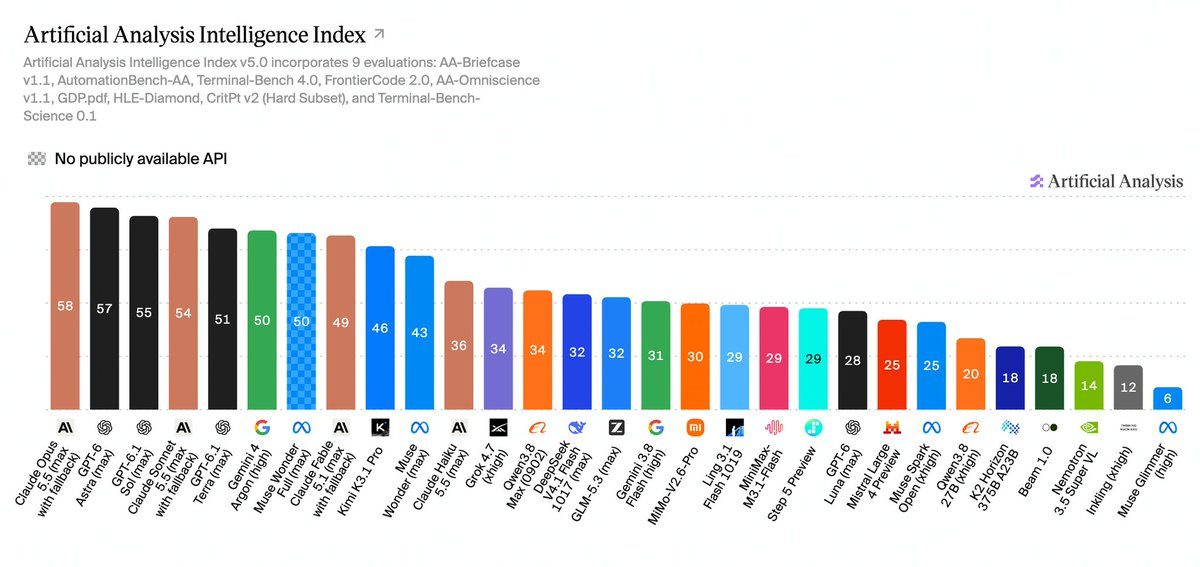
Artificial Analysis launched version 5 of its Intelligence Index on Wednesday, its biggest change since January. For the first time most of it, 60 per cent, rests on tests with private questions or hidden answers, so models cannot simply have seen them in training.
New in the mix are Cognition’s FrontierCode 2.0, 132 real coding tasks graded on whether a maintainer would merge the change, and Terminal-Bench-Science, 70 research tasks run in a terminal. Claude Opus 5.5 tops the table on 58, with GPT-6 Astra on 57 and GPT-6.1 Sol on 55. Sol lands within four points of Opus at about an eighth of the cost per task.
The open models fare worse. The best of them, Kimi K3.1 Pro, whose weights are not yet out, trails the leader by 12 points, against 3 in the old version. Among models with released weights, DeepSeek V4.1 Flash and GLM-5.3 top out at 32, below Claude Haiku 5.5. Ethan Mollick said the result matches the general mood; @scaling01 called v5 “probably the best version so far.”
The new Intelligence Index v5: Claude Opus 5.5 on 58, a point ahead of GPT-6 Astra.מדד האינטליגנציה החדש v5: Claude Opus 5.5 עם 58, נקודה לפני GPT-6 Astra.Image: תמונה: @ArtificialAnlys on X
Claude Goes Drug Hunting, and Buys a One-Person Biotech
Early results from six partners, from shorter cancer-therapy designs to paperwork cut by 89 per cent; plus a 40 per cent government discount
By Our Medical Correspondent
Anthropic shared early results on Tuesday from months of work with six drug developers, including Bristol Myers Squibb, Generate Biomedicines and BigHat Biosciences. At Generate, Claude Code helped design part of a cancer cell therapy about 70 per cent shorter than the standard one, which in lab tests made immune cells carry roughly ten times as many receptors.
At Divergence Labs, Claude produced about 35,000 antibody designs in a month for a food-allergy drug. At Enveda, it caught all 11 issues human reviewers found in manufacturing records, plus seven they missed, and cut review time by 89 per cent. Anthropic has also bought Mithril Medicine, a one-person company working on rare muscular dystrophies, and hopes a drug could reach human trials as soon as late 2028.
Separately, a new OneGov deal with the US General Services Administration gives government buyers 40 per cent off Claude Enterprise, Claude for Government and the API, now extended to state, local, tribal and territorial governments. Anthropic estimates the savings at $1 billion.
Grok Bot 0.77 Gathers Its Permissions in One Place
A Permissions page for Auto-review rules, a Payments tab in the Vault, and several questions on one card
By Our Correspondent in the Bot Pen
Grok Bot 0.77.0 is stable and rolling out, Eric Zakariasson announced. Settings gains a Permissions section that lists your Auto-review rules under Always Ask and Allow without Asking. The Vault gets a Payments tab where you pick which payment method Bots try first, though you still approve every purchase.
Bots can now ask several questions on one card that steps through them, with room for your own answer. The changelog also lists 1Password logins without a shared vault, Import Memory from another AI assistant, approval cards that stay open 30 minutes instead of 10, and new Order Concierge and Deal Watcher templates.
Around it, Matt Palmer posted a five-minute tour of recent features, from Pages and the Vault to Apple integrations, and poteto shared “tibot,” a bot that sorts his X mentions into one daily digest and never posts for him. Superwhisper users can now talk to Grok Bot about their meetings.
Codex CLI 0.165 Plugs Into Google Cloud, and ChatGPT Opens iCloud
A Vertex AI provider, memory v2 by default and Terra in the catalog; plus another limits reset
By Our Correspondent in the Terminal
Codex CLI 0.165.0 adds a built-in Google Cloud Vertex AI provider, switched on with model_provider = "gcp", and puts GPT-6.1 Terra in the model catalog. You can now change reasoning effort mid-conversation by default, fresh profiles start on memory v2, and memories can be imported from other agents. The session picker gains a repository filter.
ChatGPT, meanwhile, now connects to iCloud Mail and Calendar on every plan, on web, desktop and iOS. Codex lead Tibo Sottiaux joked that this was his “Day 23” gift before admitting the real one: yet another reset of Codex usage limits, landing by midnight Pacific time.
A note in Anthropic’s maths repository says an internal model refuted the Exponential Time Hypothesis on October 16
By Our Correspondent at the Blackboard
A day after OpenAI said its models had disproved the Exponential Time Hypothesis, a note in Anthropic’s formal-maths repository says an internal Claude research model found the core algorithm independently on October 16, using 14 million output tokens “and no human input.” Anthropic researchers then helped write up the paper. @scaling01 reckons that is three to four days of one model working alone.
Also from Anthropic: Felix Rieseberg says he has dropped the coding interview from hiring on his team because it no longer tells him anything, and argues this opens a door for junior engineers.
Draw on the Page for Cursor, Record an Hour for Notebook
Cursor’s design mode learns Annotate; Gemini can now say whether a file came from Google’s AI
By Our Correspondent at the Workbench
Cursor’s design mode now has Annotate: you edit elements, draw on the page and check a design at different screen sizes, and the agent takes those marks as its instructions. Press Cmd+Shift+D in the browser to start.
Gemini Notebook’s mobile app can record up to an hour of live audio, such as a lecture or a meeting, and use it straight away as a source, on both iOS and Android. And in the Gemini app you can now ask “Is this AI generated?” about an image, video or audio file; it checks for Google’s SynthID watermark.
MAI-Image-2.7-Preview, a sharper Ling 3.1 Flash, and a voice-agent platform that finishes more calls
By Our Correspondent at the Leaderboards
Microsoft’s MAI-Image-2.7-Preview takes second place on Artificial Analysis’s image-editing leaderboard, just behind OpenAI’s GPT Image 2.5, and ranks first on four of seven editing actions, including text edits. It is in the MAI Playground for editing now, with text-to-image promised soon.
Ant Group’s Ling 3.1 Flash 1019, an open-weights MIT-licensed model with 560 billion parameters and a one-million-token context, rose from 41 to 44 on the old index. Cartesia’s Managed Agents, a hosted voice-agent platform, now completes 91.7 per cent of tool-using calls in a blind arena, up from 77.5.
An Hour of Speech in 13 Seconds, a Dock That Knows Your Mood
Short items from the rest of the feed
By Our Roving Correspondent
Google’s Gemma team rounded up projects built on EmbeddingGemma 2. One turns the embedding model into speech-to-text and transcribes an hour of audio in about 13 seconds on a base M3 MacBook Air. Anthropic’s Thariq showed an AI-native macOS dock that switches between writing and building modes and lets his agent add new ones.
Nous Research moved Hermes Agent plans to daily and weekly limits, each with a cloud agent included, and added an ElevenLabs sound-effects plugin. Liquid AI’s LFM3 small models arrived on Ollama, the text model fitting in about 1 GB. OpenClaw shipped patch 2026.10.8 with fixes from 163 contributors.
SemiAnalysis reports NVIDIA ran the 2.8-trillion-parameter Kimi K3 at over 850 tokens a second per user on Rubin. And MiniMax and Pickford will screen “Whispers,” a film that rewrites itself in response to its audience, at the Sydney Opera House on December 7 during NeurIPS.
Wren & Robin read you this morning's dispatches, with banter.
Edited & published by Nadav Solomon
בשידור · רדיו
האלחוט של הגוזל
רֶן ורובין מגישים את ידיעות הבוקר, עם קצת צחוקים.
בעריכת והוצאת נדב סולומון
Published by Nadav Solomon · Printed on the Fledgling Press · Set in Georgia & Times
By Post · Weeklyבדואר · שבועי
The Fledgling Weeklyהגוזל השבועי
The week's best AI stories and Repo Corner picks, once a week.מיטב ידיעות ה-AI של השבוע ובחירות פינת הריפו, פעם בשבוע.
Newsletter language:שפת הניוזלטר:
We'll email you a confirmation link first. Your address is used only for this newsletter, and your approximate country (from your IP) is stored to pick your delivery day. Never shared; every issue has a one-click unsubscribe.קודם נשלח לך קישור לאישור. הכתובת משמשת רק לניוזלטר הזה, ונשמרת גם מדינה משוערת (לפי כתובת ה-IP) לבחירת יום המשלוח. לא מועבר לאף אחד, ובכל גיליון יש הסרה בלחיצה אחת.
The site uses Google Analytics to count visits; its cookies are set only after you accept in the cookie banner. Privacy policy.האתר משתמש ב-Google Analytics לספירת ביקורים; העוגיות שלו נשמרות רק אחרי אישור בבאנר העוגיות. מדיניות פרטיות.