Grok Bot Moves Into Your Phone, Claude Stops Asking & Proves 180 Million Lines
Dispatches of the past four-and-twenty hours from the laboratories of artificial intelligence
Grok Bot
Grok Bot Moves Into Your Phone
Calendar, Reminders and Contacts on iOS and Android, sign-ins through 1Password, and a release that teaches every bot to make videos
By Our Pocket Correspondent
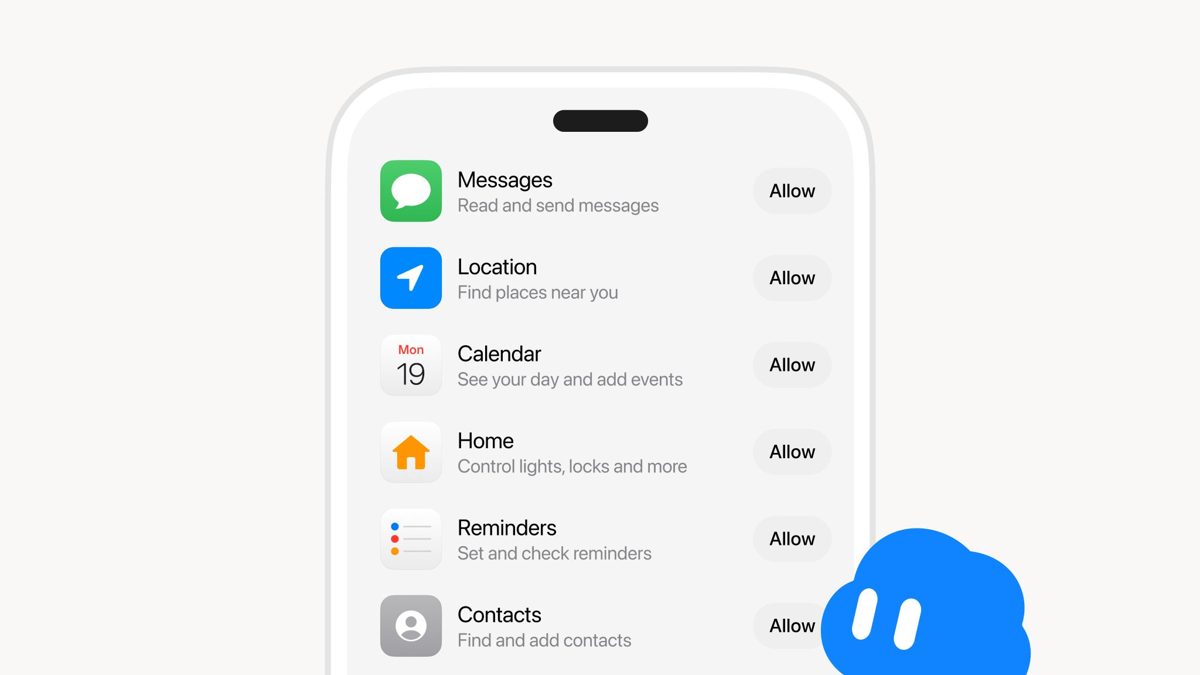
The permission screen from the announcement: each phone app gets its own Allow button.מסך ההרשאות מההכרזה: לכל אפליקציה בטלפון יש כפתור אישור משלה.Image: תמונה: @bot on X
Grok Bot can now use Calendar, Reminders, Contacts and more apps on your phone, rolling out now on iOS and Android. The screenshot in the announcement shows how it works: a list of phone apps, from Messages and Location to Home, Reminders and Contacts, each with its own Allow button, so you decide which ones your Bot may touch.
A few hours earlier came a second key to the house: Grok Bot can now use your 1Password account. You approve the logins you want to share, and your Bot signs in for you. That integration is rolling out over the next few days.
Then version 0.75.2 landed. Bots can now create videos from a description or from an image you share, chat cards have a new design, and Pages can be pinned to a section that syncs across devices. Bots can also pay with Shop Pay, and X Money connects in one tap. “The grok bot team is shipping at an incredible pace,” wrote @poteto, asking users to keep the bug reports coming.
From next week, auto mode becomes the default in Claude’s web, desktop and mobile apps on Pro, Max and Team plans
By Our Correspondent at the Gate
Starting next week, Claude sessions on the web, desktop and mobile apps will run in auto mode by default for Pro, Max and Team users. Instead of asking you to approve each step, an automated check blocks risky actions, and you can switch back to manual at any time.
The idea was first tried in Claude Code, where auto mode became the default earlier this year. There, Anthropic said a separate classifier reviews shell commands and actions, and in testing it caught 89% of dangerous commands, against 14% for people clicking through manual approvals.
Anthropic and Theorem prove that 239 fuzzing entry points in 123 open-source libraries can never crash, checked on the machine code itself
By Our Logician
Formal verification proves that code obeys a rule for every possible input, not just the ones a tester tried. It used to be ruinously slow: verifying the seL4 kernel took 20 person-years. Anthropic’s Frontier Red Team now reports that Claude, in a few weeks, proved 239 entry points across 123 libraries from Google’s OSS-Fuzz never crash on any input up to 64 MB, working directly on compiled RISC-V binaries.
The proofs run to about 180 million lines of Rocq, roughly 600,000 per proof, and a proof checker, not a human, confirms them. Along the way Claude found and patched bugs that fuzzers had missed despite trillions of runs, including an out-of-bounds write that needed a 20 MB input with one rare layout. Anthropic is publishing a subset of the proofs, and Theorem a Claude skill for verifying your own code. On the same evening @poteto showed a pstack skill that has agents draw statecharts and check them against formal specs.
Anthropic hands the SKILL.md standard to the Agentic AI Foundation, where MCP already lives
By Our Committee Reporter
A skill is just a folder with a SKILL.md file that teaches an agent a task. Anthropic says more than 70 agent platforms, including ChatGPT, Cursor, GitHub Copilot and VS Code, have adopted the standard since December 2025, with 1 million skills published and nearly 280 million installs. Now it is donating the name, logo, GitHub organisation and agentskills.io domain to the Agentic AI Foundation under the Linux Foundation, the same home it gave MCP.
Existing skills keep working and licences do not change. Engineers from Anthropic, Earendil (Pi), Google, Microsoft, OpenAI and OpenCode will govern it as a technical steering committee, starting with a roadmap of versioned releases, a formal proposal process and security guidance for people who write and install skills.
The full Claude Platform, run by Anthropic, is now generally available inside Google Cloud accounts
By Our Cloud-Watching Correspondent
A day after OpenAI moved into Google Cloud, Claude followed with a new route of its own. “Claude Models on Google Cloud (Anthropic managed)” is now generally available: the full Claude API, including Claude Managed Agents, code execution, the Skills API and fast mode for Opus 5.5, billed through Google Cloud with its IAM credentials and drawing down Google Cloud commitments. New features ship there the same day as on Claude’s own platform, with US and Global endpoints.
Days after its launch, MiniMax opens the weights of M3.1 Flash, the model behind the mystery “Space Bunny”
By Our Zoological Correspondent
MiniMax has published the weights of M3.1 Flash: 428 billion parameters in total, 23 billion active per token. That is the model MiniMax confirmed earlier this week as the one behind “Space Bunny”, the anonymous model that topped usage charts after more than 200 trillion tokens. MiniMax lists 73.7% on DeepSWE v1.1 and 61.7 on OSWorld V2, and partners report a 1 million-token context window with vision support.
The launch came with a crowd of day-one partners: SGLang reports more than 1,000 tokens per second at batch size one, NVIDIA NeMo supports fine-tuning, and Together AI, Inferact and TokenSpeed serve it in production.
Artificial Analysis rebuilds its Coding Agent Index around Cognition’s FrontierCode, while GPT-6 Astra leads a revised physics test
By Our Examinations Clerk
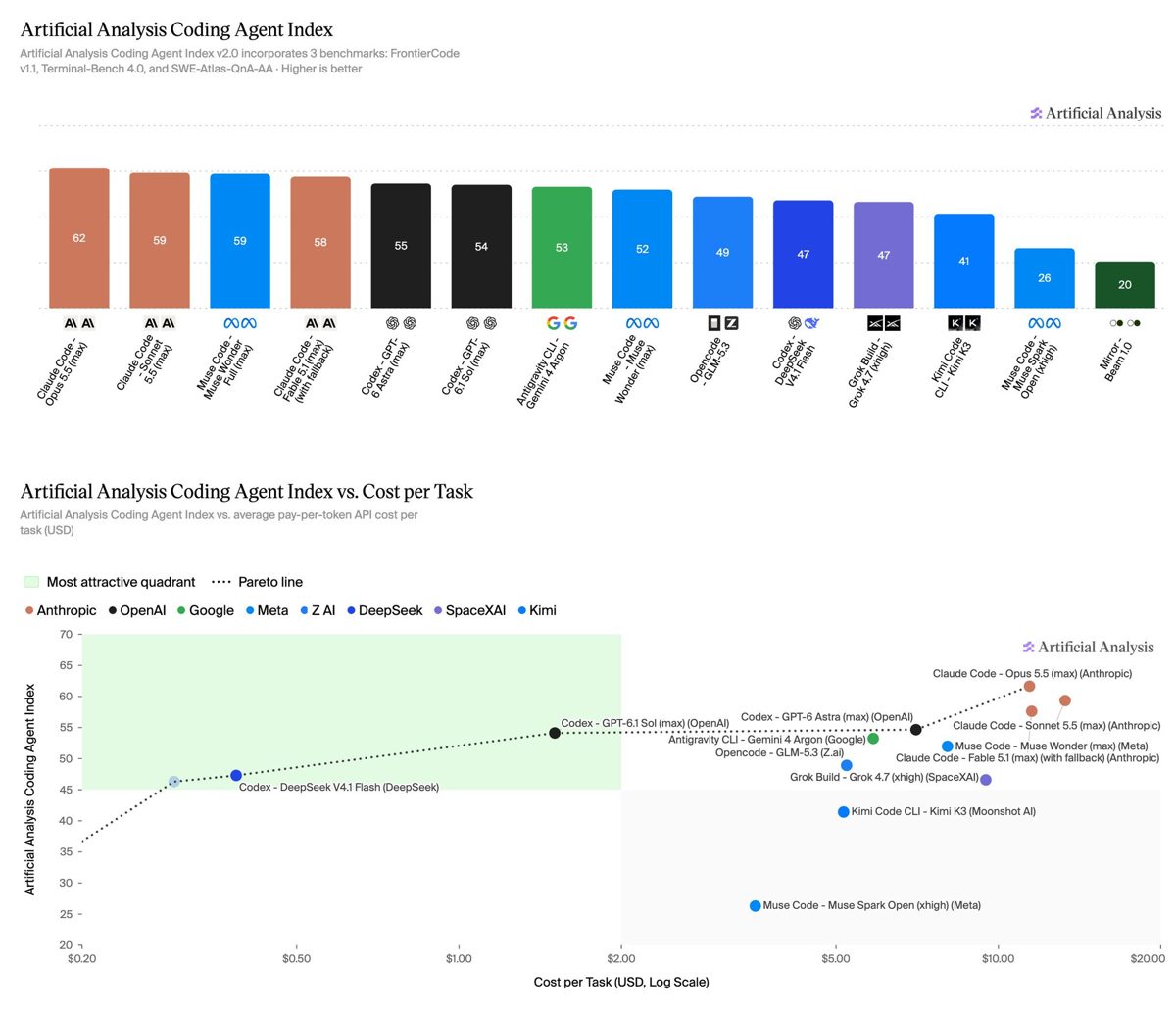
Version 2.0 of the Artificial Analysis Coding Agent Index grades models together with their agent harnesses across 290 tasks. Cognition’s FrontierCode replaces DeepSWE, scoring fixes by whether a maintainer would merge them. Claude Code with Opus 5.5 leads at 61.7, ahead of Claude Code with Sonnet 5.5 (59.3) and Muse Code with Muse Wonder Full (58.9). The bargain is Codex with DeepSeek V4.1 Flash: 47.3 at $0.39 a task, against $11.42 for the leader.
The same lab relaunched CritPt, 70 research-level physics problems now solved with a code sandbox: GPT-6 Astra scores 83% and GPT-6.1 Sol 82%, while GPT-5 from August 2025 manages 29%. Its PersonalityBench, introduced earlier this week, now adds that Claude models write the most information-dense prose, and that “slop” varies wildly even among equally clever models.
The new index, and what each score costs per task: DeepSeek V4.1 Flash in Codex sits alone in the cheap corner.המדד החדש ומה עולה כל ציון למשימה: DeepSeek V4.1 Flash ב־Codex לבד בפינה הזולה.Image: תמונה: @ArtificialAnlys on XOpenAI
OpenAI’s Decisions API Leaves Beta
Fast yes-or-no calls for apps and agents, plus outside inspectors inside OpenAI’s monitoring room
By Our Switchboard Operator
The Decisions API is now generally available. It lets apps and agents classify text and images, evaluate inputs and choose what happens next without generating a full model response. Since the beta it has gained native GPT-Live integration for voice apps, prompt caching, JSON inputs, images in question instructions and up to 400 questions per request. Codex also gained a Lovart plugin for generating brand visuals, ad sets and videos where you code.
Separately, OpenAI said it invited METR and Redwood Research this summer to pilot an embedded evaluation of its internal monitoring system for misaligned agents, with two of their staff working on site for three weeks. Their findings helped strengthen safeguards as the system expanded.
Maps history meets Calendar, web apps go straight to Sites, an embedding model turns transcriber, and DeepMind maps real forests
By Our Mountain View Correspondent
With your permission, Gemini can now look at your Google Maps searches and saved places alongside your Google Calendar to suggest plans for your day. Web apps built in the Gemini app can now be exported straight into a private Google Sites draft and published. And a community experiment turned EmbeddingGemma 2 into a speech-to-text system that transcribes an hour of audio in about 13 seconds on a base M3 MacBook Air.
Google DeepMind released Forest Typology (ForTy), a 10-metre map that tells natural forests from planted and farmed ones, built on its AlphaEarth Foundations model. The 2020 map and a 2017–2025 time series are free on Google Earth Engine, to help keep supply chains deforestation-free.
HeyGen’s first video model wins a blind test, and two tiny speech models punch far above their size
By Our Sound Engineer
HeyGen Video 1, the company’s first general-purpose video model, ranked first for text-to-video in a blind test on Artificial Analysis. On the speech side, Ant Group’s Ming-3.0-tts, an MIT-licensed model of just 0.5 billion parameters, is now the top open-weights model in the Controlled Voice TTS arena; every other open model in that top ten is 3.5 billion parameters or larger.
And Underdog released Bark 3.0, a 163 MB speech-recognition model that runs fully on-device. The company says it matches NVIDIA’s Parakeet, beats OpenAI’s Whisper large-v3, and transcribes a minute of audio in under a quarter of a second on a MacBook.
Open agents share computers with their teams, learn 3D modelling and ship a patch from 149 contributors
By Our Open-Source Desk
Nous Research’s Hermes agent can now share a computer with your team: a new plugin from Cua gives it its own Linux, macOS or Windows Space on hardware you already own, where anyone can watch live, step in and hand control back. Hermes also gained an official Meshy plugin that turns prompts and photos into 3D models through Meshy’s MCP server.
OpenClaw added DeepSeek V4.1 Flash for its agents and shipped patch release v2026.10.6, with install, Windows, Discord and security fixes from 149 contributors. Its “focus weeks” invite outsiders onto the team server to build features on OpenClaw’s own tokens.
A ten-day global hackathon for its newest models starts on Monday
By Our Prize Correspondent
The Meta Global AI Developer Hackathon starts on 26 October: ten days to build with Meta’s newest models, $150 in Meta Model API credits for every selected participant and a $1 million prize pool. Applications close on 25 October, and places are limited to 20,000 selected applicants.
Wren & Robin read you this morning's dispatches, with banter.
Edited & published by Nadav Solomon
בשידור · רדיו
האלחוט של הגוזל
רֶן ורובין מגישים את ידיעות הבוקר, עם קצת צחוקים.
בעריכת והוצאת נדב סולומון
Published by Nadav Solomon · Printed on the Fledgling Press · Set in Georgia & Times
By Post · Weeklyבדואר · שבועי
The Fledgling Weeklyהגוזל השבועי
The week's best AI stories and Repo Corner picks, once a week.מיטב ידיעות ה-AI של השבוע ובחירות פינת הריפו, פעם בשבוע.
Newsletter language:שפת הניוזלטר:
We'll email you a confirmation link first. Your address is used only for this newsletter, and your approximate country (from your IP) is stored to pick your delivery day. Never shared; every issue has a one-click unsubscribe.קודם נשלח לך קישור לאישור. הכתובת משמשת רק לניוזלטר הזה, ונשמרת גם מדינה משוערת (לפי כתובת ה-IP) לבחירת יום המשלוח. לא מועבר לאף אחד, ובכל גיליון יש הסרה בלחיצה אחת.
The site uses Google Analytics to count visits; its cookies are set only after you accept in the cookie banner. Privacy policy.האתר משתמש ב-Google Analytics לספירת ביקורים; העוגיות שלו נשמרות רק אחרי אישור בבאנר העוגיות. מדיניות פרטיות.