Claude Hunts Scorpion Toxins, DeepSeek Opens Its Engine & Mistral Finds Its Voice
Dispatches of the past four-and-twenty hours from the laboratories of artificial intelligence
Science
Claude Designs Binders Against Scorpion Venom
In 64 hours it drew up 318,484 protein designs; labs tested 211, and 17 latched onto toxins from Mexico, North Africa and the Middle East
By Our Natural History Desk
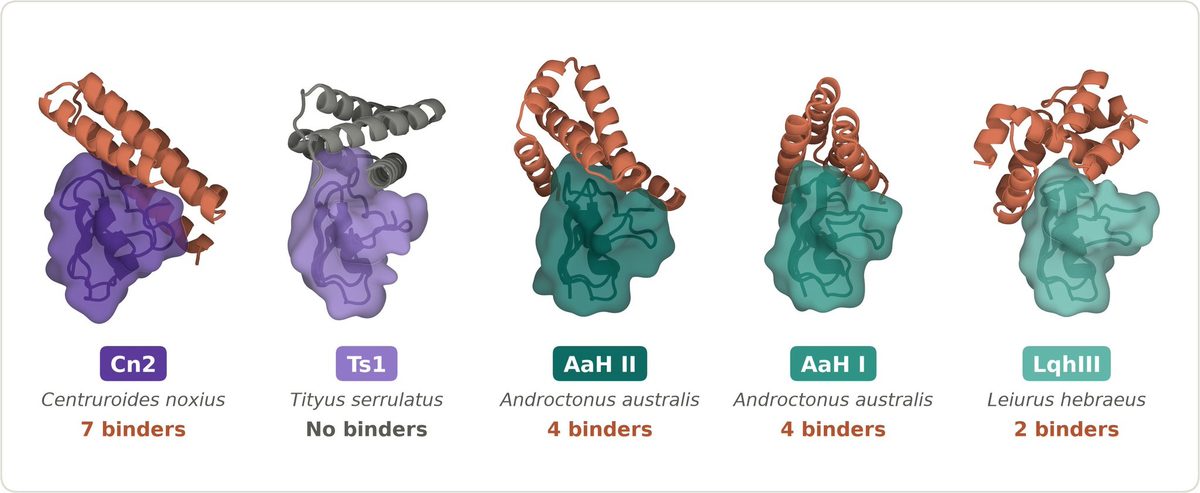
Five toxins, four scorpions: Claude’s binders (orange) found partners for every toxin but the Brazilian Ts1.חמישה רעלנים, ארבעה עקרבים: החלבונים של Claude (בכתום) מצאו בן זוג לכל רעלן חוץ מ־Ts1 הברזילאי.Image: תמונה: @AnthropicAI on X
Scorpions sting more than 1.2 million people a year and kill over 3,250, mostly children far from good medical care. Antivenoms are made the slow, old way, from the blood of immunized horses, and are often costly or scarce. So Anthropic, working with Citrini Research, asked an internal research model inside Claude Science to design small proteins, called minibinders, that grab the part of a scorpion neurotoxin that latches onto nerve cells.
Over 64 hours, mostly on its own with four follow-up prompts, Claude used 12 design tools to produce 318,484 designs and screened 553,052 design-toxin pairs. It picked 180; the team added 31. Adaptyv Bio and Twist Bioscience tested all 211, and 17 met strict criteria as binders, each against a single toxin. The two strongest grip the Mexican toxin Cn2 at single-digit nanomolar strength and seem to sit where a known neutralizing antibody binds.
Anthropic is careful: nothing has been tested in cells or mice, so this is not an antivenom. Designs meant to catch several toxins at once all failed. All 211 designs and their lab data are now public.
DeepInfer, the in-house framework that serves V4.1-Flash, goes fully open source, with the API’s token handling alongside
By Our Machinery Correspondent
DeepSeek has open-sourced DeepInfer, the inference framework that runs DeepSeek-V4.1-Flash in its own production. The company lists high-performance kernels, distributed inference, speculative decoding, “SWA Bounded Replay” and structured outputs, and promises that inference code for future DeepSeek models will land in the same repository. The stated aim is lower compute costs, lower energy use and cheaper AI for everyone.
Alongside it comes deepseek-recipe, the production component that encodes and decodes tokens exactly as the official API does, so community deployments behave the same. The launch thread drew more than four million views. For the lab with famously cheap models, giving away how it serves them is quite a statement.
Mistral’s Voxtral 3 Learns to Listen, Think and Talk
New transcription and speech models, a 30-minute voice clone and an agent kit that answers in under a second
By Our Wireless Correspondent
Mistral released Voxtral 3, a family of speech models plus a voice agent SDK built on LiveKit. Voxtral Small Transcribe 3 transcribes 50+ languages, tells speakers apart and notices when someone has stopped talking. Voxtral Mini TTS 3 speaks 35+ languages and 50+ dialects, reads emotion and pace from the conversation and takes tags like [emotion=sad][pace=slow]. Pro Voice copies a voice from up to 30 minutes of audio.
Artificial Analysis puts Small Transcribe 3 at #3 on its speech-to-text board, with a 2.1% error index, ahead of ElevenLabs Scribe v2 and Grok Voice Transcribe 2.0. The TTS lands #12 in both voice arenas and costs $13 per million characters, under Gemini 3.8 Flash TTS at $16.5. It is also quick, at 112.3 characters a second.
A drug-development platform joins the Rosalind life-sciences push, and a departed researcher returns to work on superintelligence safety
By Our Boardroom Correspondent
OpenAI has acquired Orchestra Bio, a platform that helps biopharma teams coordinate the many moving parts of drug development. It will fold into Rosalind, OpenAI’s models and tools for life-sciences research, with the aim of getting new treatments to patients sooner.
Aleksander Madry, meanwhile, says his departure from OpenAI turned out to be “more of a sabbatical.” AI has entered “a different regime,” he wrote, in which safety and security must be a central priority, so he is returning to work with @merettm. Sam Altman called the challenges “immense” and said Madry has “an excellent set of skills” for them.
Twelve-hour prompt caching in the API, a forever cache in Codex, and credits for 40,000 accounts that were billed on the wrong limits
By Our Ledger Correspondent
Developers can now choose 12-hour prompt caching in the OpenAI API, instead of the 30-minute default, or mix both in one request. Agents that reuse the same instructions and tools all day pay the cheaper cached rate even with hours between calls. Codex chief Tibo Sottiaux went further for “Day 16”: for logged-in users of Codex and Work, the cache is now kept forever, so returning to an old conversation carries no penalty.
He also owned up to a weekend problem: about 40,000 accounts had usage counted against the wrong plan’s limits. The fix is in, OpenAI is contacting each one, and those affected will get credits. Separately, Enterprise workspaces can now schedule team tasks in ChatGPT, such as a Friday digest of what shipped and what is blocked.
Locked Chats hide sensitive conversations behind a PIN or Face ID, with their own memory
By Our Privacy Correspondent
ChatGPT can now move chats out of your regular history and search into a protected space. It unlocks with a PIN on web and desktop, or with a PIN, Face ID, Touch ID or device unlock on phones. New messages in a locked chat do not update the memory used by your other chats. It is rolling out to every plan, from Free and Go to Enterprise and Edu.
Artificial Analysis tracks how fast each level of intelligence gets cheap, and why the very best still costs more
By Our Price-Index Correspondent
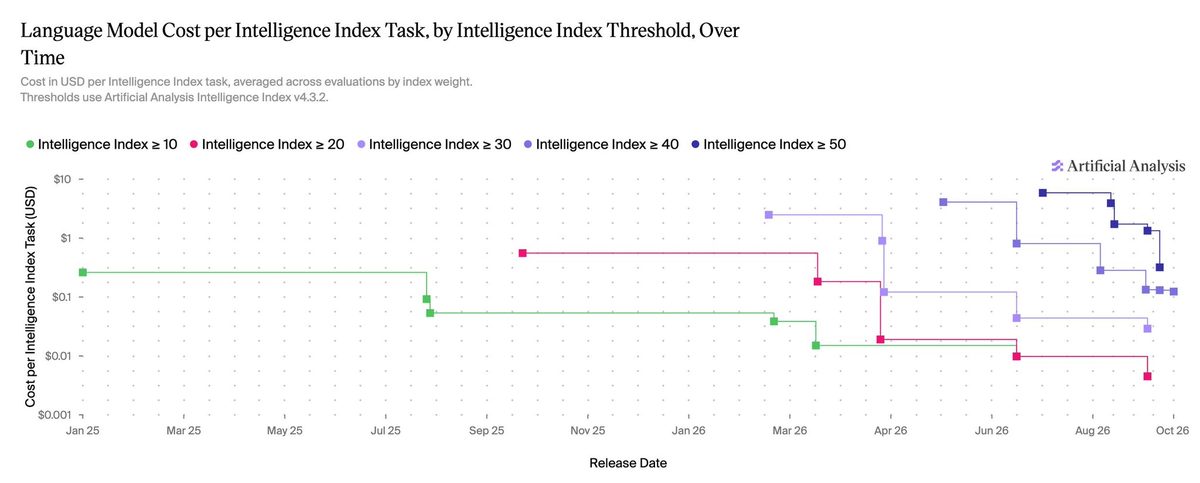
Once a model first reaches a score on the Artificial Analysis Intelligence Index, rivals soon match it for far less. Scoring 30 now costs 86 times less per task than when it was first reached: GPT-6 Luna does it for $0.03 a task, against $2.49 for the Claude Sonnet 4.6 setting that got there first in February. Scoring 50 is already 18 times cheaper, and at the top levels, prices halved within about six weeks.
The catch: the frontier itself gets pricier. The top score rose from 21 to 58 in a year, at about 11 times the cost; Claude Opus 5.5 at full effort costs $5.98 a task. Meanwhile US open-weight models gained last week, led by Meta’s Muse Spark Open at 38.9, the highest yet for an American open model.
Every staircase steps down: cost per task to reach each Intelligence Index level, January 2025 to October 2026.כל מדרגה יורדת: העלות למשימה כדי להגיע לכל רמה במדד האינטליגנציה, מינואר 2025 עד אוקטובר 2026.Image: תמונה: @ArtificialAnlys on XMade With AI
Battle Drones, and a Periodic Table That Sings
Simon Willison builds a browser RTS with Claude where two LLMs can fight each other, and Gemini 4 Argon animates Tom Lehrer
By Our Games Correspondent
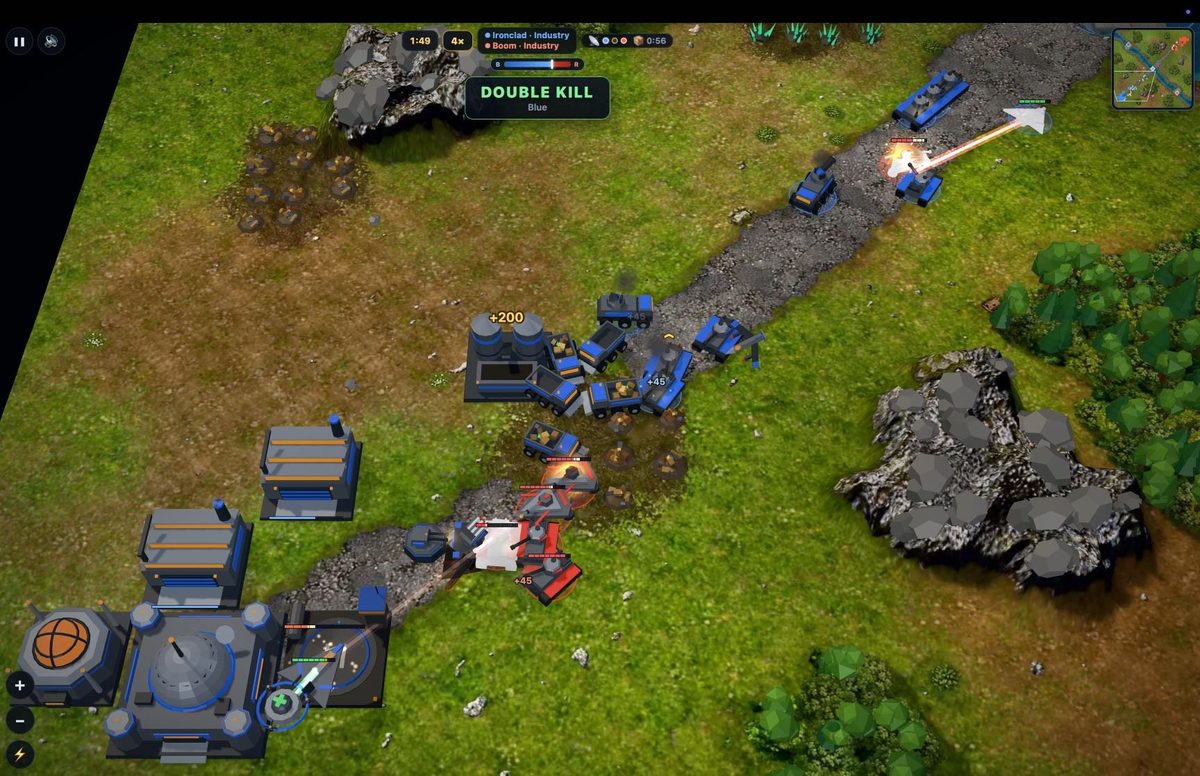
Simon Willison built Battle Drones, a Command & Conquer-style strategy game that runs in the browser, mostly with Claude Opus 5.5. Claude made every 3D model in Three.js, including a giant stomping mech called Goliath. Two language models can play each other: the game pauses every five seconds so they can think and queue orders. The first multiplayer mode ran device to device over sound, until its high-pitched whine gave Natalie a headache, so he added online play through a small WebSocket relay.
Google DeepMind, for its part, had Gemini 4 Argon build a 3D periodic table in Antigravity, synced to Tom Lehrer’s “The Elements,” with orbiting electrons, atomic data and light spectra. Sundar Pichai’s advice: “Sound on!”
A “Double Kill” for Blue in Battle Drones, built mostly by Claude Opus 5.5.„הריגה כפולה” לכחולים ב־Battle Drones, שנבנה ברובו על ידי Claude Opus 5.5.Image: תמונה: @simonw on XGrok Bot
Grok Bot Sweeps 204 Tickets in Ten Minutes
An incident sweep with one engineer approving the batch, plus a long list of new features
By Our Help-Desk Correspondent
The Grok Bot team says it uses its own bot to spot incidents in the support queue and answer every linked ticket. In one incident it cleared 204 tickets in about ten minutes, with a single engineer approving the batch. A new “What’s new” video runs through chat cards, speed, draft edits, email aliases, X DMs, tagging @bot on X, connectors, voice calls, notifications, invites and an Android assistant.
Muse Wonder Spreads, MiniMax Wins on Thrift & Ant Group’s Tiny Voice
Plus Clef and Ornith on Ollama, Fibo 2.0 for images and EmbeddingGemma 2 on a Mac
Roundup from the Wire
Meta’s Muse Wonder is now on Cline, Cloudflare, Cognition, Cursor, OpenRouter, Oracle and Vercel. Parallel Web Systems ranks MiniMax M3.1 Flash #1 for efficiency on its search leaderboard, matching DeepSeek V4.1 Flash at about a third of the cost, and OpenClaw now supports it. Ollama added Cloudflare’s Clef, a 27B multimodal decision model, and Ornith 1.5 122B, an MIT-licensed model scoring 0.845 on SWE-bench Verified.
Ant Group’s Ming-3.0-tts, a 0.5B open model under MIT, is now the top open-weights voice in Artificial Analysis’s controlled arena and ties for #1 on pronunciation. Bria’s 8B Fibo 2.0 is the leading open-weights image editor, though its license is non-commercial. And Google’s Foresight, a macOS meeting companion running EmbeddingGemma 2 on-device, spots questions as they’re asked and answers them from your local files.
Mastercard Pays Machines, PyTorch Leaves Home & Plants Get a Translator
Plus a de-bloated TV, Copilot Code’s timetable and a HeyGen voice clone
Roundup from the Wire
Mastercard opened early access to Agent Pay for Machines, letting AI agents pay by card, bank or stablecoin, after pilots on Coinbase’s x402 and Base. Two days, two moves against Nvidia’s software moat: Amazon released TorchNeuron to run PyTorch on Trainium, and Google open-sourced TorchTPU for its TPUs. A startup called Electric Plant built Bombadil, a model that reads electrical signals from sensors on plant stems, trained on about three years of data across some 125 species.
A developer let Claude Code find his parents’ Android TV on the home network, switch off 25 Xiaomi packages over ADB and write a new tvOS-style launcher, then open-sourced it as tv-vibehack. Microsoft says Copilot Code began reaching Frontier customers in late September, with Autopilot entering private preview at the end of this month. HeyGen’s Professional Voice Clone learns your voice from 30 minutes to two hours of audio.
Wren & Robin read you this morning's dispatches, with banter.
Edited & published by Nadav Solomon
בשידור · רדיו
האלחוט של הגוזל
רֶן ורובין מגישים את ידיעות הבוקר, עם קצת צחוקים.
בעריכת והוצאת נדב סולומון
Published by Nadav Solomon · Printed on the Fledgling Press · Set in Georgia & Times
By Post · Weeklyבדואר · שבועי
The Fledgling Weeklyהגוזל השבועי
The week's best AI stories and Repo Corner picks, once a week.מיטב ידיעות ה-AI של השבוע ובחירות פינת הריפו, פעם בשבוע.
Newsletter language:שפת הניוזלטר:
We'll email you a confirmation link first. Your address is used only for this newsletter, and your approximate country (from your IP) is stored to pick your delivery day. Never shared; every issue has a one-click unsubscribe.קודם נשלח לך קישור לאישור. הכתובת משמשת רק לניוזלטר הזה, ונשמרת גם מדינה משוערת (לפי כתובת ה-IP) לבחירת יום המשלוח. לא מועבר לאף אחד, ובכל גיליון יש הסרה בלחיצה אחת.
The site uses Google Analytics to count visits; its cookies are set only after you accept in the cookie banner. Privacy policy.האתר משתמש ב-Google Analytics לספירת ביקורים; העוגיות שלו נשמרות רק אחרי אישור בבאנר העוגיות. מדיניות פרטיות.