Gemini Takes the Mac’s Mouse, Codex Hunts Slowdowns & Dario Vows Not to Bend
Dispatches of the past four-and-twenty hours from the laboratories of artificial intelligence
Google · Agents
Gemini Takes the Mac’s Mouse
Computer use arrives in the Gemini app for Mac: it clicks, scrolls and types in a background window while your own screen and cursor stay yours
By Our Correspondent at the Desktop
Google’s Gemini app for Mac can now do tasks on your computer. With the new computer use feature you hand off work that spans folders, apps and the web, and Gemini carries it out in a live background window: it clicks, scrolls and types there while your own screen and cursor stay free for you. In Google’s demo it turns a quick sketch into a rigged 3D model in Blender.
The feature is rolling out in the U.S., in English, to Google AI Plus, Pro and Ultra subscribers. Josh Woodward, who runs the Gemini app, called it “a top feature request.”
The timing is pointed. The same evening Bloomberg’s Mark Gurman reported that Apple, which is building its own computer-use agent, is making it harder for rival agents to control Macs: in macOS 27.3, turning on ChatGPT’s third-party computer-use support now takes 14 distinct steps, up from four. Apple cites security; some users see anti-competitive behavior.
GPT-6.2 Sol and Astra join the catalog, the workspace view is on by default, and sessions can now run on a remote server
By Our Correspondent in the Terminal
OpenAI shipped Codex CLI 0.171.0 overnight. GPT-6.2 Sol and Astra are now in the model catalog, with Sol as the default pick. The TUI workspace is switched on by default, so searchable document previews, image previews and subagent transcripts sit alongside the main conversation.
New commands: codex exec --remote starts or resumes a non-interactive session on an existing app server, and /rc and /remote manage remote control and show device pairing codes. There are undo and redo shortcuts in the prompt box, a custom MCP status line, and fixes so drafts and queued follow-ups stay with their own threads when you switch sessions.
Inside the “Performance Factory”: agents that chase regressions, propose fixes and check them in production
By Our Industrial Correspondent
OpenAI says Codex no longer only helps build ChatGPT; it now helps keep it fast. Its Performance Factory coordinates agents that investigate slowdowns, propose fixes for engineers to review, and then check whether those fixes worked in production. In just over three months the Regression Workflow tracked more than 1,700 investigations and found root causes in over 600.
The trick is a shared skill called “perf-forensics” that writes down how the performance team investigates, plus cloud sessions that an alert can start by itself.
GPT-Live-1.1 opens to developers, with a standby mode that bills silence at $0.02 a minute
By Our Correspondent on the Line
GPT-Live-1.1, the model that has powered voice in ChatGPT Plus and Pro since October 15, is now available in the API. OpenAI says it speaks with more natural and consistent accents across languages, understands precise details like letters and numbers, follows instructions, and can hand complex work to a backend model of your choice without breaking the conversation.
The new Standby option, for both GPT-Live-1 and 1.1, handles pauses: after an idle timeout of 5 to 60 seconds the model rests, but the WebRTC call stays open at $0.02 a minute instead of the standard $0.05 until someone speaks again.
On its first day as a public company, Anthropic’s chief promises to pace AI “as long as is necessary” to keep it safe
By Our Correspondent on Wall Street
As Anthropic’s shares began trading on Thursday, chief executive Dario Amodei published his remarks on the offering. He opened with family: he and his sister Daniela lost their father to a disease that became curable only a few years later. Powerful AI working with humans, he wrote, “could compress a century of scientific and medical progress into a decade.”
Then the promise: “we will pace the training and deployment of AI systems, taking as long as is necessary to have confidence that they are safe and will remain under human control. We will not bend to either business or political pressure.”
A small Plus test, a rollout to all Business Standard users, and a redesigned mobile app for Pro
By Our Correspondent in the App
OpenAI’s Thibault Sottiaux says dots, ChatGPT’s proactive assistants, are being tested with a small number of Plus users, and are coming to all ChatGPT Business Standard users, with the rollout starting today. He says feedback on how good the proactivity has become is turning more positive after many improvements.
A new mobile design starts with Pro users who have a dot or can create one: the dot gets its own tab, and you can pin Codex, Projects, Images and more to the tab bar. It can be switched on or off in Settings under “New ChatGPT Design.” Sottiaux: the team is trying to improve an app used by 1.2 billion people “in place.”
Health now works on desktop, Android, in dots and in Sites
By Our Medical Correspondent
ChatGPT Health is now in more places: the desktop app, dots, Sites and Android. With connected health data you can study sleep and workout patterns on desktop, get a dot to suggest another workout time when a meeting gets in the way, build a site that tracks marathon training, and connect sleep, activity and workouts through Android Health Connect.
It is available in the U.S. on desktop and Android for Free, Go, Plus and Pro users; Sites need Plus or Pro, and dots need Pro.
GPT-6.2 now keeps its reasoning across turns, if you append instead of editing, and a caching bug is costing some apps dearly
By Our Correspondent at the Meter
OpenAI says agents using GPT-6.2 in the Responses API can build on earlier reasoning for better results with fewer tokens and more cache hits. Starting with its newest models, each reasoning item is tied to the conversation history before it, so editing an earlier message makes the API drop the reasoning that followed. The advice: keep history unchanged and append new turns. To catch accidental edits, for example when changing reasoning effort or adding tools, there is a new “input_transformations” object and a “Reasoning removals” section in the Usage dashboard.
Separately, a widely shared report points to Codex issue #62312: on GPT-6.2 Astra and Sol, text in the top-level instructions field of a Responses request is not actually cached, though diagnostics report a hit. Cache hit rates reportedly fell from 97.4% to 46.4% moving from 6.1 Sol to 6.2 Sol. The workaround is to put the system prompt in a leading developer message; Peter Steinberger says he landed a fix in OpenClaw.
The flagship multimodal model, 770 billion parameters with 49 billion active, is out with open weights and a safety system card
By Our Correspondent in Shenzhen
A day after Hy4 flash, Tencent released open weights for Hy4 itself: a natively multimodal mixture-of-experts model with 770 billion total and 49 billion active parameters and a 1-million-token context. Weights, GGUF files, a license and the Hy4 System Card, with a full safety evaluation report, are all published.
The team holds a live AMA on Reddit’s r/LocalLLaMA on Friday, 8 to 10 a.m. Pacific.
Within a point of Opus 5.5 on mergeable code at a third of the cost, fourth on the RSI Index, and a lineup explained
By Our Critic at Large
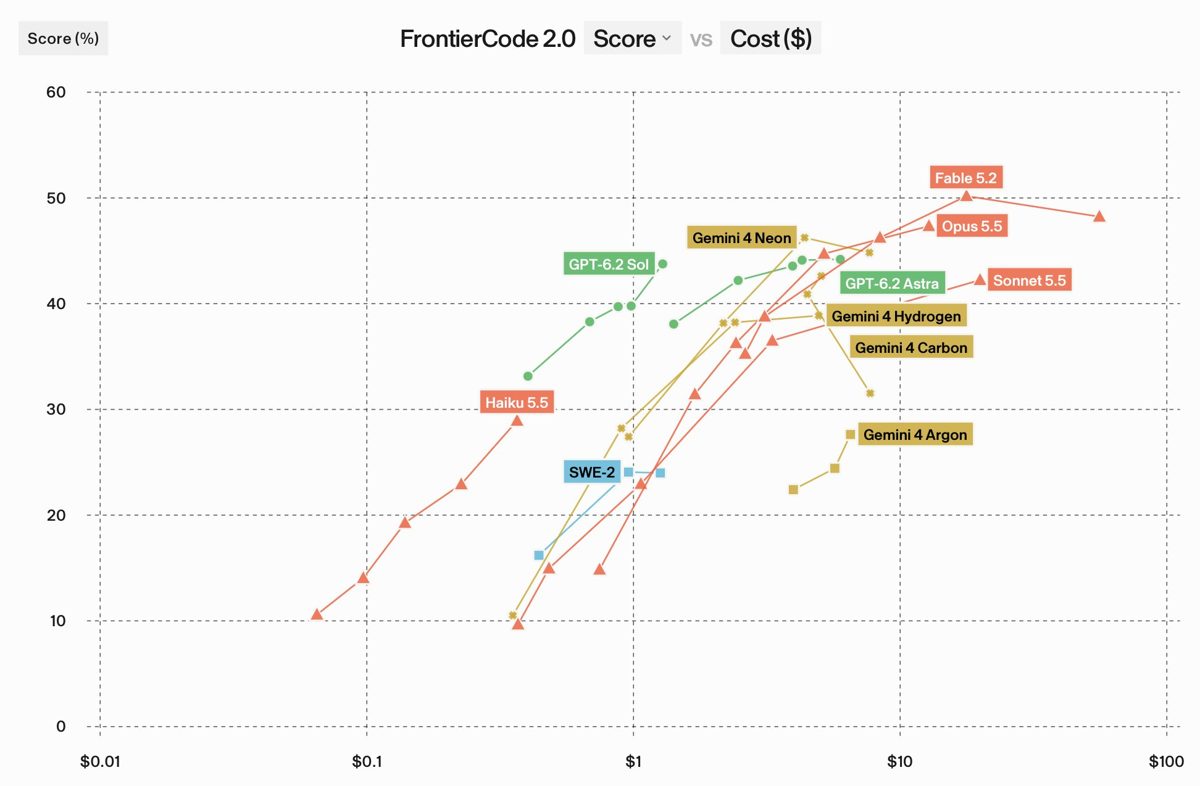
Cognition’s FrontierCode 2.0: score against cost per task. Gemini 4 Neon (gold) sits near Opus 5.5 at a lower cost.FrontierCode 2.0 של Cognition: ציון מול עלות למשימה. Gemini 4 Neon (בזהב) קרוב ל־Opus 5.5 בעלות נמוכה יותר.Image: תמונה: @cognition on X
A day after launch, the outside numbers for Gemini 4 Neon arrived. Cognition says it scores 46.2% on FrontierCode 2.0, its test of whether you should merge the PR, within one point of Opus 5.5 at about a third of the cost ($4.38 per task); Neon is now in Devin. Vals puts it fourth on its RSI Index, 3.8 points above Gemini 4 Argon, though @scaling01 warned the index is only four tasks, each run once per model.
Artificial Analysis sorted out the family: Carbon costs $4/$20 per million input/output tokens, Neon $3/$15 and Hydrogen $1.50/$7.50. Carbon leads at low effort but uses more tokens; Neon and Hydrogen scale better at higher effort and add an “xhigh” level. Simon Willison drew the lineup as pelicans on bicycles, and Demis Hassabis, accepting a tongue-in-cheek apology shared by SemiAnalysis, joked that it had forgotten to tick the “Underestimated the cracked Google DeepMind team” box.
On the cover of Science, Google’s Willow chip puts quantum contextuality to work
By Our Science Correspondent
Entanglement gets the headlines, but Sundar Pichai says quantum contextuality, the idea that properties have no fixed values independent of how you measure them, may be the deeper reason quantum computers can beat classical ones. On Google’s Willow processor the team won the “impossible” magic square game 98.3% of the time (the classical limit is 88.9%), scored 5.59 on state-independent contextuality tests (classical bound 4, quantum maximum 6), beat classical strategies in multiplayer games of up to 71 qubits, and ran a landmark shallow-circuit algorithm at scale for the first time, on up to 105 qubits.
A practical bonus: these tasks catch subtle hardware errors that random benchmarks miss, a sharper ruler for building better quantum machines.
Hermes Enterprise runs inside Teams, the Microsoft Store and Azure, and shares its best skills across a company
By Our Business Correspondent
Nous Research has partnered with Microsoft to bring its Hermes Agent to companies. In Teams, employees hand Hermes jobs like financial analysis, document drafts or inbox triage and review the result in the same chat; the work runs in isolated Azure Container Apps sandboxes, and firms with strict data-residency rules can run it in their own Azure tenant.
When someone finds a good way to do a recurring task, Hermes saves it as a skill; with “Collective Wisdom” it can be shared with the team after review, so the next person starts with the best method anyone has found.
Airbnb fine-tuned Gemma 4 E2B for policy checks: frontier-level quality at 35 milliseconds and about 1% of the cost
By Our Correspondent in the Server Room
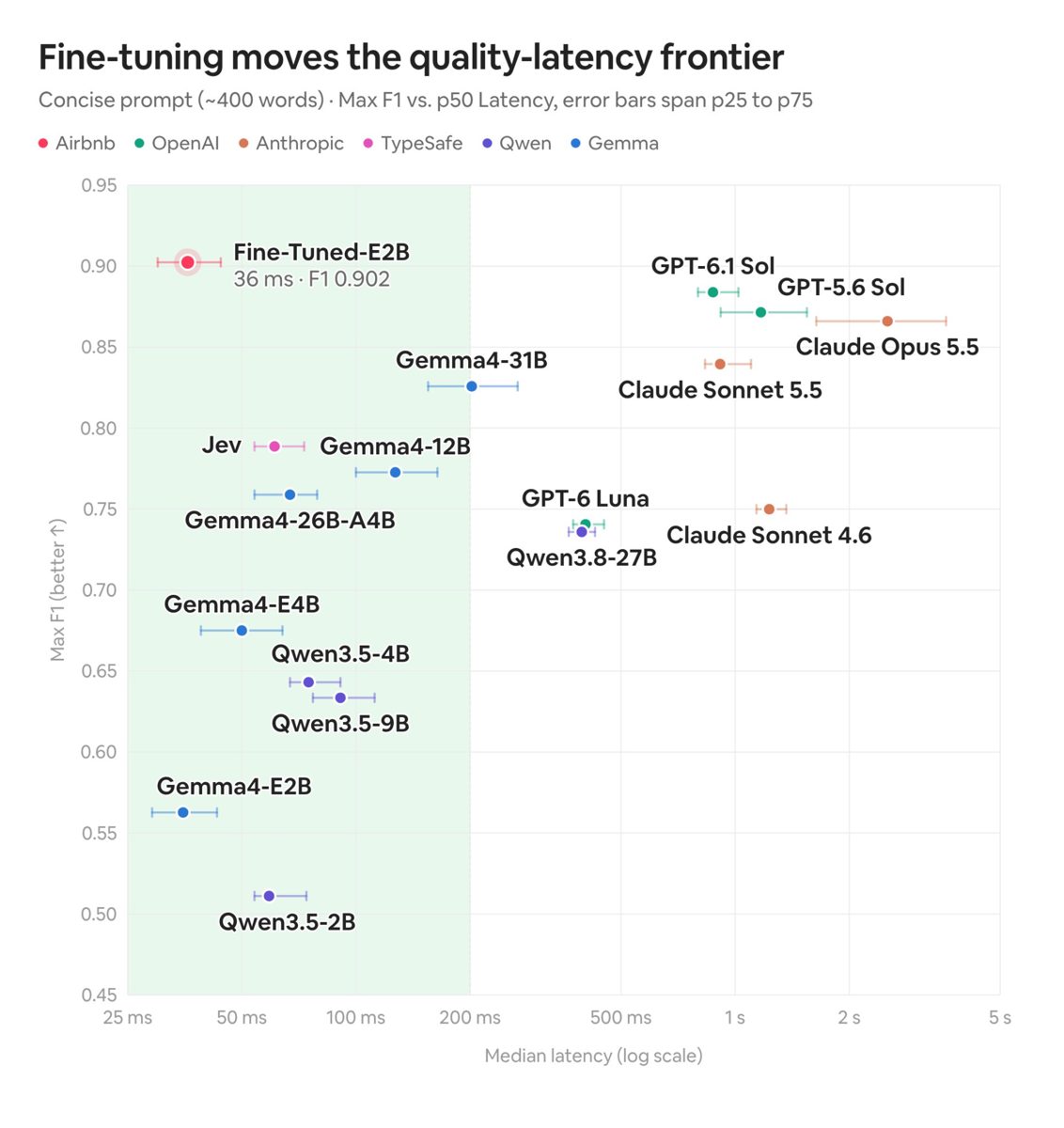
Airbnb’s chart: the fine-tuned E2B (red, top left) beats much larger models on quality and speed.הגרף של Airbnb: E2B המכוונן (באדום, למעלה משמאל) עוקף מודלים גדולים בהרבה באיכות ובמהירות.Image: תמונה: @googlegemma on X
Airbnb’s engineers took Gemma 4 E2B, one of Google’s smallest open models, fine-tuned it for policy classification, and served it on a single NVIDIA RTX Pro 6000. Quality jumped from 0.563 to 0.902 max F1, matching top frontier APIs; median latency is 35 ms (85 ms at p99) against roughly 900 ms for frontier models; and at high volume it costs about 1% of the frontier API bill.
A Chrome extension, email for everyone, and a legal benchmark win
By Our Correspondent in Menlo Park
Meta’s Muse now has a Chrome extension that puts the assistant in a browser sidebar for easier browser use; Alexandr Wang says 200,000 people already use it. Muse email is rolling out to everyone in supported markets, with your own @muse.ai address. And on Legora’s November BAR benchmark for legal work, Muse Wonder ranked highest on overall quality and led four task types: analysis and answering, extraction, drafting and editing.
Microsoft’s “Today” is a feed, not a chat box: an agent works overnight on your mail, calendar, Teams and documents
By Our Office Correspondent
The product lead of Microsoft’s new Today describes it as a new form factor for work: a feed, not a chat box. While you sleep, an agent prepares the day: replies drafted, conflicts spotted, important messages pulled to the top, documents waiting for review. There is nothing to prompt or configure; you check what it did and send, accept or mark done in a few taps. It starts inside Outlook and Copilot. Microsoft also began rolling out Agent 365 Business Analytics, which ties AI spend, adoption and ROI to business results.
Zoom takes first place in live transcription, and ElevenLabs’ Scribe v3 climbs to second in recorded audio
By Our Correspondent with Headphones
Artificial Analysis benchmarked two new speech-to-text models. Zoom’s Scribe V2.1 Pro Live takes first place for final-transcript accuracy in live streaming, with a 2.4% word error rate, just ahead of Microsoft’s MAI-Transcribe-2-Streaming at 2.5%. For recorded audio, ElevenLabs’ Scribe v3 ranks second at 1.95%, better than Scribe v2 (2.18%), behind Alibaba’s Fun-Realtime-ASR-preview (1.73%) and just ahead of MAI-Transcribe-2 (2.04%).
SSH in Antigravity, a busy bot directory, Avatar 6 wins a blind test, and more
By Our Wire Service
Antigravity: the desktop app now connects to remote servers over SSH, alongside Remote Control. Grok Bot directory: one day in, 1,200+ bots submitted and 7,000+ adds to Grok Bot, with 12 updates shipped. HeyGen: in a blind test across 8 providers, creators ranked Avatar 6 first on personal and stock avatars; Ideogram 4.6 is now inside HeyGen. Kimi: Fireworks says K3.1 Pro beats K3 on 14 of 17 practitioner-built benchmarks. Artificial Analysis: you can now follow model makers and build your own weighted index. Hackathons: Mistral’s Le Chonk in London on Saturday, November 21, and Paris on December 5; Meta’s Muse Ember applications open November 23.
Get the answer in the first line: make your bot lead with the bottom lineהתשובה בשורה הראשונה: הבוט פותח בשורה התחתונה
The problemהבעיה
Bots often walk you through background, caveats and steps before they reach the point, so the actual answer is buried in the fourth paragraph and you end up skimming for it.
בוטים מרבים להוביל אתכם דרך רקע, הסתייגויות ושלבים לפני שהם מגיעים לעניין, כך שהתשובה עצמה קבורה בפסקה הרביעית ואתם נאלצים לחפש אותה.
The fixהפתרון
Tell the bot to open every reply with its conclusion or recommendation in one or two sentences, then give the reasons and details below, so you can stop reading once you have what you need.
בקשו מהבוט לפתוח כל תשובה במסקנה או בהמלצה במשפט או שניים, ורק אחר כך לפרט את הנימוקים והפרטים, כדי שתוכלו להפסיק לקרוא ברגע שקיבלתם את מה שצריך.
Try this prompt (works with any AI bot or agent)נסו את הפרומפט (עובד עם כל בוט או סוכן AI)
1. Think the question through fully before you write anything.
2. Start every reply with the bottom line: the answer, decision or recommendation in one or two sentences.
3. If you are unsure, say so in that same opening line and say what would settle it.
4. Below the bottom line, give the key reasons, then any details, steps or caveats.
5. Never open with background, a restated question or filler.
6. If the reasoning changes your answer while you write, rewrite the opening line so it matches.
1. חשוב על השאלה עד הסוף לפני שאתה כותב משהו.
2. פתח כל תשובה בשורה התחתונה: התשובה, ההחלטה או ההמלצה במשפט או שניים.
3. אם אינך בטוח, אמור זאת כבר בשורה הפותחת וציין מה יכריע.
4. מתחת לשורה התחתונה, תן את הנימוקים העיקריים ואחר כך פרטים, שלבים או הסתייגויות.
5. לעולם אל תפתח ברקע, בחזרה על השאלה או במילות מילוי.
6. אם הנימוק משנה את התשובה תוך כדי כתיבה, כתוב מחדש את השורה הפותחת כך שתתאים.
Wren & Robin read you this morning's dispatches, with banter.
Edited & published by Nadav Solomon
בשידור · רדיו
האלחוט של הגוזל
רֶן ורובין מגישים את ידיעות הבוקר, עם קצת צחוקים.
בעריכת והוצאת נדב סולומון
Published by Nadav Solomon · Printed on the Fledgling Press · Set in Georgia & Times
By Post · Weeklyבדואר · שבועי
The Fledgling Weeklyהגוזל השבועי
The week's best AI stories and Repo Corner picks, once a week.מיטב ידיעות ה-AI של השבוע ובחירות פינת הריפו, פעם בשבוע.
Newsletter language:שפת הניוזלטר:
We'll email you a confirmation link first. Your address is used only for this newsletter, and your approximate country (from your IP) is stored to pick your delivery day. Never shared; every issue has a one-click unsubscribe.קודם נשלח לך קישור לאישור. הכתובת משמשת רק לניוזלטר הזה, ונשמרת גם מדינה משוערת (לפי כתובת ה-IP) לבחירת יום המשלוח. לא מועבר לאף אחד, ובכל גיליון יש הסרה בלחיצה אחת.
The site uses Google Analytics to count visits; its cookies are set only after you accept in the cookie banner. Privacy policy.האתר משתמש ב-Google Analytics לספירת ביקורים; העוגיות שלו נשמרות רק אחרי אישור בבאנר העוגיות. מדיניות פרטיות.