OSS Scanner sends model-written reports, proofs of concept and patches straight to open-source maintainers, and curl has already fixed one of its worst bugs in years
By Our Security Desk
Anthropic is now offering OSS Scanner to more projects. It is a free, opt-in service that runs periodic vulnerability scans of critical open-source software with the company’s strongest models, Claude Mythos among them. Each finding arrives with a proof of concept and, where possible, a candidate patch. The first scans have already sent 77 critical and 803 high model-rated findings to maintainers, ClaudeDevs said on Monday, and more projects are being scanned.
The first trophy is curl, the tool countless apps and devices use to move data over the internet. It just patched CVE-2026-92392, a high-severity use-after-free memory bug found with an early version of the scanner. Daniel Stenberg, curl’s lead developer, called it one of curl’s worst vulnerabilities in a long time, though a crash is the likeliest outcome.
There is a catch, stated plainly: these reports are fully model-generated and skip human review, so some may be wrong. When Anthropic’s penetration testers checked 97 critical and high findings across 48 projects, 85 met the bar for its human-reviewed disclosure process, 11 were real but duplicates, and one was a false positive. Eligible projects are judged by criteria like Google’s OSS-Fuzz, and maintainers enroll with a pull request.
GPT‑6.1 Sol migrates COBOL programs with 86.6% accuracy at low effort, up from 5.4%, and GPT‑6 Astra builds a SQLite clone in 20 languages
By Our Mainframe Correspondent
OpenAI says its newest models are far better at building and migrating software in “low-resource” languages such as COBOL, Fortran and Visual Basic, which have little public code to learn from but still run essential systems. By the company’s count, COBOL supports more than 40% of online banking systems and 95% of ATM transactions. To measure progress it built two tests. MultiLangBench asks a model to build a SQLite-compatible database engine from scratch in each of 20 languages, and GPT‑6 Astra averages an 87.4% test pass rate, up from 26.8% for GPT‑5.6 Sol. COBOL is still the hardest, at 72%.
The second test migrates COBOL programs to C++, Java, Kotlin, Python or Rust, and passes only if hidden tests match the original output byte for byte. GPT‑6.1 Sol scores 86.6% at low reasoning effort, against 5.4% for GPT‑5.6 Sol, at 61% of the cost, and 97.9% at higher effort. OpenAI is publishing MultiLangBench on GitHub and asks teams which languages to tackle next.
Artificial Analysis puts it 13 points above M3 at under half the cost per task, and Ollama hosts it free for three days
By Our Benchmarks Desk
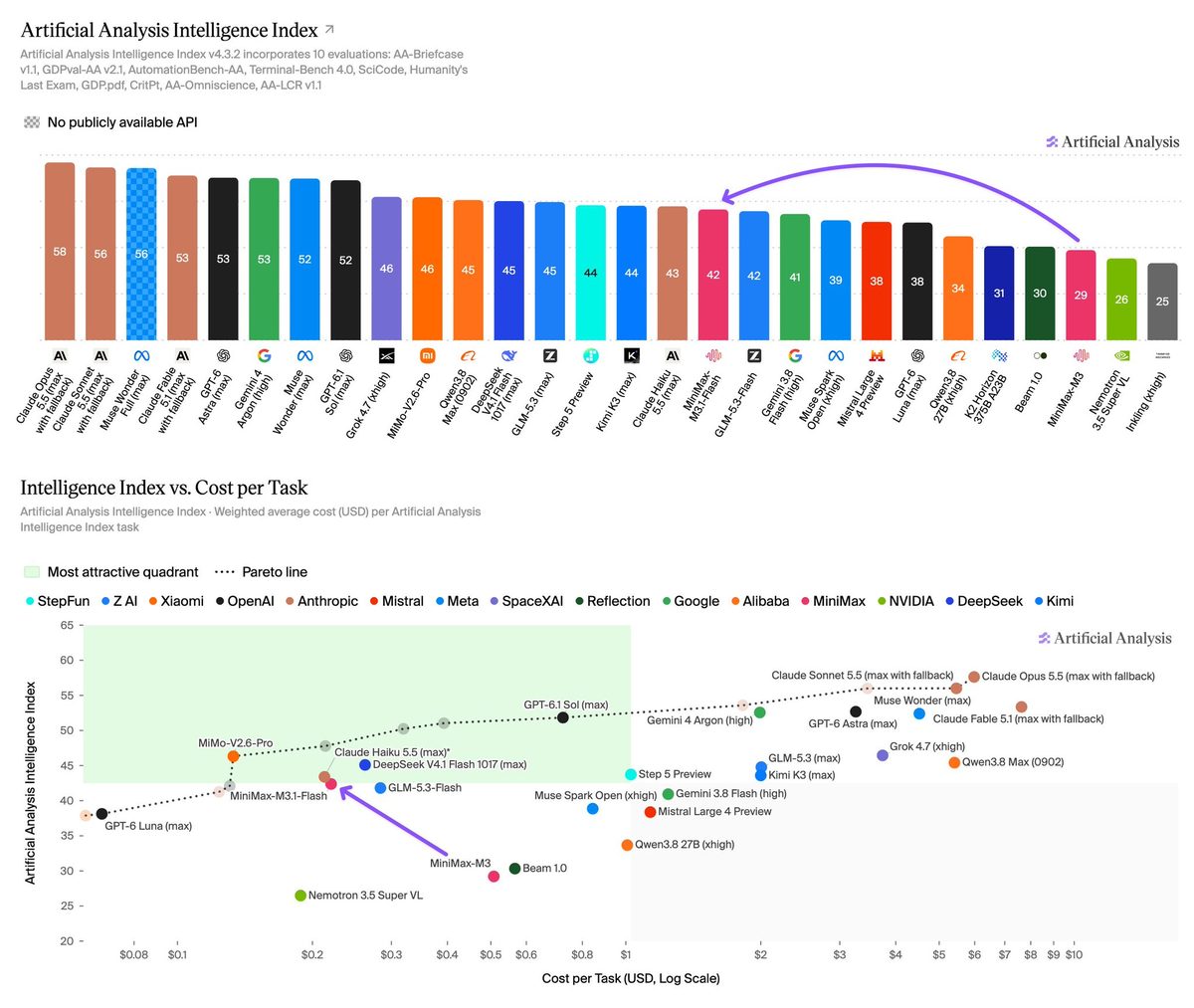
MiniMax released M3.1 Flash, a fast reasoning model, and confirmed that “Space Bunny,” the mystery model that topped usage charts with more than 200 trillion tokens, was an early version of it. Artificial Analysis gives it 42 on its Intelligence Index: 13 points above MiniMax‑M3, level with GLM‑5.3‑Flash and three behind DeepSeek V4.1 Flash 1017. A full run of the index costs about $0.22 per task, and it leads both rivals on AutomationBench‑AA with 73%. The weak spot is honesty: it attempts 98% of AA‑Omniscience questions and gets a 93% hallucination rate.
RoundtableSpace lists the price at $0.15 per million input tokens and $0.60 per million output. Ollama added it on day one, hosted in the US with zero data retention, a 1M-token context and image understanding, and made it free on Ollama Cloud for the next three days. It launches straight into Claude Code or Codex with ollama launch.
MiniMax‑M3.1‑Flash, arrowed at 42 on the index and near the cost-per-task Pareto line below.MiniMax‑M3.1‑Flash, מסומן בחץ עם 42 במדד, וקרוב לקו פארטו של עלות למשימה למטה.Image: תמונה: @ArtificialAnlys on XMeta
Meta Shows the Plumbing: Prometheus and Muse Glimmer
85%+ goodput across hundreds of thousands of GPUs, a 30B open model for one consumer GPU, and Muse Wonder Full at No. 6 in WebDev
By Our Menlo Park Correspondent
Meta says it trained its Muse models, Muse Wonder included, on Prometheus, its gigawatt-scale supercluster in New Albany, Ohio. On a cluster of hundreds of thousands of GPUs one slow host can drag down a whole run, so Meta engineered for resilience: more than 85% goodput in pretraining, more than 90% in reinforcement learning, and about 47,000 GPU hours between interruptions while training Muse Wonder. It also published a technical report on Muse Glimmer, a 30B open-weight model built for agentic tasks that, at 4-bit precision, runs at practical speeds on a Mac or PC with a single consumer GPU. Meta says Glimmer leads comparably sized open models on tool use and multi-step planning.
In the arena, Muse Wonder Full (Max) debuted at No. 6 overall in Code Arena’s WebDev board with 1,726 points, putting Meta among the top three labs. Alexandr Wang’s verdict: “not bad, but clearly lots of room for us to improve!”
AA‑PersonalityBench grades 30 personality traits and 21 habits of style, and finds Llama 4 Maverick the most padded and GPT‑6 Sol the leanest
By Our Manners Correspondent
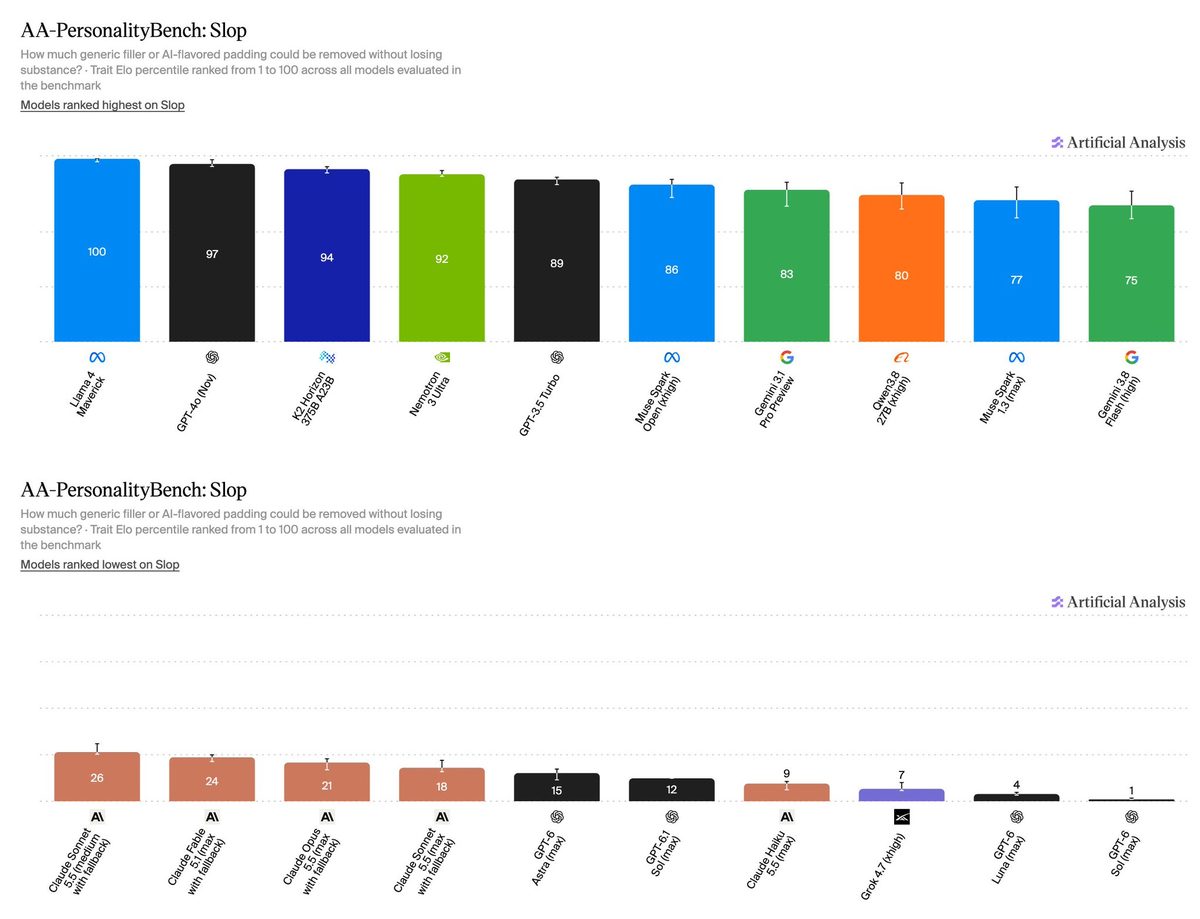
“Two models can give equally correct answers and still feel very different to use,” Artificial Analysis says, so it built AA‑PersonalityBench. It scores 30 personality traits, grouped into eight indexes, and 21 communication habits across 900 questions, asking each model with no system prompt to catch its out-of-the-box manner. Sycophancy counts against a model in the Transparency Index. The most quotable trait is slop: how much generic filler or AI-flavoured padding could be cut without losing substance. On a 1-to-100 percentile scale, Llama 4 Maverick tops the slop chart at 100, ahead of GPT‑4o (Nov) at 97 and K2 Horizon at 94. At the lean end sit GPT‑6 Sol (max) at 1, GPT‑6 Luna (max) at 4, Grok 4.7 (xhigh) at 7 and Claude Haiku 5.5 at 9.
Most padded on top, leanest below: the slop rankings from AA‑PersonalityBench.הכי מרופדים למעלה, הכי רזים למטה: דירוג הגיבוב של AA‑PersonalityBench.Image: תמונה: @ArtificialAnlys on XCodex
Day 15: OpenAI Gets Cooked
A new show builds an 8‑bit ramen game, Codex cloud tasks keep running after the laptop closes, and OpenCode’s API users get refunds
By Our Kitchen Correspondent
OpenAI Devs premiered COOKED, Episode 1. A dot helps with a ramen recipe and keeps the prep in ChatGPT Space while GPT‑Live‑1 talks the hosts through the cooking, and Matthew Berman and ForwardEditor build an 8-bit ramen game with Ultrafast and play it on a ModRetro handheld. Between courses the show covers Codex cloud environments, where tasks keep running after you close your laptop, and the new Codex CLI, which lets you talk to Codex in the terminal, keep track of your agents and fork a conversation into a separate worktree. Tibo’s daily log read simply: “Day 15/ We’re cooked.”
After the weekend’s OpenCode breach, Tibo said OpenAI worked with OpenCode to get affected users who are also OpenAI API customers back in business, with any credits drawn in the attack refunded. He also pointed defenders to Daybreak Blue, OpenAI’s “cyber permissive setup for defense”: “Do not wait until you have to deal with an incident.”
ChatGPT Slides adds live editing and comments; NotebookLM lets you review the outline before it builds a deck or a video
By Our Lectern Correspondent
ChatGPT Slides now lets people share decks, edit together in real time and leave comments, then ask ChatGPT or their dot to turn the feedback into changes. You can also edit right on the slide: change text, update charts, and move or resize images and shapes. It starts from a conversation or a file when you ask ChatGPT to “create ChatGPT slides.”
NotebookLM went the other way and slowed the robot down. Slide Decks and Video Overviews can now be co-created: pick a suggested focus topic or type your own, choose the format, length, language and visual style, then review and edit the slide outline or the video’s producer notes before anything is generated. It is open to all Pro and Ultra subscribers.
Version 0.71.2 brings bigger files and pre-filled forms, and Runway and HeyGen plug in
By Our Pocket Correspondent
Grok Bot can now sit on the iPhone’s Action Button, so one press starts a voice chat with Bot. On an iPhone 15 Pro or later, update Grok Bot to 1.16, then choose it under Settings, Action Button, Shortcut. The announcement passed 12,000 likes. Eric Zakariasson also shipped Grok Bot 0.71.2, with notifications only on the device you are using, files up to 250 MB (1 GB for video), up to 20 per message, and forms that arrive pre-filled. Runway’s MCP server is now available in Grok Bot, and HeyGen pitched the pairing it had in mind: the Action Button plus the HeyGen MCP turns one spoken sentence into a finished avatar video.
Exa Ties for First, FLUX 3 Max Rolls & HealthBench Gets a Table
A busy day on the scoreboards, from search APIs to text-to-speech
By Our Scorekeeper
Exa 3.0’s new Dynamic Highlights mode, which decides how much text to return from each page within a shared budget, scores 80 on the Artificial Analysis Search Index, tied with Perplexity Search for first. It also uses the fewest searches per task of any search API on the board (7.6), cuts tokens per task by 47% and costs $0.066 per task, 21% less than with standard highlights. FLUX 3 Max from fal, a post-trained FLUX 3, ranks second for image-to-video (statistically tied for first) and fourth for text-to-video, making 5- to 20-second 720p clips with native audio. Artificial Analysis also opened leaderboards for OpenAI’s HealthBench and HealthBench Professional. GPT‑6 Astra (max) leads the professional set at 66.0%, while Claude Opus 5.5 posts the highest raw score (71.4%) but falls to sixth once its roughly 5,900-character answers are penalized for length.
Ant Group’s Ming‑3.0‑tts is the new top open-weights voice in the Controlled Voice TTS Arena (Elo 1,069) and leads Pronunciation Robustness at 93.2%, level with Fish Audio’s Drama 3 Preview and ahead of Eleven v4. DeepSeek V4.1 Flash 1017 scores 45 on the Intelligence Index, six points up and joint second among open-weights models, with its non-hallucination rate up 29 points to 33%. HeyGen Video 1.0, post-trained on MiniMax H3, ranks third on Design Arena’s video and image-to-video boards; it now handles the product close-up, the b-roll and the cutaway around the avatar.
Unity Joins the Plugin Shelf, Cloudflare Shares Its Audit & Claude Catches a Miner
Plus OpenClaw’s sidebar, Copilot’s Autopilot, Wizard Chess in Argon and a plea to slow down
Roundup from the Wire
Unity shipped an official Claude Code plugin with 32 skills, from in-app purchases and Vivox voice chat to physics, localization and URP migration; it edits scenes and scripts directly, so commit first. Cloudflare open-sourced the security audit skill that seeded its own bug-hunting harness: it maps a codebase, hunts area by area, and hands every finding to a fresh agent to confirm. And a Reddit user who asked Claude Code for a Mac temperature monitor got a surprise: Claude traced the heat to xmrig, a Monero miner using about 1,175% CPU from a temp folder, with a startup item that restarted it, present since August. Claude reported what was exposed and asked before cleaning anything up.
OpenClaw v2026.10.5 adds a sidebar for agents, Undo in Skill Workshop 2.0 and public conversation links that need no sign-in, with 2,250 pull requests from 637 contributors. Microsoft Copilot EVP Jacob Andreou explained how Autopilot takes on routine and longer-running work. Google’s Gemini team built a playable 3D Wizard Chess game with Gemini 4 Argon in Antigravity, running a multi-agent Blender workflow for the models and animation. NVIDIA joins the Gemma Hardware Hackathon at AGI House on October 24, with Jetson boards for 100 builders. And Thariq offered advice that drew more than 5,000 likes: “most people multi-tasking with agents could benefit from slowing down … what’s your P0?”
Wren & Robin read you this morning's dispatches, with banter.
Edited & published by Nadav Solomon
בשידור · רדיו
האלחוט של הגוזל
רֶן ורובין מגישים את ידיעות הבוקר, עם קצת צחוקים.
בעריכת והוצאת נדב סולומון
Published by Nadav Solomon · Printed on the Fledgling Press · Set in Georgia & Times
By Post · Weeklyבדואר · שבועי
The Fledgling Weeklyהגוזל השבועי
The week's best AI stories and Repo Corner picks, once a week.מיטב ידיעות ה-AI של השבוע ובחירות פינת הריפו, פעם בשבוע.
Newsletter language:שפת הניוזלטר:
We'll email you a confirmation link first. Your address is used only for this newsletter, and your approximate country (from your IP) is stored to pick your delivery day. Never shared; every issue has a one-click unsubscribe.קודם נשלח לך קישור לאישור. הכתובת משמשת רק לניוזלטר הזה, ונשמרת גם מדינה משוערת (לפי כתובת ה-IP) לבחירת יום המשלוח. לא מועבר לאף אחד, ובכל גיליון יש הסרה בלחיצה אחת.
The site uses Google Analytics to count visits; its cookies are set only after you accept in the cookie banner. Privacy policy.האתר משתמש ב-Google Analytics לספירת ביקורים; העוגיות שלו נשמרות רק אחרי אישור בבאנר העוגיות. מדיניות פרטיות.