Gemini 4 Neon Joins the Front Row, Anthropic Prices Its IPO & Grok Bot Books the Trip
Dispatches of the past four-and-twenty hours from the laboratories of artificial intelligence
Google · Models
Gemini 4 Neon Joins the Front Row
Google’s fourth model in seven weeks scores third on the Artificial Analysis index at $3/$15 per million tokens, and tops the coding-agent table in Antigravity
By Our Correspondent at the Model Counter
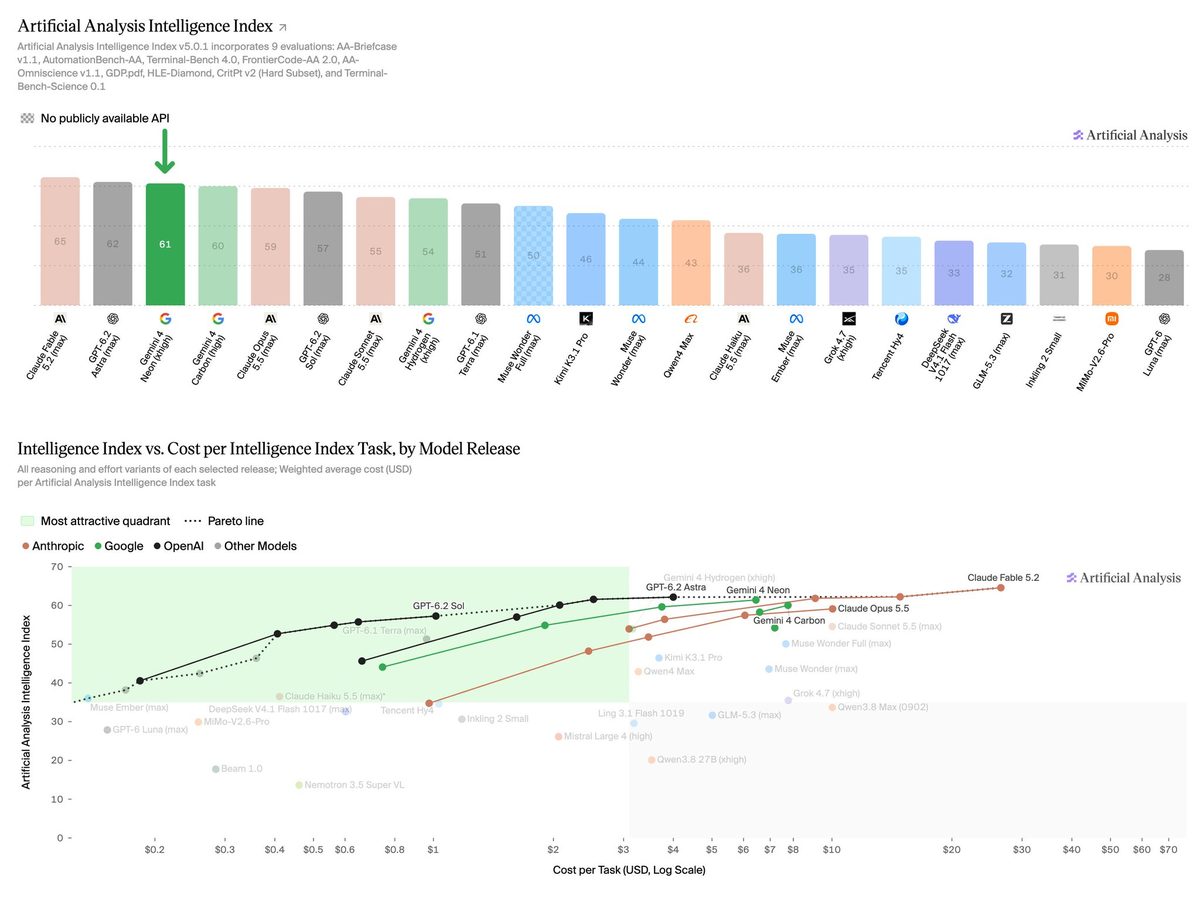
Artificial Analysis’s Intelligence Index: Gemini 4 Neon (61, green) in third place, and the cost-per-task chart below.מדד האינטליגנציה של Artificial Analysis: Gemini 4 Neon (61, בירוק) במקום השלישי, ומתחת: גרף העלות למשימה.Image: תמונה: @ArtificialAnlys on X
Google DeepMind released Gemini 4 Neon on Wednesday, a model it places between the heavyweight Carbon and the quick Hydrogen: “frontier-level intelligence with fast end-to-end task completion” for software engineering, knowledge work and science. It costs $3 per million input tokens ($0.15 when cached) and $15 per million output tokens, with a 1-million-token context window. It is rolling out in the Gemini API in AI Studio, in Gemini for business, in Antigravity for paid Pro and Ultra subscribers, and in the Gemini app for Pro and Ultra users, where it appears as “Deeper analysis” in the model menu and can also run Tasks.
The independent scorekeepers at Artificial Analysis put Neon (xhigh) at 61 on their Intelligence Index, third overall behind GPT-6.2 Astra and Claude Fable 5.2 and one point ahead of Gemini 4 Carbon. It costs $6.44 per index task, about 17% less than Carbon, and finishes a task in roughly 21 minutes instead of 36, at about 110 output tokens per second. In the Antigravity CLI it scores 59 on their Coding Agent Index, level with Claude Code running Fable 5.2 (58), at $6.86 per task against $15.47. Cursor reports 63.7% on CursorBench 4.1 at default effort, up from 57.3% for Hydrogen, and the Vals Index ranks it second at 70.9%.
Demis Hassabis called it “alchemy at its finest.” Google says Neon records its lowest fabrication rate yet in internal Antigravity testing, and a cyber version goes to vetted defenders in the coming days. The internet’s verdict was quick, too: @scaling01, scarred by past benchmark promises, asked whether any benchmarks can still be trusted, then gave Google “big props” for skipping the preview label.
980 million shares, ticker “ANT”, trading on Nasdaq from today
By Our Financial Correspondent
Anthropic priced its initial public offering at $83.00 a share on Wednesday, and its Class A stock is expected to start trading today on the Nasdaq Global Select Market under the symbol “ANT.” The offering is 980,000,000 shares: 956,351,354 sold by Anthropic and 23,648,646 by existing stockholders, whose proceeds Anthropic does not receive. At the offer price that is about $81 billion of stock.
The deal is expected to close on November 20. Underwriters have 30 days to buy up to 147,000,000 more shares, and the SEC declared the registration effective the same day. Goldman Sachs and Morgan Stanley handle the prospectus. On the feed, @scaling01 summed it up in two words: “big ipo.”
Flights, hotels and rental cars; version 1.2.3 goes stable; and a community directory opens its doors
By Our Travel Desk
Grok Bot can now book flights, hotels and rental cars, “finding you the best deal anywhere you go,” the @bot account announced. Version 1.2.3 is now stable, said @ericzakariasson: you can pick how each tool runs, reconnect accounts right from chat, and the bot now reaches for connectors before the browser.
There is also a new community directory at grok-bot.directory to browse and install bots and apps that people have built, or publish your own, and each publisher now gets a profile page to share. Lauren Tan (@poteto) wrote a guide to automating anything with the bot; as @RoundtableSpace summarised it, every automation is a goal plus a process, both described in plain English. She also announced a new Dr Eggbot v2 template with new skills, which owners should install fresh and then ask the old eggbot to hand over what they want to keep.
OS-level limits instead of a container, no network by default; and CLI 0.170.0 adds voice calls
By Our Correspondent in the Terminal
OpenAI explained how Codex’s sandbox works. Instead of moving work into a separate container, Codex uses OS-level sandboxing to limit commands in your own environment, so building an iOS app on a Mac still works with your real tools. In a Git repository, the default profile lets Codex edit source files without asking but blocks writes to the root .git and .codex folders. Network access is off by default: when a command asks for it, Codex either asks you or routes the request to auto-review, and you can allow a package registry’s domain in a permission profile.
Sam Altman reposted the write-up. Separately, Codex CLI 0.170.0 brings WebRTC voice calls in the terminal interface, auto-refreshed auth headers for OpenTelemetry exporters, and, experimentally, MCP servers with the same name across environments.
Working with AMD, OpenAI’s models found up to 14% better power, performance and area on flagship GPU designs
By Our Correspondent at the Foundry
OpenAI says that, working with AMD, its models identified up to a 14% improvement in PPA (power, performance and area) on AMD’s flagship GPU designs in under five months, building on work AMD’s engineers had already spent years optimizing. The same approach helped improve Jalapeño, OpenAI’s first custom inference chip.
Codex lead Tibo Sottiaux (@thsottiaux) pointed to it as proof that GPT-6.2 Astra is “pretty good at hard things,” while admitting he hears the feedback on its communication style and that the team is working on it.
OpenAI shares data on AI use by its own researchers, and a recap of how a model moves from training to release
By Our Science Correspondent
OpenAI published new data on how AI is changing its own research: researchers’ AI use keeps rising exponentially and agents are completing longer tasks, but human involvement remains central. Reading the charts, @scaling01 notes that the 90th-percentile OpenAI researcher now spends about $23,000 a day on coding agents, up from about $7,000 in September, and that the data shows task time horizons doubling every 3.8 months.
The lab also shared how it approaches safety at every stage of a model’s life, from early research to internal use to public release, saying that as capabilities rise, so do the safety and alignment standards a model must meet to move forward.
Native audio, real-time prompts and a helper agent arrive in Project Genie
By Our Correspondent in the Sandbox
Genie 4, Google DeepMind’s most realistic interactive world model yet, is now in Project Genie with native audio, real-time editing and a new agent that helps you build virtual worlds. You can type new prompts while exploring, dropping in characters or changing the scene, and the sound adapts in real time, as Sundar Pichai pointed out.
It is rolling out to eligible Google AI Ultra subscribers, with a community gallery to discover, remix and share creations, and an updated Genie 3 in the model picker with sessions of up to three minutes. Demis Hassabis: “Looks like it is turtles all the way down then.”
Shorter answers, far fewer headings and em dashes, and a sharp drop in admitting uncertainty
By Our Correspondent on the Style Desk
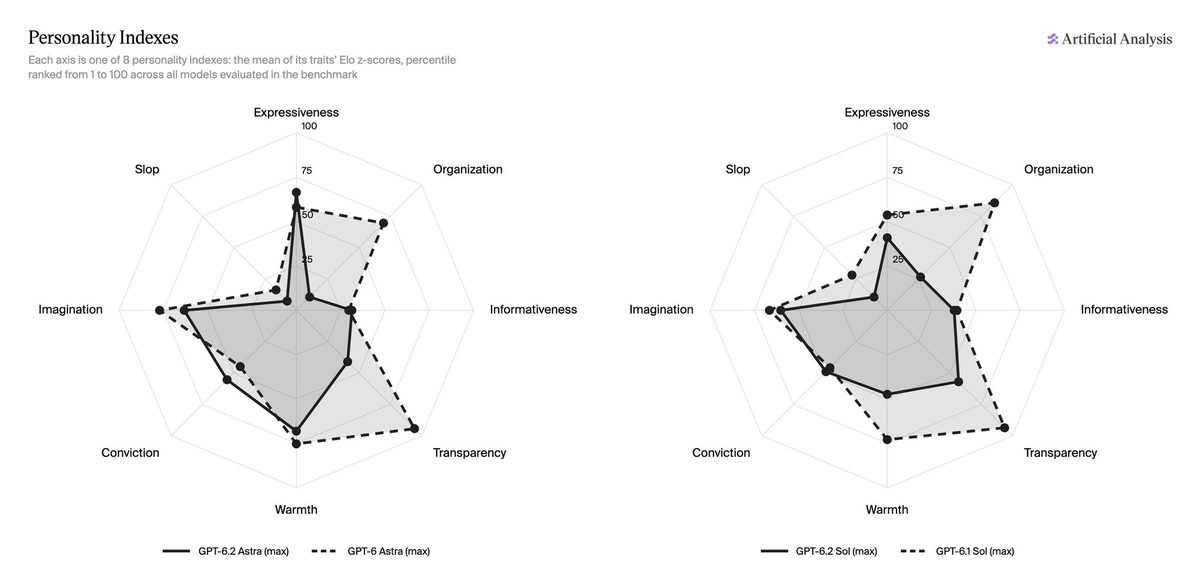
Artificial Analysis’s personality radar: GPT-6.2 (solid) against the previous releases (dashed).מכ״ם האישיות של Artificial Analysis: GPT-6.2 (קו רציף) מול הגרסאות הקודמות (קו מקווקו).Image: תמונה: @ArtificialAnlys on X
Artificial Analysis ran GPT-6.2 through its PersonalityBench and found both models changed noticeably. Responses are shorter: Astra fell from 352 to 210 words, Sol from 337 to 223. They are less structured but more answer-first: Astra’s Answer First score rose from 49 to 89. Headings per response dropped from 1.99 to 0.11 for Astra, and em dashes from 3.19 to 0.70.
The catch: both models are less likely to admit uncertainty, with Astra falling from 96 to 24 on that trait. At higher effort levels, though, both score higher on being evidence-based and on stating their assumptions. Tibo Sottiaux offered one reason early testers and the crowd disagreed: some got access a while ago, and the team made many changes in the last three to four days.
Background mode in the Responses API gets 2-hour and 8-hour targets for GPT-6.2
By Our Correspondent at the Meter
Not every job needs an instant reply, OpenAI notes. In Responses API background mode you can now set a “completion_window” of 2 hours for 30% less per token than Standard, or 8 hours for 40% less, on GPT-6.2 Astra or Sol. A continuation ID reused on follow-up requests gives them higher queue priority. OpenAI’s example: send your meeting notes before you log off and get a morning brief.
An Accounting plugin for month-end and reconciliation, and dictation that types as you talk
By Our Correspondent in the Back Office
ChatGPT for Accounting is now available: a new Accounting plugin and partner plugins for month-end reports, bank reconciliation, data entry and audit prep, working with tools such as QuickBooks. Separately, Live Dictation turns your speech into text as you talk, so you no longer wait for a message to finish transcribing.
224 billion parameters, 12 billion active, a 1M-token context, and an AMA on Friday
By Our Correspondent in Shenzhen
Tencent’s Hy4 flash is now open-weight, including FP8 and Base versions: 224 billion parameters with 12 billion active, a 1-million-token context, and native multimodal input, pitched as fast and efficient for everyday productivity. GGUF builds and day-zero vLLM support followed, and Tencent says the full Hy4 is coming next.
The research team holds a Reddit AMA this Friday, November 20, from 8 to 10 a.m. Pacific (18:00 to 20:00 Israel time).
A virtual fitting room while you shop, and Muse Ember tops a speed-and-cost race
By Our Fashion Correspondent
Muse will now offer to show you how you look in clothes while you shop for them, Alexandr Wang announced: “trying things on in person? as if....” Meanwhile Arena crowned Muse Ember (Max) the leader among efficient models for real work: 27 seconds per task against 5.8 minutes for GPT-6 Luna and 1.9 minutes for Claude Haiku 5.5, a +2.3% net improvement on its Agent Arena score against +1.4% and +0.4%, and 1.9¢ per task against 7.0¢ and 6.9¢.
Up to 8K, seventh in text-to-image and sixth in editing, for a fraction of OpenAI’s price
By Our Art Critic
Kling Image 4.0 ranks #7 in Text to Image and #6 in Image Editing on Artificial Analysis’s boards, a big jump from Kling Image 3.0 Omni, which ranked #86. It generates images up to 8K, and its 2K price is under a third of every OpenAI model ranked above it, though MAI-Image-2.7 ranks higher on both boards for less. Its best use cases are UI and UX design (#4) and retail product shots (#4).
Autopilot starts rolling out in Frontier, and Copilot Workspaces arrives
By Our Correspondent at Ignite
Out of Microsoft Ignite, Copilot “goes multiplayer”: Autopilot is starting to roll out in the Frontier program, and Copilot Workspaces is now available there too. OpenClaw creator Peter Steinberger reposted Microsoft’s high-level Autopilot architecture diagram showing where OpenClaw fits in.
Gemini on budget phones, free Qwen4-Max, a cheaper coding loop, and AI builds Vice City
By Our Wire Service
Gemini: the app was re-architected to run on lower-memory Android phones, including eligible Android (Go edition) devices. Nous: Qwen4-Max is free in Nous Portal for five days. Telegram: it is reportedly preparing its own AI agent, said to run on Nous’s Hermes. OpenCode: version 2.3.2 stops re-billing the system prompt on every step; its notes say uncached input on gpt-6.2-sol fell from about 14,000 tokens per step to 3. Artificial Analysis: every chart now has reasoning-effort filters. GTA VI: for the game’s launch, Artificial Analysis asked Claude Fable 5.2 and GPT-6.2 Astra to build this week’s Miami as Vice City from one prompt each.
Random pick from the archive · first published November 18, 2026הצעה אקראית מהארכיון · פורסמה לראשונה ב־18 בנובמבר 2026
Build the right thing first: have your bot write a mini-spec before it startsלבנות את הדבר הנכון מההתחלה: הבוט כותב מפרט קצר לפני שהוא מתחיל
The problemהבעיה
Bots tend to dive straight into a task from a one-line request, then hand back something polished that solves the wrong problem, and the rework costs more than the original job.
בוטים נוטים לקפוץ ישר לעבודה מבקשה של שורה אחת, ולהחזיר תוצאה מלוטשת שפותרת את הבעיה הלא נכונה. התיקון עולה יותר מהמשימה עצמה.
The fixהפתרון
Before any bigger task, the bot drafts a short plan on one screen: the goal, who it serves, how you will know it is done, and what is out of scope. You approve or correct it, and only then does the work begin.
לפני כל משימה גדולה, הבוט מנסח תוכנית קצרה במסך אחד: המטרה, למי היא מיועדת, איך נדע שסיימנו, ומה לא נכלל. אתם מאשרים או מתקנים, ורק אז מתחילה העבודה.
Try this prompt (works with any AI bot or agent)נסו את הפרומפט (עובד עם כל בוט או סוכן AI)
1. Before you start any task that is bigger than a quick answer, write a short spec first.
2. In the spec, state the goal in one sentence, who the result is for, 2-4 checkable success criteria, and what is out of scope.
3. List your assumptions and any open questions.
4. Show me the spec and wait for my approval or edits before doing the work.
5. When you finish, check the result against each success criterion and tell me which ones pass.
1. לפני כל משימה שגדולה מתשובה מהירה, כתוב קודם מפרט קצר.
2. במפרט ציין את המטרה במשפט אחד, למי מיועדת התוצאה, 2-4 קריטריונים להצלחה שאפשר לבדוק, ומה מחוץ לתחום.
3. פרט את ההנחות שלך ושאלות פתוחות.
4. הצג לי את המפרט וחכה לאישור או לתיקונים שלי לפני שאתה מתחיל.
5. בסיום, בדוק את התוצאה מול כל קריטריון הצלחה ודווח אילו מהם עברו.
Wren & Robin read you this morning's dispatches, with banter.
Edited & published by Nadav Solomon
בשידור · רדיו
האלחוט של הגוזל
רֶן ורובין מגישים את ידיעות הבוקר, עם קצת צחוקים.
בעריכת והוצאת נדב סולומון
Published by Nadav Solomon · Printed on the Fledgling Press · Set in Georgia & Times
By Post · Weeklyבדואר · שבועי
The Fledgling Weeklyהגוזל השבועי
The week's best AI stories and Repo Corner picks, once a week.מיטב ידיעות ה-AI של השבוע ובחירות פינת הריפו, פעם בשבוע.
Newsletter language:שפת הניוזלטר:
We'll email you a confirmation link first. Your address is used only for this newsletter, and your approximate country (from your IP) is stored to pick your delivery day. Never shared; every issue has a one-click unsubscribe.קודם נשלח לך קישור לאישור. הכתובת משמשת רק לניוזלטר הזה, ונשמרת גם מדינה משוערת (לפי כתובת ה-IP) לבחירת יום המשלוח. לא מועבר לאף אחד, ובכל גיליון יש הסרה בלחיצה אחת.
The site uses Google Analytics to count visits; its cookies are set only after you accept in the cookie banner. Privacy policy.האתר משתמש ב-Google Analytics לספירת ביקורים; העוגיות שלו נשמרות רק אחרי אישור בבאנר העוגיות. מדיניות פרטיות.