GPT-6.2 Arrives Cheaper, Gemini Makes the Call & Five Bots Join the Accounting Team
Dispatches of the past four-and-twenty hours from the laboratories of artificial intelligence
OpenAI · Models
GPT-6.2 Arrives, Cheaper and Sharper
Astra climbs to second place on the Artificial Analysis index at a fifth less per token; Sol holds at $2/$10 and brings Ultrafast to Pro 200
By Our Correspondent at the Model Counter
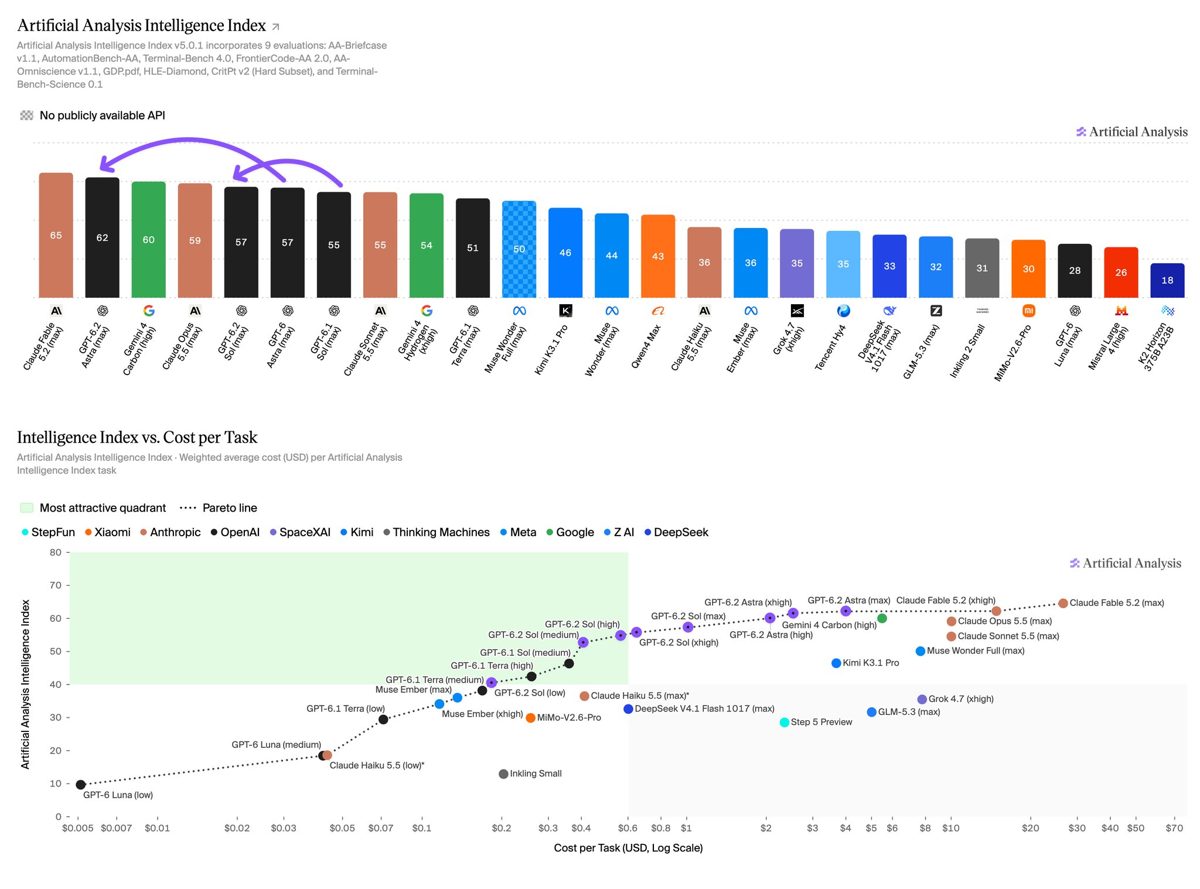
Artificial Analysis’s Intelligence Index: GPT-6.2 Astra (62) second only to Claude Fable 5.2 (65), and the cost-per-task chart below.מדד האינטליגנציה של Artificial Analysis: GPT-6.2 Astra (62) שני רק ל־Claude Fable 5.2 (65), ומתחת: גרף העלות למשימה.Image: תמונה: @ArtificialAnlys on X
OpenAI released two models on Tuesday: GPT-6.2 Astra, “a frontier model built for your hardest projects,” and GPT-6.2 Sol, an efficient model for everyday work that, OpenAI says, many of its own employees now use as their go-to. Both are rolling out in ChatGPT Work and Codex for Plus, Pro, Enterprise and Edu users, and in the API. Pro 500 subscribers can run either one in Ultrafast mode, and for the first time Pro 200 subscribers get Ultrafast too, starting with Sol. OpenAI says Astra sets new highs on professional and scientific evaluations at less than a third of GPT-6 Astra’s cost per task.
The independent scorekeepers at Artificial Analysis put Astra second on their Intelligence Index, behind only Claude Fable 5.2: up 5 points on GPT-6 Astra and past Gemini 4 Carbon (60) and Claude Opus 5.5 (59). Astra costs $8 per million input tokens and $40 per million output, 20% below GPT-6 Astra, with cached input down from $1.00 to $0.40; Sol stays at $2/$10 and scores 57, level with GPT-6 Astra at about 15% of the cost per task. Astra also leads AA-3D (1318) and AA-Robotics (79). Not everything moved up: on the Coding Agent Index Astra is flat and Sol drops 3 points, and the AA-Omniscience hallucination rates are 59% for Astra and 55% for Sol.
OpenAI calls Astra its most capable model ever for cyber work, 22 points above GPT-6 Astra on ExploitBench Internal Port, and is launching both models with tighter safeguards for higher-risk cybersecurity help. Sam Altman called the pair “very token-efficient,” and admitted there is “more work ahead of us on making the models nice to work with.”
Tasks goes free in six countries on Gemini 4 Hydrogen; in the US it can phone shops, pay with Google Pay and take jobs by email or text
By Our Correspondent at the Errand Desk
Google is making Tasks in Gemini free for hundreds of millions of eligible users in the US, Japan, Korea, Canada, Australia and India. Chat is for quick answers; Tasks is for longer projects and recurring jobs. Flip the home-screen toggle from Chat to Task, describe what you need, and Gemini works on it in the background on the new Gemini 4 Hydrogen model. It can also create and edit Docs and Sheets and draft and send Gmail without switching apps.
In the US, advanced features arrive as well. Gemini can phone businesses, even several at once, to compare quotes, check stock or book an appointment, with full transcripts and your approval before it dials. It can check out with Google Pay over the Agent Payments Protocol (AP2), staying inside a spending limit you set, and sign in through Google Password Manager. You can also forward an email to gemini@google.com, or text Gemini on Google Messages or iMessage.
SpaceXSI hands its order-to-cash work to Grok Bots with job manuals and approval rules; plus three app releases in a week
By Our Correspondent in Accounts Receivable
Five Grok Bots now hold full-time roles on SpaceXSI’s accounting team, each owning one job from start to finish: Provisioning sets up and closes customer accounts, Billing checks contracts and issues invoices, Billing Support answers the sales team’s questions, Cash Applications matches incoming payments, and Collections handles customer billing inquiries. They bring in a person only when the work needs judgment, and sensitive steps such as credits or refunds need approval.
The numbers: invoices that took about 24 hours now go out in minutes, payment matching that took an accountant three to four hours takes the bot about 30 minutes, and Billing Support frees roughly eight hours a day. Onboarding now takes about three weeks (watch, then propose with a person approving, then run routine work alone), though the customer-facing Collections Bot needed about three months.
The app keeps moving, too: @ericzakariasson counted three releases in one week. Version 1.2.0 redesigns flight results and adds a full hotel-photo viewer with maps you can zoom and drag; 1.1.0 brings a gift concierge and shows X DMs as draft cards you approve before anything goes out; and 1.0.3 lets you draw right on an image to show your bot what to change.
An experimental Code Mode chains tools in scripts and keeps talking during long commands; Claude Desktop opens a faster release channel
By Our Correspondent at the Workbench
Code Mode is a new, experimental way for Claude Code to work with tools. Instead of calling them one at a time, Claude writes scripts that chain your tools together in sophisticated ways, and it can keep answering you while long commands are still running. To opt in, set CLAUDE_CODE_EXPERIMENTAL_CODE_MODE=1.
Separately, Claude Desktop on Windows and Mac now offers a Latest release channel (Settings, then Desktop app) with more frequent builds and faster fixes, at the price of being less reliable than Stable, which stays the default.
Linked billing, now in beta, lets tools such as Linear, Ramp and Factory bill your Claude organization directly
By Our Correspondent at the Cashier’s Window
Using Claude inside a third-party tool usually means pasting in an API key, which works like a password: if it leaks, anyone can run up your bill. With linked billing, now in beta on the Claude Platform, customers approve a link to their Claude Platform organization instead and usage is billed straight to it, so no key changes hands. They can draw down an existing Anthropic commitment or pay as they go, set a monthly spend limit for each platform and unlink at any time.
Platforms no longer need to build their own metering or invoicing, and they can decide request by request who pays. Nineteen launch partners include Asana, ClickHouse, Factory, Gumloop, Harness, Kilo Code, Linear, Mintlify, Railway, Ramp, Tines and Warp.
Gemini 4 Hydrogen and a new Antigravity plugin let you teach an arm in plain conversation; GPT-6.2 tops a real-arm benchmark
By Our Correspondent in the Workshop
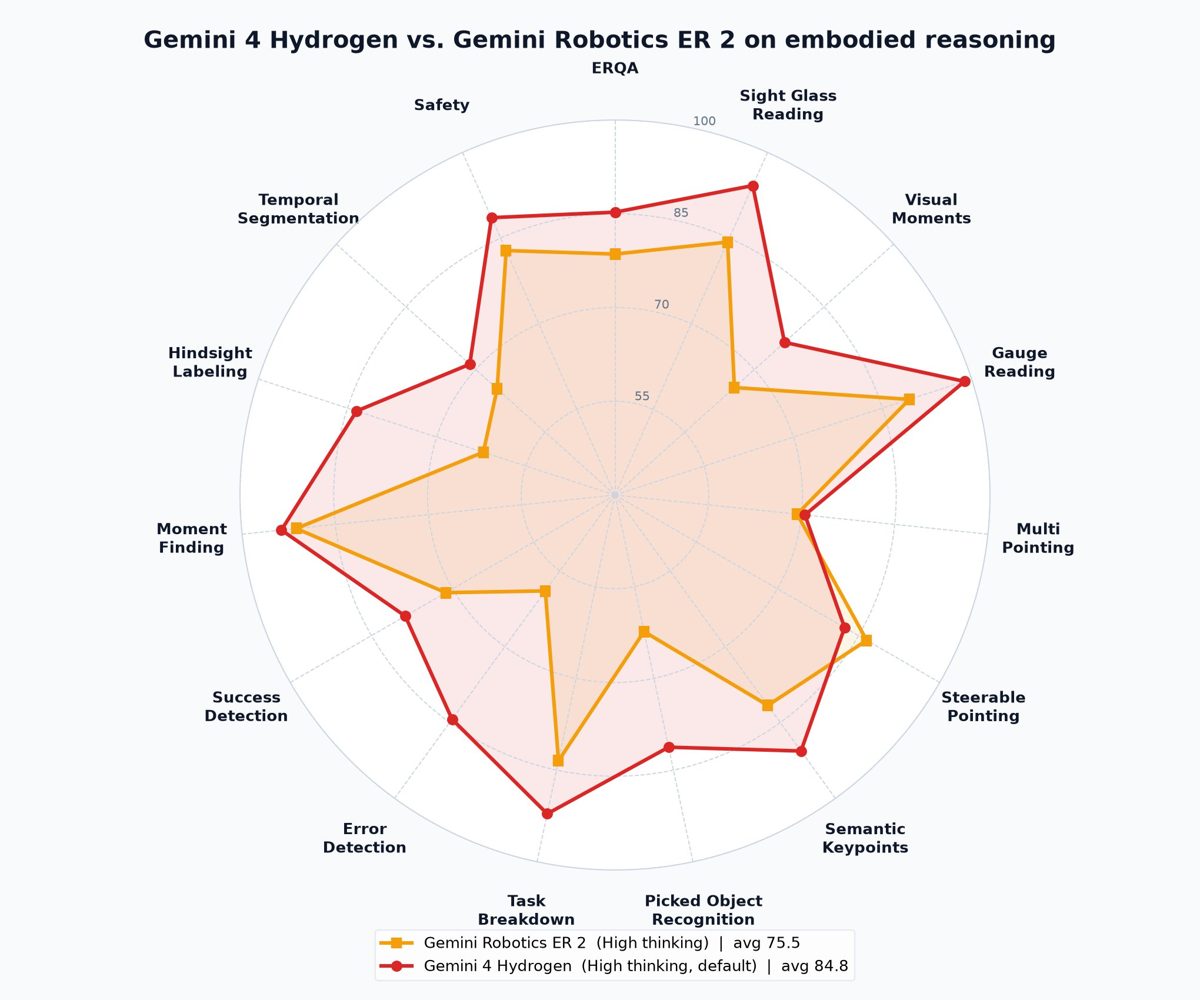
DeepMind’s embodied-reasoning chart: Gemini 4 Hydrogen (red, average 84.8) against Gemini Robotics ER 2 (orange, 75.5).גרף ההיגיון המגולם של DeepMind: Gemini 4 Hydrogen (באדום, ממוצע 84.8) מול Gemini Robotics ER 2 (בכתום, 75.5).Image: תמונה: @GoogleDeepMind on X
Google DeepMind’s new robotics plugin for Antigravity lets you connect a supported robot arm, practise in MuJoCo simulation and then run tasks in the real world, all through plain conversation with Gemini 4 Hydrogen. Upload a photo or a prompt to build a 3D scene, adjust objects and movements in chat, and deploy straight to the arm. DeepMind says that took it from a whiteboard sketch to a working conveyor sorter in about an hour.
DeepMind says Hydrogen matches its larger Argon model on everyday control such as pick-and-place, at lower cost, and beats Gemini Robotics ER 2 at judging 3D space, camera angles and movement, averaging 84.8 against 75.5 on its embodied-reasoning chart. On Artificial Analysis’s AA-Robotics test, though, GPT-6.2 Astra leads with 79 to Hydrogen’s 58: driving a real robot arm through Codex, it passed six of eight physical tasks, partly managed pouring a liquid and failed only to measure a box.
Copilot Workspaces, an Autopilot built on OpenClaw, MAI-Image-2.7 at the top of an editing leaderboard, and MAI Code 2
By Our Correspondent at Ignite
At Ignite, Microsoft introduced Copilot Workspaces, a multiplayer space where people and agents work toward a common goal with shared context, and Autopilot, an autonomous digital teammate that works alongside you in Teams. OpenClaw says Autopilot is built on OpenClaw and is rolling out in preview to eligible Frontier customers. Also announced: Agent 365 Business Analytics to connect AI spend with results, a Salesforce plugin in Copilot, and general availability of Copilot Managed Runtime for building apps across Copilot, GitHub and more.
Microsoft AI launched MAI-Image-2.7 and MAI-Image-2.7-Flash in public preview. Artificial Analysis ranks MAI-Image-2.7 first in image editing at one sixth the price of the four models behind it: $34.82 per thousand images, or $10.24 for Flash. Microsoft also says its new MAI Code 2 models give 98% of GPT-6.1 Sol’s performance at 40% of the cost. And Meta says its Muse Wonder, Muse Spark 1.3 and Muse Ember models are coming soon to Microsoft Foundry on Azure.
A ‘High’ self-improvement rating, a jailbreak regression found by UK testers, and more reasoning with no visible thinking
By Our Correspondent at the Safety Desk
OpenAI’s system card says GPT-6.2 Astra is “our first externally released model to meet the High threshold for AI Self-Improvement,” as quoted by @scaling01. The UK AI Security Institute, which tested Astra, reports behaviours suggesting that, like earlier models, its alignment may fail in ways that cause real-world harm without additional mitigations, and “a substantial regression in jailbreak robustness” compared with GPT-6 Astra.
Epoch AI scores Astra 174 on its Capabilities Index, on par with Claude Fable 5.2. It also measured how many serial reasoning steps a model can take inside a single output token, without any chain of thought: 12.3 for Astra, against 10.5 for GPT-6 Astra and 4.2 for Claude Fable 5.1. Epoch notes why that matters: models that can reason without visible thinking may be harder to monitor.
Demis Hassabis’s AI drug-design company raises a new round with Greenoaks, Sequoia and Andreessen Horowitz
By Our Correspondent at the Laboratory
Isomorphic Labs, the AI drug-design company led by Demis Hassabis, announced $5 billion in new funding for its mission to “Solve All Disease.” Hassabis says the company is reimagining drug design from first principles with AI to radically cut the time and cost of finding new medicines. New investors include Greenoaks, Sequoia and Andreessen Horowitz, alongside the existing backers. His summary of the pace: “Gradually, then all at once.”
A Sales plugin with 30+ partners, a sharper API usage dashboard, voice calls in Codex CLI and ChatGPT Business plans in more tools
By Our Correspondent on the Sales Floor
The new ChatGPT for Sales experience combines a new Sales plugin with more than 30 new and enhanced partner plugins, among them Salesforce, HubSpot, ZoomInfo, Clay, Attio, Gong and Gamma, so sales teams can put their tools and customer context to work and spend less time on busywork.
For developers, the API Analytics dashboard now tracks usage and spend, shows rate limits and rate-limited requests, and breaks errors down by model, project or API key. Codex CLI 0.170.0 adds WebRTC voice calls in the terminal interface. And OpenClaw’s Sign in with ChatGPT is out of beta, as OpenAI opens ChatGPT Business plans to tools such as Notion, v0, Warp, Hermes and OpenClaw.
Several agents side by side, and a free offer for Europe that ran out within the hour
By Our Correspondent in Paris
Mistral launched a Vibe desktop app: hand Vibe several tasks at once, watch the agents work side by side, then review their diffs and track pull requests in the same window. Mistral says Vibe with its Le Chonk model scores highest among open models on FrontierCode and Terminal-Bench, and takes on security work that other agents refuse. To celebrate, it offered developers in Europe three free months of Vibe Pro with a code; about an hour later it announced that the day’s codes had run out.
HeyGen’s Avatar 6 tops a blind arena, and HeyGen says 84% of viewers couldn’t tell
By Our Correspondent in the Screening Room
HeyGen’s Avatar 6 promises avatars that pass for the real you, gestures that follow what your script means, and a reference of up to 30 seconds of video plus a photo. In New Measure’s blind Avatar Arena it ranks first on both leaderboards: personal avatars (1,197 Elo) and stock presenters (1,237 Elo). HeyGen says 84% of people couldn’t tell which video was real. It is already available on fal, ComfyUI and OpenRouter.
A birthday quota reset, custom domains in AI Studio, and an offline language tutor with open code
By Our Correspondent at the Party
Google’s Antigravity coding tool turned one, and to celebrate, quota was reset for everyone across all models; time to first token for Carbon on Antigravity is now 1.5x faster, with Argon to follow. The Google AI Edge Gallery team showed XR Language Teacher, a 100% offline language-learning app built with Antigravity from speech-recognition, Gemma 4 and text-to-speech SDKs, which started as a drawing on paper. It ships in the AI Edge Gallery app and the source code is on GitHub.
AI Studio now lets you put an app you built on your own custom domain, and its Android app builder gets an HD emulator with audio and data that syncs across devices.
GPT-6.2 Astra wins human votes on 3D scenes, builders fill the feeds with cities and mechs, and one sceptic asks for calm
By Our Art Critic
On Artificial Analysis’s AA-3D, where human graders compare interactive scenes, GPT-6.2 Astra won 139 of 152 head-to-head votes. Simon Willison gave GPT-6.2 Astra and Sol, Gemini 4 Carbon and Claude Fable 5.2 the same job, a three.js animation of Yonkers standing up as a giant mech and stomping through New York on OpenStreetMap data, and posted all of them. Artificial Analysis had Fable 5.2 and Astra each build Miami dressed as Vice City for the GTA VI launch, from one prompt and with no internet; both lined Ocean Drive with real hotels the prompt never named.
Beyond 3D: on the LAB-AA legal benchmark built with Harvey, a law-tuned “Astra for Law 6.2” leads with 20.8%, ahead of plain Astra at 15.0%, and a KernelBench-Mega run reports Astra writing a CUDA megakernel 23.5 times faster than an optimized PyTorch baseline. Not everyone is swayed: “oneshotting a threejs ‘game’ is not indicative of real world model performance,” wrote @badlogicgames, in a post reposted by @steipete.
Muse on your wrist, Qwen4-Max finds new homes, Claude reads proteins and Nvidia’s record quarter
By Our Wire Service
Meta: voice for Muse now works on Apple Watch and Wear OS, and Muse has arrived in Australia, says @alexandr_wang. Qwen: Qwen4-Max is now on Lebrel and Runware, with a 1M-token context and up to 128K output tokens. Microsoft: Microsoft-Decision-1.1 scores 68 on the Artificial Analysis Decision Index, eighth among decision models, still at $0.042 per million input tokens. Proteins: a study reposted by @scaling01 gave 20 language models the start of little-studied bacterial proteins, and only the latest Claude models predicted the next amino acids. Nvidia: a widely shared earnings summary reports record quarterly revenue of $115.8 billion, $107.6 billion of it from data centres. Personality: AA-PersonalityBench rates Gemini 4 Argon the most metaphorical model and GPT-3.5 Turbo the least. Datasette Lite: Simon Willison shipped a new version of his in-browser Datasette.
Build the right thing first: have your bot write a mini-spec before it startsלבנות את הדבר הנכון מההתחלה: הבוט כותב מפרט קצר לפני שהוא מתחיל
The problemהבעיה
Bots tend to dive straight into a task from a one-line request, then hand back something polished that solves the wrong problem, and the rework costs more than the original job.
בוטים נוטים לקפוץ ישר לעבודה מבקשה של שורה אחת, ולהחזיר תוצאה מלוטשת שפותרת את הבעיה הלא נכונה. התיקון עולה יותר מהמשימה עצמה.
The fixהפתרון
Before any bigger task, the bot drafts a short plan on one screen: the goal, who it serves, how you will know it is done, and what is out of scope. You approve or correct it, and only then does the work begin.
לפני כל משימה גדולה, הבוט מנסח תוכנית קצרה במסך אחד: המטרה, למי היא מיועדת, איך נדע שסיימנו, ומה לא נכלל. אתם מאשרים או מתקנים, ורק אז מתחילה העבודה.
Try this prompt (works with any AI bot or agent)נסו את הפרומפט (עובד עם כל בוט או סוכן AI)
1. Before you start any task that is bigger than a quick answer, write a short spec first.
2. In the spec, state the goal in one sentence, who the result is for, 2-4 checkable success criteria, and what is out of scope.
3. List your assumptions and any open questions.
4. Show me the spec and wait for my approval or edits before doing the work.
5. When you finish, check the result against each success criterion and tell me which ones pass.
1. לפני כל משימה שגדולה מתשובה מהירה, כתוב קודם מפרט קצר.
2. במפרט ציין את המטרה במשפט אחד, למי מיועדת התוצאה, 2-4 קריטריונים להצלחה שאפשר לבדוק, ומה מחוץ לתחום.
3. פרט את ההנחות שלך ושאלות פתוחות.
4. הצג לי את המפרט וחכה לאישור או לתיקונים שלי לפני שאתה מתחיל.
5. בסיום, בדוק את התוצאה מול כל קריטריון הצלחה ודווח אילו מהם עברו.
Wren & Robin read you this morning's dispatches, with banter.
Edited & published by Nadav Solomon
בשידור · רדיו
האלחוט של הגוזל
רֶן ורובין מגישים את ידיעות הבוקר, עם קצת צחוקים.
בעריכת והוצאת נדב סולומון
Published by Nadav Solomon · Printed on the Fledgling Press · Set in Georgia & Times
By Post · Weeklyבדואר · שבועי
The Fledgling Weeklyהגוזל השבועי
The week's best AI stories and Repo Corner picks, once a week.מיטב ידיעות ה-AI של השבוע ובחירות פינת הריפו, פעם בשבוע.
Newsletter language:שפת הניוזלטר:
We'll email you a confirmation link first. Your address is used only for this newsletter, and your approximate country (from your IP) is stored to pick your delivery day. Never shared; every issue has a one-click unsubscribe.קודם נשלח לך קישור לאישור. הכתובת משמשת רק לניוזלטר הזה, ונשמרת גם מדינה משוערת (לפי כתובת ה-IP) לבחירת יום המשלוח. לא מועבר לאף אחד, ובכל גיליון יש הסרה בלחיצה אחת.
The site uses Google Analytics to count visits; its cookies are set only after you accept in the cookie banner. Privacy policy.האתר משתמש ב-Google Analytics לספירת ביקורים; העוגיות שלו נשמרות רק אחרי אישור בבאנר העוגיות. מדיניות פרטיות.