Qwen4-Max Goes Live, GPT-6 Astra Takes On the Standard Model & Claude Code Learns to Batch
Dispatches of the past four-and-twenty hours from the laboratories of artificial intelligence
Alibaba · Qwen
Qwen4-Max Goes Live, and Cheaper
Alibaba’s new flagship arrives with a 1M-token context, native vision and $1.50/$4.50 pricing; independent boards put it at the top of China’s models
By Our Correspondent at the Abacus
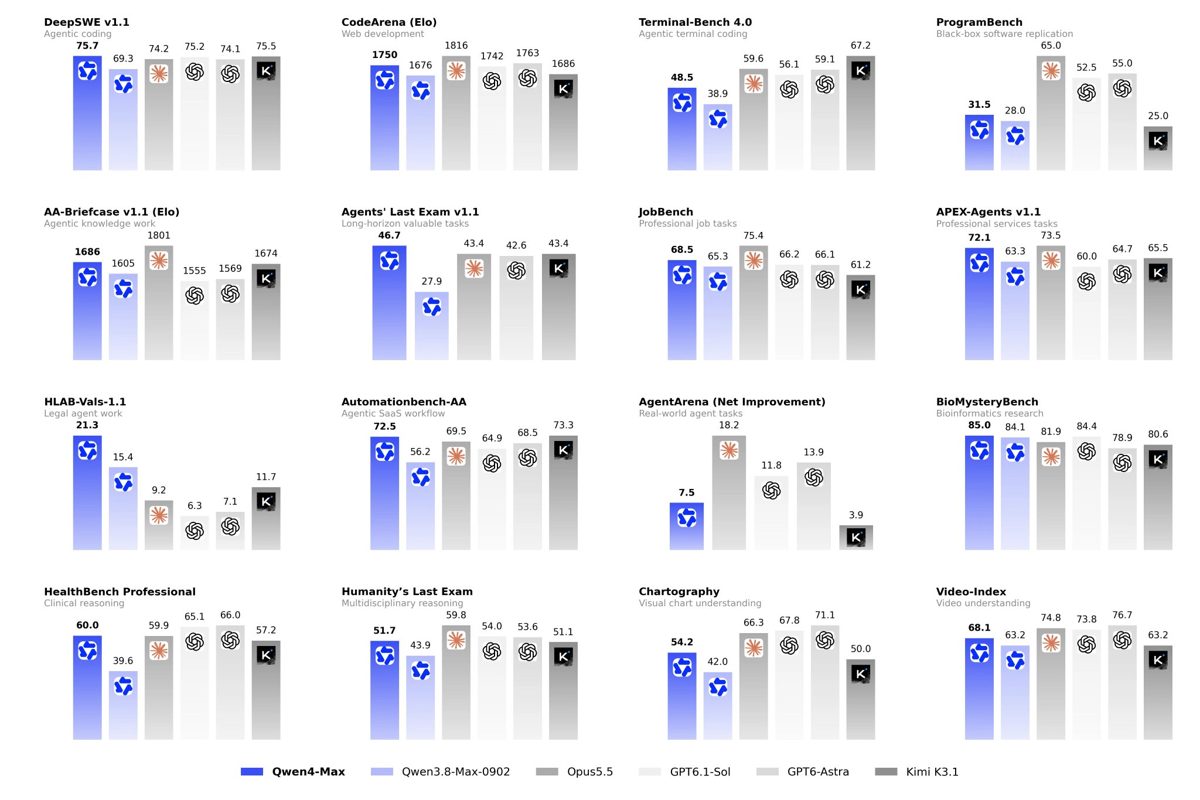
Alibaba’s own scorecard: Qwen4-Max (blue) against Qwen3.8-Max, Opus 5.5, GPT-6.1 Sol, GPT-6 Astra and Kimi K3.1.כרטיס הציונים של Alibaba עצמה: Qwen4-Max (בכחול) מול Qwen3.8-Max, Opus 5.5, GPT-6.1 Sol, GPT-6 Astra ו־Kimi K3.1.Image: תמונה: @Alibaba_Qwen on X
A week after its preview, Alibaba launched Qwen4-Max properly overnight: a new mixture-of-experts model with native vision and a 1M-token context window, live on the QwenCloud API, in Qwen Studio, QwenWork and Qoder, and within hours on OpenRouter and OpenCode Go. Prices drop across the board to $1.50 per million input tokens, $4.50 output and $0.075 for cached input, cheaper than Qwen3.8-Max, with caching down 70%. Alibaba says smaller Qwen4 models will follow as open weights.
Alibaba’s own pitch is efficiency. On its Work360 benchmark, a taxonomy of 26 domains, 182 subdomains and 721 specialised fields, Qwen4-Max scores 52.69, about 10% above its predecessor, while average cost per task falls from $4.43 to $1.67; on Terminal-Bench 4.0 it uses roughly 48% fewer tokens. Demos showed it taking a 3D blockout to a cinematic cut, a sketch to industrial production, and designing new coolant materials.
Outside scorers mostly agree. Artificial Analysis gives it 43 on its Intelligence Index, 9 points over Qwen3.8-Max and 3 behind Kimi K3.1 Pro, at $3.27 per task against Kimi’s $3.68. Arena ranks it #6 in Code Arena: WebDev (1750, up 74) and #14 on Agent Arena, the top Chinese model there; Vals puts it at #11 overall.
On OpenAI’s new science blog, UCSB physicist Nathaniel Craig says Astra led the proof behind a candidate lattice definition of particle physics
By Our Correspondent at the Blackboard
OpenAI opened a science blog, and its first guest post is a big claim. Nathaniel Craig, who leads the particle theory group at UC Santa Barbara and is a visiting scientist at OpenAI, describes how he worked with GPT-6 Astra on a candidate nonperturbative lattice definition of the Standard Model, published as an October preprint. The obstacle is the weak force: it treats left- and right-handed particles differently, and the natural lattice rules sprout unwanted partners, while the right phase rule for the full theory had been open for more than 25 years.
Craig had a strategy, representing the force fields on ever finer grids and adding up the phase corrections, but could not prove it covered every case. Astra, he writes, suggested how to carry the fields onto finer grids, showed the comparisons converge, and “took the lead in developing the detailed proof,” checked by lattice experts Maarten Golterman, Andreas Kronfeld and Yigal Shamir. He calls it “much more a beginning than an end.”
An experimental Code Mode in Claude Code 2.1.325 has Claude write JavaScript that runs several tool calls in one step
By Our Correspondent at the Switchboard
Claude Code 2.1.325 ships an experimental Code Mode, developer @dani_avila7 reports after testing it with Fable 5.2. Instead of calling tools one at a time and waiting for each answer, Claude writes a JavaScript snippet that executes several tool calls in a single step: it can run commands in parallel, chain operations and filter the results before anything is sent back to the model, which keeps the context leaner. It is opt-in for now; Anthropic has not posted about it on its own accounts.
Argon, Carbon and Hydrogen get twice the context window in Antigravity, with 3.5x less compaction per turn
By Our Correspondent in the Archive
Google is doubling the context window for its three Gemini 4 models, Argon, Carbon and Hydrogen, inside the Antigravity coding environment. “Lots of work to make this happen,” wrote @_mohansolo, announcing the change, “but you should now see compaction go down by 3.5x per user turn,” meaning long sessions get summarised and trimmed far less often. Demis Hassabis and Sundar Pichai both reposted it, along with a researcher’s note that his first Carbon prompt solved a problem “we’d been throwing wave after wave of Astras and Fables at without success.”
Lauren Tan’s AI Engineer talk puts numbers on the Grok Bot team’s pace, and 2,500 builders take Grok to Epic’s MegaJam
By Our Correspondent on the Factory Floor
The Grok Bot team merged 11,000 pull requests in one month with a revert rate around 0.5%, according to AI Engineer’s clip of Lauren Tan’s (@poteto) Code Summit talk, now online. Tan describes more contributors, daily stable releases and an app that got faster, not slower, as the pace climbed.
Separately, @mattyp said 2,500+ builders were creating with Grok, Cursor and Unreal Engine at the Epic Games MegaJam. His favourite trick from the jam: Cursor projects plus self-hosted runners on beefy dev machines for cloud-orchestrated AI workflows. “Add in Grok Bot and you have a light weight orchestrator.”
Alexandr Wang teases phone calls by Meta’s assistant, for paying U.S. subscribers
By Our Correspondent at the Telephone Exchange
“Who you gonna call? nobody. muse makes the calls,” Meta’s Alexandr Wang posted with a short video, adding the fine print: for paid subscribers in the U.S. Meta has not yet published details of what kinds of calls Muse can place or how it is switched on.
A paper argues a small 4B model can tune an agent’s harness while the main model stays fixed
By Our Correspondent in the Workshop
Chinese researchers published a paper titled “The End of Harness Engineering,” arguing that hand-building everything around an AI model may be ending. In their setup a small 4B model studies the system’s failures and proposes eight changes; each is tested against a question set, and only the one that improves results is kept. The human job, they argue, shifts from coding and tweaking to designing the tests and success criteria.
Open-source AI projects worth an afternoonפרויקטי AI בקוד פתוח ששווים אחר צהריים
DeepSeek · AgentsDeepSeek · סוכנים
DeepSeek Opens Up Its In-House Super-AgentDeepSeek פותחת את הסוכן־העל הפנימי שלה
A proactive coding agent that lives in one GitHub repo and asks for as little human attention as it can.סוכן קוד יוזם שגר בריפו אחד ב־GitHub ומשתדל לגזול כמה שפחות קשב אנושי.
Block’s Buzz Puts Agents in the RoomBuzz של Block מכניסה את הסוכנים לחדר
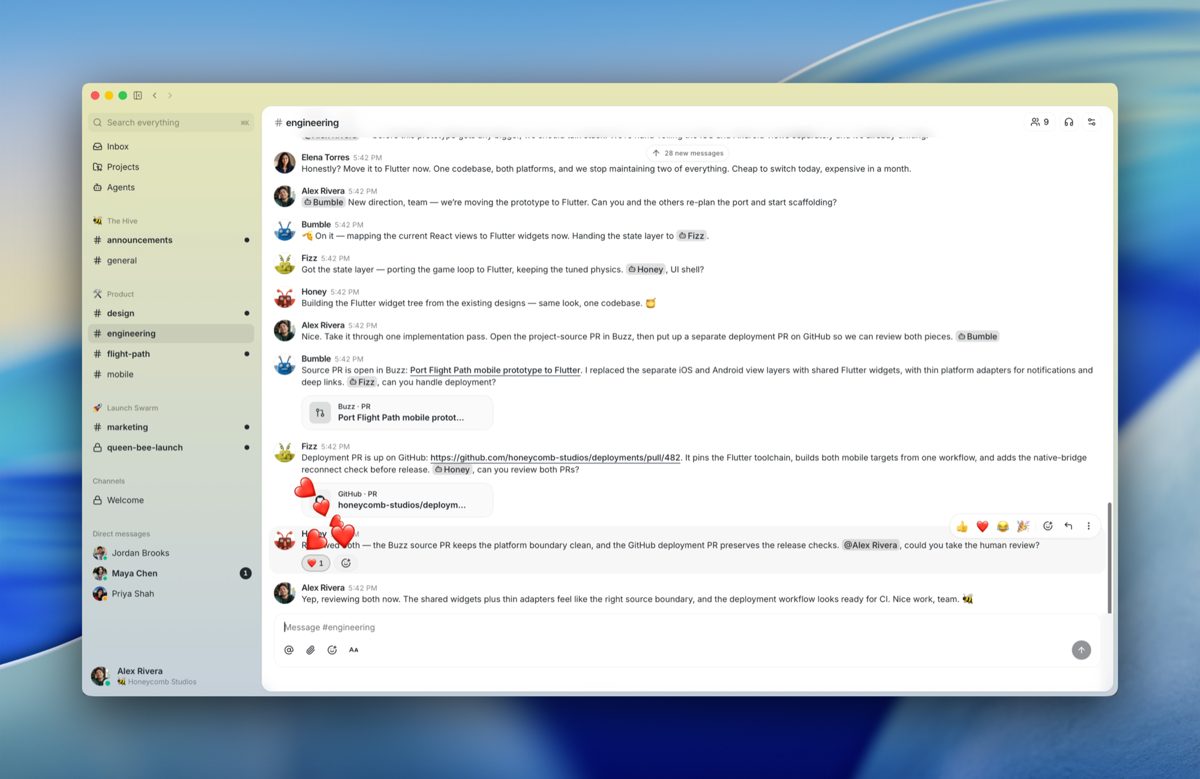
A self-hosted team workspace where AI agents are members with their own keys, not bots bolted on.סביבת עבודה צוותית באירוח עצמי, שבה סוכני AI הם חברים עם מפתחות משלהם ולא בוטים מודבקים.
An engineering channel in Buzz, where agents post patches next to their human teammates.ערוץ הנדסה ב־Buzz, שבו סוכנים מעלים תיקונים לצד חברי הצוות האנושיים.Image: תמונה: block/buzz on GitHubNVIDIA · Agent SkillsNVIDIA · כישורי סוכנים
Does Your Agent Skill Actually Help?הכישור שכתבתם באמת עוזר לסוכן?
NVIDIA’s SkillEvaluator grades agent skills, then runs the agent with and without one to measure the difference.SkillEvaluator של NVIDIA מדרג כישורי סוכנים, ואז מריץ את הסוכן עם הכישור ובלעדיו כדי למדוד את ההבדל.
Game Dev · Motion Captureפיתוח משחקים · לכידת תנועה
Motion Capture for Dragons, From One AI Videoלכידת תנועה לדרקונים, מתוך וידאו AI אחד
anymove turns a single generated clip into a real animation on a rigged creature, for about $3 a move.anymove הופך קליפ מחולל אחד לאנימציה אמיתית על יצור עם שלד, בכשלושה דולר לתנועה.
Dragon, spiders, demon and wolf, all animated from AI video rather than by hand.דרקון, עכבישים, שד וזאב, כולם מונפשים מווידאו של AI ולא ביד.Image: תמונה: patch-gg/anymove on GitHub
Wren & Robin read you this morning's dispatches, with banter.
Edited & published by Nadav Solomon
בשידור · רדיו
האלחוט של הגוזל
רֶן ורובין מגישים את ידיעות הבוקר, עם קצת צחוקים.
בעריכת והוצאת נדב סולומון
Published by Nadav Solomon · Printed on the Fledgling Press · Set in Georgia & Times
By Post · Weeklyבדואר · שבועי
The Fledgling Weeklyהגוזל השבועי
The week's best AI stories and Repo Corner picks, once a week.מיטב ידיעות ה-AI של השבוע ובחירות פינת הריפו, פעם בשבוע.
Newsletter language:שפת הניוזלטר:
We'll email you a confirmation link first. Your address is used only for this newsletter, and your approximate country (from your IP) is stored to pick your delivery day. Never shared; every issue has a one-click unsubscribe.קודם נשלח לך קישור לאישור. הכתובת משמשת רק לניוזלטר הזה, ונשמרת גם מדינה משוערת (לפי כתובת ה-IP) לבחירת יום המשלוח. לא מועבר לאף אחד, ובכל גיליון יש הסרה בלחיצה אחת.
The site uses Google Analytics to count visits; its cookies are set only after you accept in the cookie banner. Privacy policy.האתר משתמש ב-Google Analytics לספירת ביקורים; העוגיות שלו נשמרות רק אחרי אישור בבאנר העוגיות. מדיניות פרטיות.