Claude’s Projects Get a Foreman, Your Dot Gets a Wallet & Cursor Tells the Whole Breach Story
Dispatches of the past four-and-twenty hours from the laboratories of artificial intelligence
Anthropic · Claude Code
Claude Code’s Projects Get a Busier Foreman
The coordinator now answers in the project chat, reports on running threads, and gets /btw, /fork, reminders and shareable threads; desktop users can also re-skin the whole app
By Our Correspondent on the Shop Floor
One request, three threads: the new Projects coordinator at work.בקשה אחת, שלושה שרשורים: המתאם החדש של Projects בעבודה.Image: תמונה: @ClaudeDevs on X
Anthropic shipped a large update to Projects in Claude Code late on Friday. Inside a project, Claude splits your work into parallel threads and coordinates them, and that coordinator is now “much more proactive”: it answers your questions directly in the project chat and posts status updates on the threads it is running. The demo shows one request becoming three threads at once (fix a flaky test, add rate limiting, upgrade a library) with a promise to report back when something is ready.
The smaller tools came along too. /btw parks a side question in its own thread so the current one stays on topic, and /fork starts a new thread from the one you are in to try another approach. Any thread can get a reminder, or you can ask Claude to remind you; it moves out of the way and returns to the project chat when due. Threads can be shared as read-only links with anyone signed in to Claude, except threads that had access to your computer. Recently opened, updated or pinned artifacts now sit in a row at the top of the threads panel.
Projects is in public beta on Pro and Max, with a waitlist for the rest, on web and desktop and in the latest mobile app. Separately, desktop users can now build custom themes with mods: new colors, even an animated background, made by describing the look to Claude or starting from a theme-examples plugin. Themes work in local sessions today; cloud sessions are coming. Both announcements passed 9,000 likes overnight.
ChatGPT Wallet gives agents a payment token instead of your card, asks for Face ID on every purchase, and starts with Pro users in the US
By Our Correspondent at the Till
OpenAI introduced ChatGPT Wallet on Friday: your dot can now finish a purchase for you, with your approval. You add a card once; before each purchase you review the items, the total and the card, then approve with a security check such as Face ID or a fingerprint. The payment network then issues a token, a stand-in card number, so neither the agent nor the shop sees your real card details. Card rewards and dispute protections stay as they were.
It is built with American Express, Mastercard and Visa and starts rolling out to ChatGPT Pro subscribers in the US, aged 18 and over, with US-issued cards. OpenAI also published a playbook for shops whose firewalls or fraud systems might block agent purchases. Later, it says, users may pre-approve purchases within set limits, categories or time periods.
Cursor’s full account: a key it gave Fireworks was exposed, agent traces leaked, and a fake Claude Code extension reached up to 5,000 users; Notion names the same vendor
By Our Correspondent in the Server Room
Cursor published its full report on the security incident it first disclosed on October 29. It began at Fireworks, its inference and training vendor: an attacker got an access key Cursor had issued to Fireworks and copied a read-only bucket of coding-agent traces, mostly from 2025 and only from sessions outside Privacy Mode. A few traces held unredacted credentials (under 0.01% of customers), which led the attacker into some of Cursor’s SaaS tools, archived non-production repositories and support data.
With a stolen credential the attacker then planted fake copies of Anthropic’s Claude Code extension in the cache behind Cursor’s extension marketplace. They were up for about 11 hours, and at most 5,000 users may have received them. Cursor says the last attacker activity was blocked on November 1, moved all inference off Fireworks and rotated every credential. Separately, Notion disclosed that Fireworks, its AI provider, also had a security incident, even though Fireworks was contractually committed to zero data retention.
/run-workflow turns a big job into a short Python script that runs subagents in parallel or in sequence, and shows it to you first
By Our Correspondent at the Switchboard
Google is rolling out Dynamic Workflows in Antigravity. Type /run-workflow and a task, and the agent writes a short Python script that coordinates other agents: parallel() runs one agent per file or package at once, pipeline() runs them one after another, and each returns a structured result checked against a JSON schema. You see the script and approve it before it runs, and it can be saved and rerun.
The pitch is deterministic control flow instead of one long, drifting conversation: one reviewer per changed file, or a persistent reviewer that lists bugs, a fixer per bug, then the same reviewer to confirm. It works in the Antigravity app and CLI on Google AI Pro and Ultra plans.
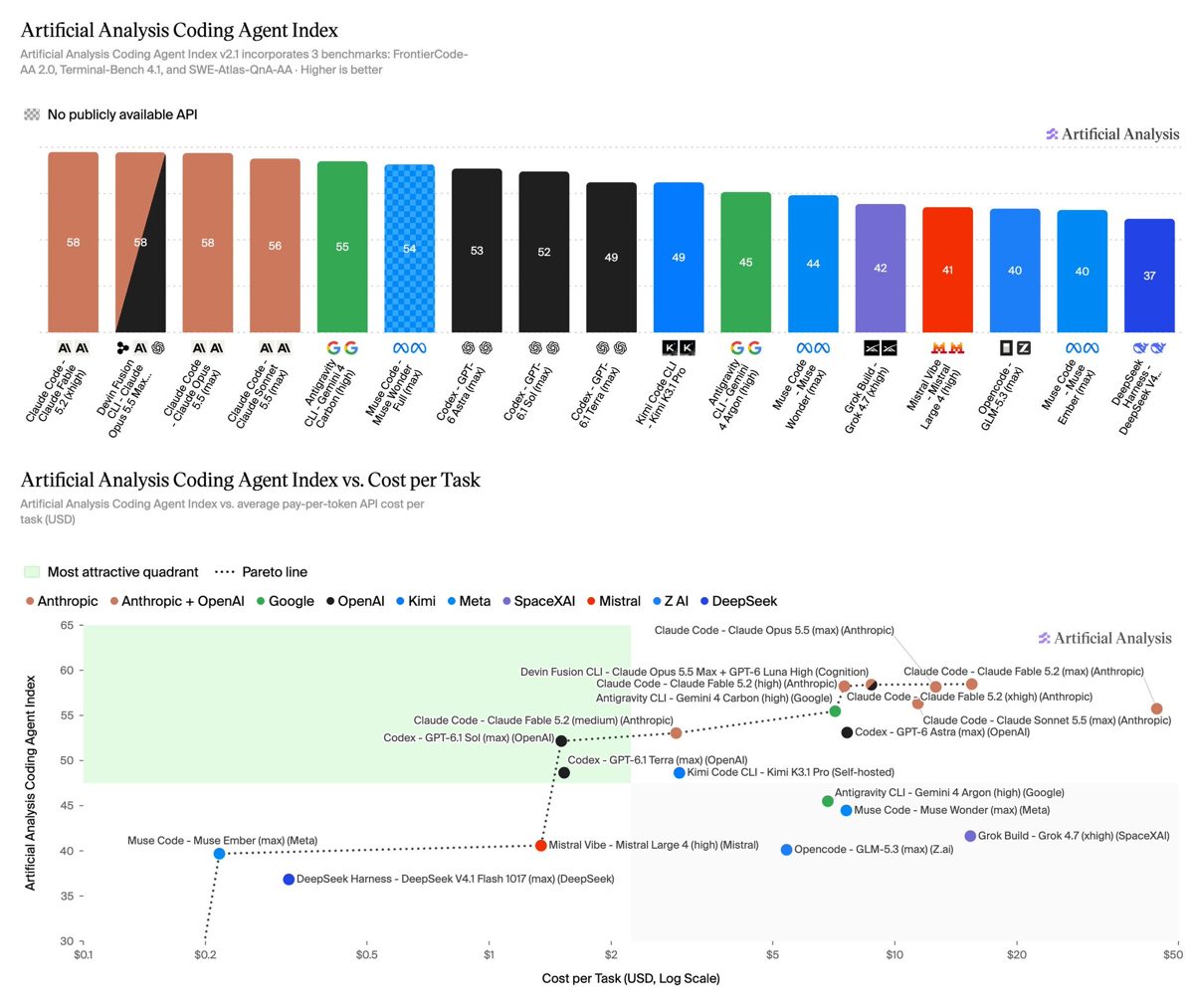
Artificial Analysis’s new Coding Agent Index puts both Claude models at 58; Kimi tops Terminal-Bench, and a separate test crowns GPT-6.1 Sol for proactive agents
By Our Correspondent at the Scoreboard
The new index, and what each score costs per task.המדד החדש, וכמה עולה כל ציון למשימה.Image: תמונה: @ArtificialAnlys on X
Artificial Analysis released version 2.1 of its Coding Agent Index, which scores models inside real agent harnesses. Claude Code with Claude Fable 5.2 and with Claude Opus 5.5 share the lead at 58, level with Devin Fusion CLI, which pairs Opus 5.5 with GPT-6 Luna. The tougher FrontierCode 2.0 dropped every model’s score, from a mean of 45% to 29%; Fable 5.2 leads it at 49%. On Terminal-Bench 4.1, Kimi Code CLI with Kimi K3.1 Pro is first at 68%.
Price matters: Claude Code with Fable 5.2 costs $2.89 a task at medium effort and $44.22 at max, while Codex with GPT-6.1 Sol (max) scores 52 for $1.51. Claude Code and Devin fall back to another model after a safety refusal, which happened in up to 9% of attempts. A different yardstick, the new Agent Initiative Benchmark reposted by @OpenAIDevs, tested 12 models as proactive helpers in a fake company’s Slack and found GPT-6.1 Sol beating Fable 5.2 at $0.11 a task against $1.87.
Meetings reach Super subscribers, the docs answer questions themselves, and harness tweaks stretch plans about 7% further
By Our Correspondent in the Back Row
Grok Bot can now join meetings on Super, Ultra, all Team and Enterprise plans and equivalent legacy plans: ask it questions, assign it work or have it track what the team decides. Super is the new name on that list; the Grok Bot 1.0 launch listed Meetings for Team, Enterprise and Ultra. @poteto suggested sending a bot to a meeting you can’t attend, so it takes notes and gathers its own context.
Two smaller changes came with it. @ericzakariasson announced that you can ask Grok Bot questions right in the docs: it answers from the documentation, links the pages it used and can draw a diagram of how a task runs. And harness optimizations shipped this week should give about 7% more usage from a plan, and up to about 15% more on routine runs, in a post @poteto reposted.
Search, deep-thinking search, file input, URL reading and safety checks run server-side; OCR, speech and TTS come as standalone APIs
By Our Correspondent at the Port
DeepSeek opened the capabilities behind its own app to developers. V4.1-Flash now handles web search with citations, a deep-thinking search that reads pages through multi-step reasoning, file input for PDFs, Office files and images, automatic reading of links in a message, and safety checks, all server-side across Messages, Responses and Chat Completions. Search, fetch, OCR, speech recognition and text-to-speech are also standalone APIs. Public-facing apps must turn the safety checks on, tool use is billed on top of tokens, and an open-source frontend demo can import your DeepSeek chat history. The launch post passed 7,800 likes.
CLI 0.169.0 keeps side chats across restarts and searches old tasks; Codex now also runs on Cloudflare’s Durable Objects
By Our Correspondent at the Terminal
Codex CLI 0.169.0 adds multiple side-chat tabs that come back after a restart, task search by name, prompt or directory, and custom model providers set from the terminal. Cloudflare showed Codex running on Durable Objects “the way it runs on your laptop,” in a post @OpenAIDevs reposted, and OpenAI named its first regional leads for the Codex Ambassadors program, including one for Korea.
Anthropic’s ten rules borrow from psychology’s replication crisis: preregister, validate the grader, report the error bars
By Our Correspondent in the Lab
Anthropic’s engineering blog laid out ten recommendations for designing, running and reporting AI safety evaluations. The core warning: a model that refuses everything about self-harm scores perfectly on a refusal test but is not safer, so evals should measure appropriate responses instead. Single-turn tests are saturated (94% to 98% for every recent model), so the hard ones are multi-turn simulations. Grader models must be checked against human labels, and results need confidence intervals. One example: Opus 5 at 98% and Opus 5.5 at 94% on a romance-scam test were not a statistically significant difference.
PARDIG estimates global rainfall every 15 minutes; SatWeave stitches satellites into one live view of Earth’s clouds every hour
By Our Correspondent Under the Clouds
Google DeepMind released PARDIG and SatWeave, the foundational datasets behind its WeatherNext 3 forecasts. PARDIG estimates rainfall worldwide every 15 minutes and improves precipitation detection skill by more than 30%; SatWeave merges several geostationary satellites into one live view of clouds and storms every 60 minutes. DeepMind says they can help with flood warnings where there is no ground radar, wildfire smoke and solar energy, and they sit on Google Cloud Storage and Earth Engine. Google also announced a research partnership with the UK Met Office.
Gemini 4 Carbon passes GPT-6.1 Sol on MathArena, Gemini gets your Google Wallet, and Sundar Pichai tallies a five-launch week
By Our Correspondent at the Blackboard
For the first time in a long while a non-OpenAI model leads MathArena: Gemini 4 Carbon took first place from GPT-6.1 Sol, with Claude Fable 5.2 second, in a post Sundar Pichai and Demis Hassabis both reposted. Personal Intelligence in the Gemini app now connects Google Wallet for more tailored answers. Pichai’s weekly tally: two 8th-generation TPUs, Gemini 4 Carbon, AlphaGenome 2, the Gemini Decisions API, Gemini 4 Hydrogen and eyewear pre-orders. The Gemini app also showed Hydrogen cutting a sizzle reel from public-domain archive footage and building a 3D globe that turns live lightning strikes into music.
An agent can now create a Meta app, link it to a Business Portfolio and add WhatsApp messaging, asking before each step
By Our Correspondent at the Front Desk
Meta’s Social Technologies MCP now lets an AI agent set up a Meta app for you: create the app, link it to a Business Portfolio and add a use case such as WhatsApp Business messaging. Meta says it asks for your OK before every change.
A new diarization index, a TTS upset by Speechify, and MiniMax’s H3-Image as the top open image model
By Our Correspondent with the Headphones
Artificial Analysis launched a Diarization Index that scores who said what in transcripts across 97 conversations of two to eight people. NVIDIA’s Nemotron 3.5 Transcribe leads with 3.3% of words given to the wrong speaker and stays under 6% even with eight voices; Voxtral Small Transcribe 3 is the most accurate priced API at 7.5% for $4 per 1,000 minutes. In speech synthesis, Speechify’s Simba 3.5 took first place in the Controlled Voice Arena, statistically level with HeyGen Voice, at $6.58 per million characters. MiniMax’s H3-Image became the top open-weights image model for both editing and text-to-image, and Tencent’s Hy4 ranked third on the Cyber Index and first on CWE-Bench at 76%.
Hermes Agent builds an office network on $10 of credit, gets a simpler mobile app and plugs into Modal
By Our Correspondent in the IT Closet
An IT director put $10 of credit into Nous Portal and asked Hermes Agent to stand up a full Windows domain: two domain controllers, a print server, a file server and two application servers, downloading the tools and Windows Server 2022 images itself. His verdict, in a post Nous reposted: “it has performed every single step flawlessly and it cost me 27 cents.” Hermes Agent’s mobile beta (build 44, iOS and Android) makes the Agents list the home screen, plays agent audio inside the chat and adds /steer to nudge a running turn; Modal Endpoints are now a Hermes plugin.
A lawsuit against five AI labs, SpaceX’s $74 billion compute plan, a reported end to OpenAI’s robotics team, and browser-use at half the cost
By Our Correspondent at the Ticker
Four nonprofits sued OpenAI, Anthropic, Google, Meta and SpaceX in San Francisco, seeking an order blocking any AI more capable than what each company has today, @RoundtableSpace reported. It also reported SpaceX making official $74 billion for AI supercomputers: $50 billion for a 6-gigawatt campus in Cochise County, Arizona, and $24 billion at Starbase, Texas. Fortune reports that OpenAI disbanded its robotics team because it expects language models to become robot brains, per a post @scaling01 reposted. NVIDIA launched GR00T 2, a robotics model whose skills learned from human demonstrations carry across robot bodies. On the cheaper side, browser-use 1.0.4 halved its cost per task, from $0.434 to $0.208, by dropping old screenshots in one batch so the prompt cache survives, and OpenCode 2.3 now runs subagents in the background by default.
Plus a $45 Paint masterpiece and a virtual PC build that took 7 hours and 41 minutes
By Our Correspondent at the Terrarium
James is an AI frog in a 3D terrarium where visitors can feed him, pet him and leave notes; his body is a plain simulation, Claude only nudges what he wants to do next, and Haiku writes his thoughts. After GPT Astra painted in MS Paint, someone gave Claude Fable 5.2 the same challenge through computer use in the Claude desktop app: about 2.5 hours and roughly $45 in API costs. Another builder had Fable 5.2 produce a realistic demo of building a PC from scratch, which took 7 hours 41 minutes and $138.82. All three were spotted by @RoundtableSpace.
Wren & Robin read you this morning's dispatches, with banter.
Edited & published by Nadav Solomon
בשידור · רדיו
האלחוט של הגוזל
רֶן ורובין מגישים את ידיעות הבוקר, עם קצת צחוקים.
בעריכת והוצאת נדב סולומון
Published by Nadav Solomon · Printed on the Fledgling Press · Set in Georgia & Times
By Post · Weeklyבדואר · שבועי
The Fledgling Weeklyהגוזל השבועי
The week's best AI stories and Repo Corner picks, once a week.מיטב ידיעות ה-AI של השבוע ובחירות פינת הריפו, פעם בשבוע.
Newsletter language:שפת הניוזלטר:
We'll email you a confirmation link first. Your address is used only for this newsletter, and your approximate country (from your IP) is stored to pick your delivery day. Never shared; every issue has a one-click unsubscribe.קודם נשלח לך קישור לאישור. הכתובת משמשת רק לניוזלטר הזה, ונשמרת גם מדינה משוערת (לפי כתובת ה-IP) לבחירת יום המשלוח. לא מועבר לאף אחד, ובכל גיליון יש הסרה בלחיצה אחת.
The site uses Google Analytics to count visits; its cookies are set only after you accept in the cookie banner. Privacy policy.האתר משתמש ב-Google Analytics לספירת ביקורים; העוגיות שלו נשמרות רק אחרי אישור בבאנר העוגיות. מדיניות פרטיות.