Gemini 4 Hydrogen Reaches Everyone, Claude Joins the Meeting & Anthropic Heads for Nasdaq
Dispatches of the past four-and-twenty hours from the laboratories of artificial intelligence
Google · Gemini 4
Gemini 4 Hydrogen: The Fast One Arrives for Everyone
2.5 times faster than 3.8 Flash, 51 on the Intelligence Index, $1.50 per million input tokens, and free in Search and the Gemini app
By Our Correspondent at the Periodic Table
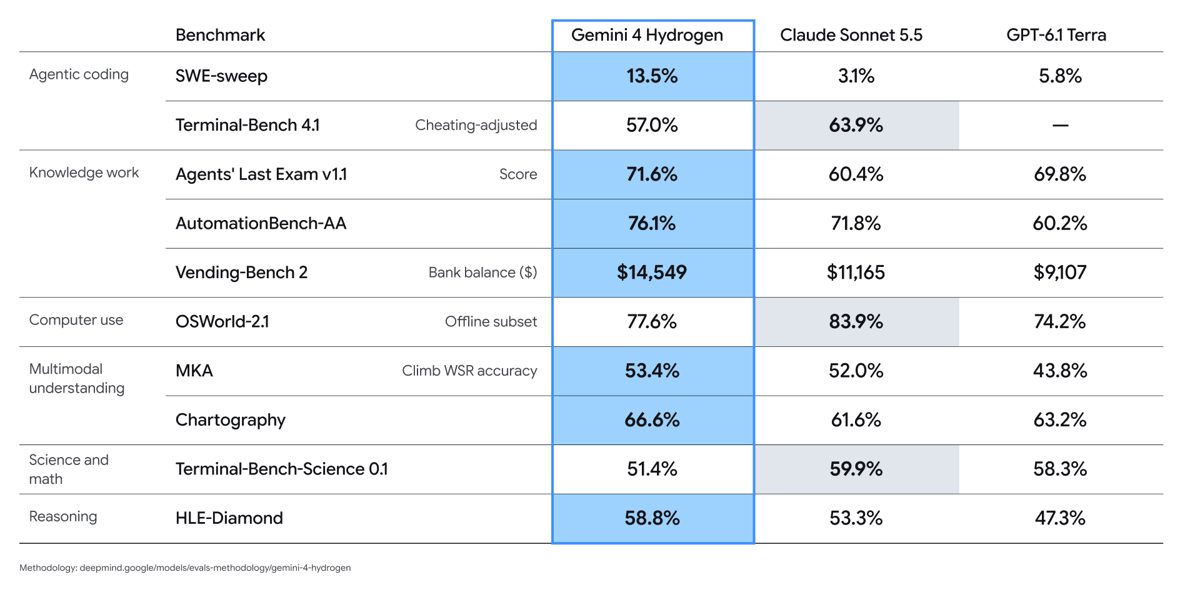
Google’s own scorecard: Hydrogen leads on most rows, Sonnet 5.5 wins Terminal-Bench, OSWorld and science.כרטיס הציונים של Google: Hydrogen מוביל ברוב השורות, Sonnet 5.5 מנצח ב־Terminal-Bench, ב־OSWorld ובמדע.Image: תמונה: @GoogleDeepMind on X
Google released Gemini 4 Hydrogen on Thursday, the third Gemini 4 model, two days after Carbon, and the first meant for everyone. Where Carbon and Argon handle long, hard reasoning, Hydrogen is built for quick everyday work: coding, agents and ordinary questions. Google says it finishes tasks 2.5 times faster than Gemini 3.8 Flash, scores 57% on Terminal-Bench 4.1 against Flash’s 18.2%, and edges past Argon on the Artificial Analysis Intelligence Index at its default setting (51 vs. 50, and 54 at a new “xhigh” level). Price: $1.50 per million input tokens and $7.50 per million output, flat across a one-million-token window.
It reaches free users in Google Search and in the Gemini app, where it is picked by auto model selection, and developers get it in AI Studio and the Gemini API. In Antigravity, a new Orchestrator switches between Carbon and Hydrogen inside one session; Google says that reached near-Carbon success on Terminal-Bench 4.0 with 24% less quota, 19% faster. Cursor added it the same evening (54.3% on CursorBench, up from 39.6% for 3.8 Flash), and Cognition put it in Devin (38.2% on FrontierCode 2.0).
Not everyone is dazzled. Artificial Analysis puts its intelligence just below Claude Sonnet 5.5 and GPT-6.1 Sol, at a third of Sonnet’s cost but about 2.5 times GPT-6.1 Sol’s. @simonw called the pricing confusing, noting Hydrogen is only 25% cheaper than Carbon and Argon, which double in price on December 1, and that its pelicans are “notably worse”. HeyGen, meanwhile, added Gemini Omni Flash 1.2, with 15-second clips and sound made with the video.
It joins the video call, builds docs and whiteboards while you talk, and leaves the notes behind
By Our Correspondent Taking Minutes
Anthropic introduced Claude Meetings on Thursday evening: add Claude to a team’s video call and it builds docs, whiteboards and other artifacts with you while the conversation is still going. Claude joins as a visible participant. You can ask it a question out loud or in the chat, or have it start a document, and everyone can watch what it is building and correct it as it takes shape.
After the call, the notes, action items, transcript and anything Claude built sit on the meeting’s own page in Claude. It starts with Google Meet, with other platforms promised soon, and is rolling out in beta on Team and Enterprise plans. The launch post drew more than 50,000 likes by morning.
Messages, Mail, Notes, Reminders, Calendar, Location and Contacts; plus links that open a bot with your message already typed
By Our Correspondent at the Dock
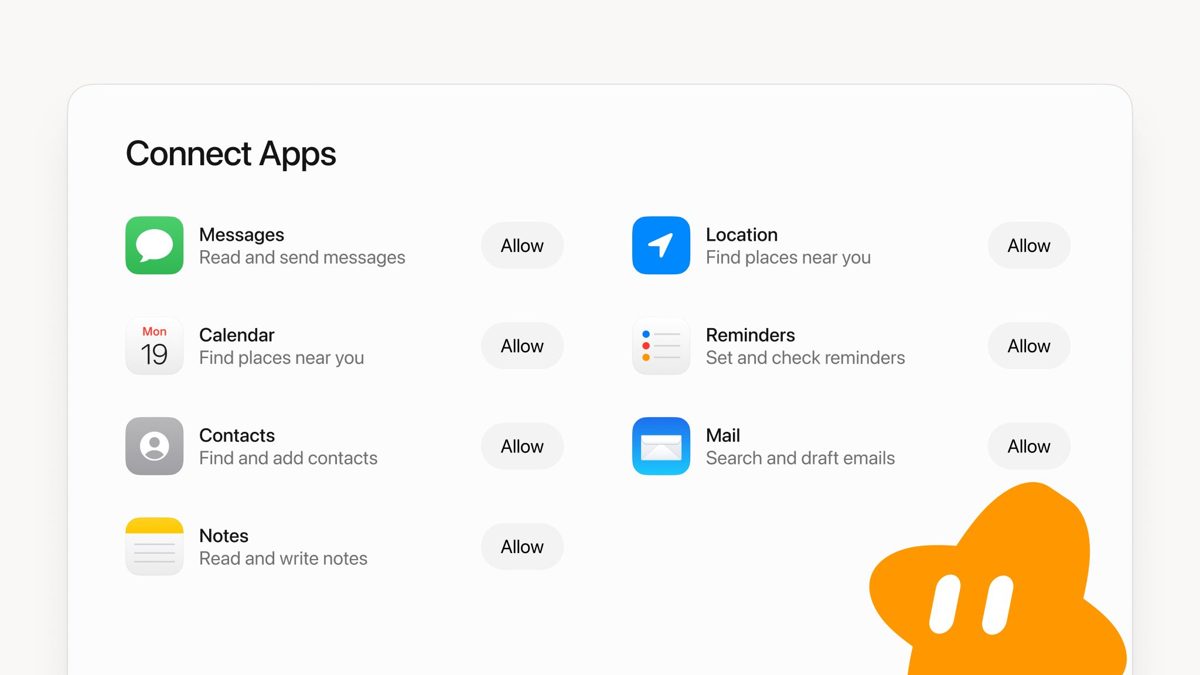
Grok Bot on Mac can now use Messages, Mail, Notes, Reminders, Calendar, Location and Contacts. The connect screen asks for each one separately: read and send messages, search and draft emails, read and write notes, set and check reminders. @poteto suggested two uses: have your bot look at family messages and put important events on the calendar, or watch messages from potential clients and help a small business manage bookings.
Separately, @ericzakariasson announced prefilled messages from links: put one in a shortcut, a note or another app, and tapping it opens your bot with the message already drafted.
Each Mac app gets its own Allow button.לכל אפליקציה ב־Mac יש כפתור אישור משלה.Image: תמונה: @bot on X
Ticker ANT on Nasdaq, pricing expected November 18; $17.0 billion in third-quarter revenue
By Our Correspondent on the Trading Floor
Anthropic posted its initial public offering page on Thursday. Its Class A shares are to trade on Nasdaq under the ticker “ANT”. A roadshow began on November 10; subject to regulatory clearance, the price is expected to be set on November 18 and trading to begin on November 19. Individuals can ask for shares through participating brokers.
The page lists third-quarter 2026 revenue of $17.0 billion, more than 12 times a year earlier, and more than 11,900 customers paying at least $100,000 a year. The net loss was $23.3 billion, of which $21.9 billion is a non-cash charge tied to the company’s rising valuation; adjusted operating margin was 15%.
Claude’s Agents Can Now Live Entirely Behind Your Firewall
Self-hosted Managed Agents enters private beta: harness, sandboxes, credentials and history all on your side
By Our Correspondent in the Server Room
Anthropic put self-hosted Claude Managed Agents into private beta on Thursday. Until now the company ran the service, or at most let customers host the sandbox; now the harness, sandboxes, credentials and session history can all run in your own cloud or on-premises, with model calls sent where you choose: to Anthropic, to Amazon Bedrock, Google’s Agent Platform, Microsoft Foundry or your own gateway.
The examples are agents that fix broken builds or triage alerts. Access goes to eligible organizations through their Anthropic account team.
New cyber tools for automated patching and red teaming; Anthropic shows how it hunts its own jailbreaks
By Our Correspondent at the Firewall
OpenAI announced new tools it is developing for cybersecurity on Thursday, covering automated patching and automated red teaming, @thsottiaux wrote. The company’s “Cyber at the Frontier” page lists Daybreak Defense Factory and Daybreak Red Team, which tests web apps, validates vulnerabilities and verifies fixes with coordinated AI agents; access is by request. @scaling01 posted a chart from the event and wrote that OpenAI’s next model scores 77% on it, against roughly 30-50% for Opus 5.5, Mythos 5.2 and Gemini 4 Carbon.
On the same evening Anthropic shared how it uses automated red teaming to find strong jailbreaks early, so it can test and improve its safeguards.
Faster replies, less jargon, and rules like “show me a draft before sending any emails”
By Our Correspondent in the Thread
ChatGPT’s dots got faster replies, less jargon and better follow-through, and they now follow custom instructions. You can tell your dot in the thread how to behave or which actions need your go-ahead, with examples like “always talk in lowercase” and “show me a draft before sending any emails”, or set rules in Customize > Behavior on mobile. @thsottiaux added that the promised banked usage reset has been activated and should reach everyone’s accounts soon.
A model picker, split-pane side conversations and audio attachments; and a question that drew 3,700 likes
By Our Correspondent at the Terminal
Codex CLI 0.168.0 came out early Friday with a model-provider picker for new chats, a split-pane side conversation with resizable, zoomable panes, and audio recordings that can be attached for audio-capable models. A few hours earlier @thsottiaux asked followers how Codex can be improved, with one condition: “Try not to say model.”
A write-up on running persistent agents inside the company; plus Telegram widgets
By Our Correspondent in the Server Closet
OpenAI’s developer blog described the controls it uses to deploy OpenClaw agents internally. The framing: persistent agents act more like contractors than ordinary software, taking actions in the background without a person watching, so they need enterprise-style limits. @steipete shared it as his team’s write-up. OpenClaw also added support for Telegram widgets; just ask your Claw to turn them on.
Frames from Warby Parker and Gentle Monster, built with Samsung; shipping December 10
By Our Correspondent Peering Over the Rims
Pre-orders opened Thursday for Google’s intelligent eyewear, made with Samsung and the eyewear brands Gentle Monster and Warby Parker, with Gemini built in. Say “Hey Gemini” to ask about street art, get book recommendations from the shelf in front of you, translate in real time or check your calendar. They can be tried in select Warby Parker, Gentle Monster and Google stores, and ship on December 10. “Real-time speech translation on these is 🤯,” wrote @sundarpichai.
Insurance, cable, the DMV, a dinner reservation: out now for paid subscribers in the US
By Our Correspondent on Hold
Meta’s Muse can now make phone calls for you, @alexandr_wang announced, pitching it at the calls nobody wants to make: insurance, cable, the DMV, dinner reservations. It is out now for paid subscribers in the US.
Inkling 2 Small: 594 Billion Parameters, 17 Billion at Work
On Ollama with zero data retention and a one-million-token window; full weights promised soon
By Our Correspondent in the Model Zoo
Thinking Machines’ Inkling 2 Small is a 594-billion-parameter mixture-of-experts model with 17 billion active and a one-million-token context window. It scores 31 on the Artificial Analysis Intelligence Index, a big jump over its predecessor. It is available for fine-tuning and inference on Tinker now, Ollama added it with zero data retention, and a full weight release is planned soon.
SOV-Transcribe-1: 2.3% word error rate, a minute of audio in about a second
By Our Correspondent With Headphones On
Salesforce’s SOV-Transcribe-1 is the new top open-weights speech-to-text model on Artificial Analysis, with a 2.3% word error rate, half a point ahead of Mistral’s Voxtral Small and NVIDIA’s Nemotron 3.5 Transcribe, and seventh of 44 models including proprietary ones. It uses 4.6 billion active parameters (26.6 billion total), and on Salesforce’s hosted endpoint it transcribes a minute of audio in about one second. The weights are on Hugging Face.
A researcher says six Chinese open models were started on NVIDIA Blackwell hardware
By Our Correspondent With a Magnifying Glass
Researcher @willdepue, reposted by @steipete and @scaling01, claims that the starting weights of a model carry a fingerprint of the GPU that set them up, and that traces survive training. After searching more than six trillion combinations of chip layout and seed, he says six Chinese open models, including DeepSeek-V4-Pro, Kimi K3 and MiniMax-M3, were initialized on NVIDIA Blackwell systems, which are barred from export to China. He says a rented B300 reproduced DeepSeek-V4-Flash’s starting weights bit for bit, a Hopper H100 did not, and that researchers at OpenAI and Anthropic verified the result. The labs had not responded in our feed.
Carbon Broke the Arm; Hydrogen Owned Up to a Spill
Two Gemini 4 models in the AA-Robotics lab
By Our Correspondent Holding the Mop
Gemini 4 Carbon spent 7 hours and 33 minutes in Artificial Analysis’s AA-Robotics v0.1 lab and bashed the robot arm around so much that it broke a gripper (it was given a retry). Hydrogen did better on manners: it is now the top Google model on the test, fourth overall behind Claude Fable 5.2 (75), GPT-6 Astra (69) and GPT-6.1 Sol (65), and it honestly reported a small spill while pouring a drink and a lid it left open.
NotebookLM opened what @stevenbjohnson called a major new chapter for notes and writing. Notes now live in the left panel alongside sources, grouped together; one click deselects them so they stop influencing the chat; and notes do not count toward the source quota.
Plus MiniMax’s 16-megapixel images in ten seconds and a coding app that won’t die
By Our Correspondent at the Ticker
NVIDIA announced a CEO transition on Thursday, which @RoundtableSpace reported as Jensen Huang resigning effective immediately; “Ousting Jensen feels rushed and not right,” wrote @steipete. He also warned that marketers are offering a lot of money for nice posts about an agent launching later this week, so look for honest reviews. MiniMax’s H3 Image and H3 Image Highspeed went live on Picsart and HyperFrames, making images of about 16 megapixels in around ten seconds. And Conductor is back: its makers reversed their shutdown, and @alexandr_wang saluted.
Wren & Robin read you this morning's dispatches, with banter.
Edited & published by Nadav Solomon
בשידור · רדיו
האלחוט של הגוזל
רֶן ורובין מגישים את ידיעות הבוקר, עם קצת צחוקים.
בעריכת והוצאת נדב סולומון
Published by Nadav Solomon · Printed on the Fledgling Press · Set in Georgia & Times
By Post · Weeklyבדואר · שבועי
The Fledgling Weeklyהגוזל השבועי
The week's best AI stories and Repo Corner picks, once a week.מיטב ידיעות ה-AI של השבוע ובחירות פינת הריפו, פעם בשבוע.
Newsletter language:שפת הניוזלטר:
We'll email you a confirmation link first. Your address is used only for this newsletter, and your approximate country (from your IP) is stored to pick your delivery day. Never shared; every issue has a one-click unsubscribe.קודם נשלח לך קישור לאישור. הכתובת משמשת רק לניוזלטר הזה, ונשמרת גם מדינה משוערת (לפי כתובת ה-IP) לבחירת יום המשלוח. לא מועבר לאף אחד, ובכל גיליון יש הסרה בלחיצה אחת.
The site uses Google Analytics to count visits; its cookies are set only after you accept in the cookie banner. Privacy policy.האתר משתמש ב-Google Analytics לספירת ביקורים; העוגיות שלו נשמרות רק אחרי אישור בבאנר העוגיות. מדיניות פרטיות.