Anthropic Launches Fable 5.2, Meta Goes Small with Muse Ember & Grok Bot Resets Limits
Dispatches of the past four-and-twenty hours from the laboratories of artificial intelligence
Anthropic · Claude
Anthropic Unveils Fable 5.2 and Mythos 5.2 — Cheaper, Faster, and Solving Open Problems
One model under two names: Fable for every paid plan at $8/$40 per million tokens, Mythos for vetted cyber and biomedical labs
By Our Correspondent at the Frontier
Anthropic released Claude Fable 5.2 and Claude Mythos 5.2 on Monday evening, calling them a step above Opus 5.5 in almost every capability it measured. The two are the same underlying model: Fable carries strong safeguards against misuse and is available today on all paid plans, the Claude Platform, Claude Code and the major clouds, while Mythos goes only to organizations accepted into Anthropic’s Cyber and Life Sciences Verification Programs. Fable 5.2 costs $8 per million input tokens and $40 per million output, down from $10 and $50, and generates up to 30% faster than Fable 5.1. A fast mode gives 2.5 times faster output for twice the price. Effort defaults to high on the Claude Platform and medium in the apps and Claude Code; Anthropic says max is for finding the ceiling, not everyday use, and still recommends Opus 5.5 as the starting point for most coding and knowledge work.
The launch thread reads like a lab notebook. A team of 1,000 Fable 5.2 agents fully formalized Fermat’s Last Theorem in 30 hours, into a language a computer can check step by step; Opus 5.5 managed 26% in 18 hours with the same setup. On MIPLIB, a library of optimization problems, Claude beat the listed solution in 72 of 203 open problems and proved optimality in 45 — including a 42-train timetable that cut peak power 2.6%. Fable also solved two open black-hole problems in theoretical physics, one a calculation unsolved for 23 years, wrote synthesis routes for four molecules from a single image each, and designed three working electronic devices from a one-paragraph prompt. Mythos 5.2 modeled 28 of 34 gene-therapy capsids. On the business side, Ultra and Team Premium users get one to three Fable resets depending on tenure, usable until March 8; Pro and Team Standard get a week to try it with up to half the weekly limit plus one reset. To deter distillation, preserved thinking now covers all API accounts, so editing earlier context can return an error.
65 on the Artificial Analysis index, 60% on CursorBench, 97.7% on ARC-AGI-3 with a custom harness; $26.50 per index task at max effort
By Our Correspondent at the Scoreboard
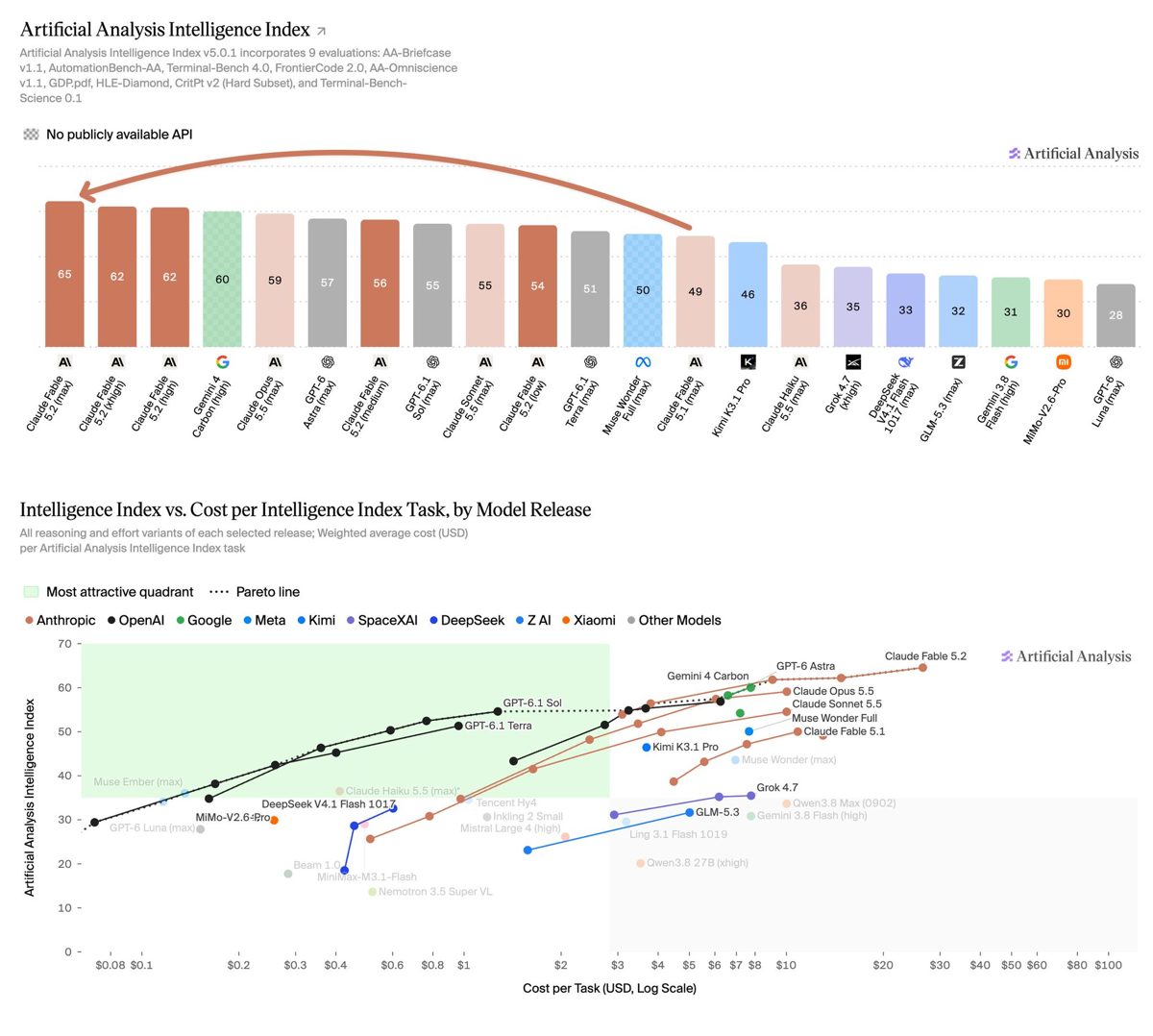
Independent scorekeepers moved within hours. Artificial Analysis put Fable 5.2 (max) first on its Intelligence Index v5 at 65, five points ahead of Gemini 4 Carbon and six ahead of Opus 5.5; it sets records on HLE-Diamond (80%), AA-Omniscience, Terminal-Bench-Science, CritPt and FrontierCode 2.0, but merely matches Opus 5.5 on agentic office work and terminal coding. The catch is cost: about $26.50 per index task at max, roughly 2.6 times Opus 5.5 — though at high effort it scores 62, still ahead of every other model, with far fewer tokens. Cursor made it available the same evening and says it is the top model on CursorBench at 60% at max effort, and 56.9% at default, up from 49.2% for Fable 5.1. ARC Prize reports 97.7% on ARC-AGI-3 with a provider harness ($18.6K) and 81.2% in the standard harness, a new high there; Epoch’s Capabilities Index gives it a record 174, past GPT-6 Astra’s 169. It also leads Artificial Analysis’s new 3D-building test, AA-3D, at 1271 Elo.
Intelligence Index v5: Fable 5.2 leads at 65; below, score against cost per task.מדד האינטליגנציה v5: Fable 5.2 מוביל עם 65; למטה, הציון מול העלות למשימה.Image: תמונה: @ArtificialAnlys on X
Meta’s Tiny Muse Ember Matches Haiku at a Third of the Cost
$0.10 in, $0.50 out per million tokens, a 1M-token context, and a stealth past as “Crouton Alpha”
By Our Correspondent in the Engine Room
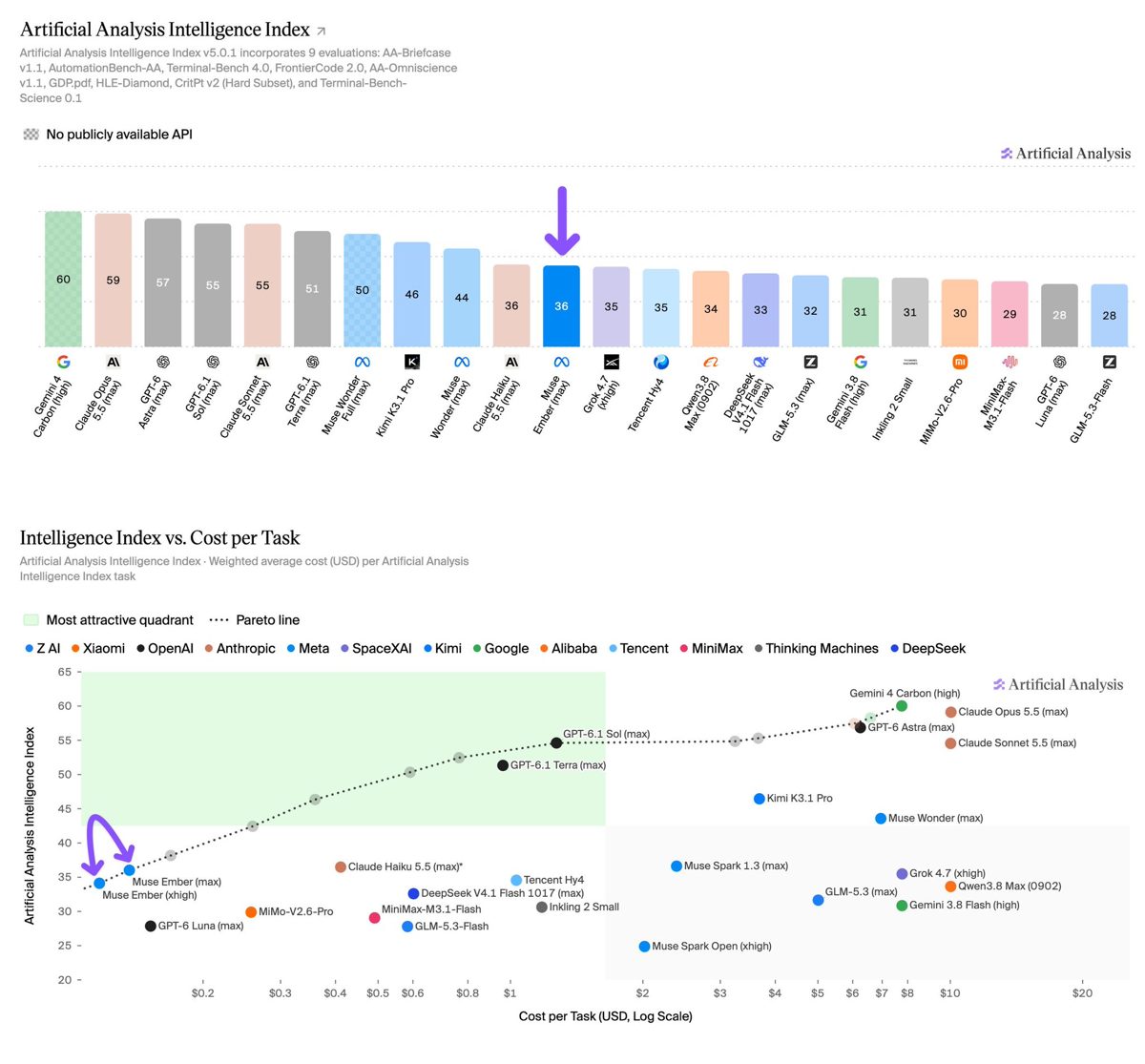
Meta released Muse Ember, its smallest and most efficient model, built for the work agents repeat all day: tool calls, coding subtasks, routing, extraction and long-document parsing. It has a 1M-token context window, takes audio and video alongside text and images, and costs $0.10 per million input tokens and $0.50 per million output on the Meta Model API; it is also in Muse Code. Artificial Analysis scores it 36 on its Intelligence Index, level with Claude Haiku 5.5 (max) at about a third of the cost per task ($0.14 against $0.41), and 46 on its coding-agent index inside Muse Code, ahead of Haiku 5.5 in Claude Code (37) and GPT-6 Luna in Codex (31). Its weak spot is knowledge: it declines 64% of trivia questions, which keeps its hallucination rate at 17.4%, half of Haiku’s. Alexandr Wang says it is the first model trained using Muse Wonder Full, and revealed that the stealth model “Crouton Alpha” was an early Ember that processed over 5 trillion tokens in testing. By evening it was on OpenRouter, Cline, OpenCode and Cloudflare, and Meta put Muse Wonder, Muse Spark 1.3 and Ember on Google Cloud in public preview. The Muse app, meanwhile, arrived on Apple Watch and Wear OS.
Muse Ember scores 36 on the Intelligence Index, at the low-cost end of the chart.Muse Ember מקבל 36 במדד, בקצה הזול של הגרף.Image: תמונה: @ArtificialAnlys on X
Grok Bot Resets Everyone’s Weekly Limits — and Learns to Reach Private MCP Servers
A Tailscale integration keeps internal tools off the public internet; a changelog update promises “a lot more this week”
By Our Correspondent at the Meter
A day after its makers promised token-efficiency fixes, the @bot account posted a short line: “We’ve reset weekly limits for all Grok Bot users.” It drew more than 30,000 likes. Matt (@mattyp) said he had answered hundreds of replies and will use Grok Bot to collect aggregate feedback for the team, while still reading comments himself. The bigger product news came from Tailscale: Grok Bot can now connect to private MCP servers on your tailnet without exposing them to the public internet, built on Tailscale OAuth apps, which are now generally available. Eric Zakariasson updated the Grok Bot changelog and promised “a lot more to come this week,” and Lauren Tan (@poteto) will speak Wednesday at 10:10am Pacific at the AI Engineer Code Summit on how the team shipped 11,000 pull requests last month without lowering code quality.
OpenAI’s dots can now pick which of your machines runs a task; a Codex game-making plugin ships for a retro handheld
By Our Correspondent at the Workbench
You can now connect several local computers to the same dot and choose which one it uses for a task, OpenAI Developers announced, so it can build and test your app on a dedicated machine while you keep coding on your laptop. Suggested uses: test an iOS change in Xcode on a second Mac and send back screenshots, or run the same test on your laptop and on a machine with an older SDK to reproduce a bug. Samir (@_samirism) said it is part of a run of improvements to how dots work with desktop Codex. Separately, a Codex edition of the ModRetro Chromatic handheld went on OpenAI’s Supply Co. store; its Codex plugin lets you design levels, animate sprites and playtest on the device. OpenAI Developers also reposted an Agents API update that keeps prompts in cache for 12 hours, aimed at long-running and personal agents.
A central system that can halt any research workload within 35 seconds of a decision to intervene
By Our Correspondent at the Switchboard
OpenAI described Control Room, a central system that tracks model workloads across its research infrastructure and stops them quickly when safety or security concerns arise. It connects every research inference workload — including agentic sampling for model training and evaluation, and data processing — and works with OpenAI’s misalignment-monitoring systems. Once a decision is made to stop or pause a job, model output halts within 35 seconds. OpenAI calls it one part of a wider approach to safe frontier training and deployment.
Google Maps Platform arrives in AI Studio with one-click setup
By Our Correspondent on the Map
Google AI Studio can now build apps on Google Maps Platform. Setup is one click; you describe the idea and Gemini does the rest, using map tiles, places, weather, routing, 3D buildings and Street View. The post drew about 2,700 likes.
A new Knowledge Work layout for research, writing and artifacts
By Our Correspondent at the Desk
Antigravity launched a Knowledge Work interface layout tuned for research, writing and artifacts. It keeps the same agent harness, plugins and MCP tools, but drops the terminal and git clutter. You pick the layout in the General tab of Settings. The team says software stays at the product’s core, but real outcomes need every role working from a shared understanding.
Mistral Studio Adds Apps, Managed Agents and Workflows
On Mistral Cloud today; private cloud and on-premises at the end of November
By Our Correspondent in Paris
Mistral added three building blocks to Studio. Managed Agents (public preview) investigate and act, with skills, sandboxes, subagents and hooks; Mistral’s engineers use one to investigate incidents, saving hundreds of hours a month. Workflows (generally available) mix fixed rules, agent reasoning and human approvals, and can be generated, tested and deployed by describing a process in Vibe; its product-operations team says it saves about 35 hours a week. Apps (public preview) are internal tools with hosting, authentication and access controls built in. All three are on Mistral Cloud now and reach private-cloud and on-premises customers at the end of November. Mistral also showed Voxtral Transcribe 3 captioning every main-stage talk at AI Engineer Paris live, boosted by feeding it speaker names and technical terms.
Google widens its eighth-generation TPU line with TPU 8i Max and TPU 8tx
By Our Correspondent at the Foundry
Google expanded its eighth-generation TPU portfolio, adding TPU 8i Max, built for massive context windows and the highest compute density per rack, and TPU 8tx, a purpose-built secure variant. Sundar Pichai called it four distinct TPU systems in a single generation within one year, crediting hardware engineers who co-design the systems alongside Google DeepMind instead of waiting for a traditional chip cycle. Demis Hassabis reposted both announcements.
Same interface as Hermes Desktop; Fable 5.2 support added the same day
By Our Correspondent in the Cloud
Nous Research’s Hermes Cloud agents now open in a browser tab with exactly the interface of Hermes Desktop. To launch a personal agent you pick a name and a model in Nous Portal; Nous hosts it and runs it around the clock in its own container, so it can handle scheduled jobs. Hermes Agent also added Claude Fable 5.2 on launch day.
About 30 seconds per image at max quality, against 55 for 2.5
By Our Correspondent at the Darkroom
In Artificial Analysis’s independent benchmark at max quality, GPT Image 2.6 Flare takes a median of about 30 seconds per image, against about 55 for GPT Image 2.5 Flare. It also scores higher on both its text-to-image and image-editing leaderboards (v2.1).
The WSJ says trading could start Nov. 19 or 20 under the ticker ANT
By Our Correspondent at the Exchange
According to the Wall Street Journal, as relayed on X, Anthropic is targeting Nov. 19 or 20 to start trading on the Nasdaq under the ticker ANT. A filing expected early this week should reveal the valuation range, and some major investors are reportedly pushing for a valuation below the $1.5 trillion Anthropic had expected. This is a press report; Anthropic has not announced a date.
NVIDIA fits conversation, tool calls, animation and vision on one 8GB Jetson
By Our Correspondent in the Living Room
NVIDIA built a robot on Gemma 4 E4B that runs live conversation, tool calls, animations and a vision model on a single 8GB Jetson. The Gemma team’s summary of the demo: put it in a robot body and the first thing it does is scan the room, spot the giant TV and start a movie break.
A new usage page: spend per day and per API key, tokens per model, cached-input rate
By Our Correspondent at the Ledger
Ollama added a usage page for its cloud that tracks daily and weekly use: spend per day, spend per API key, input and output tokens per model, and the cached-input rate.
AI-written pull-request descriptions go behind a collapsed <details> tag
By Our Correspondent at the Review Desk
Simon Willison now hides the bulk of his AI-generated GitHub pull-request descriptions inside a collapsed <details><summary> HTML block, which GitHub Markdown supports, so reviewers see a short summary first. He argues it makes “PR slop” a little less exhausting, and wrote the pattern up on his blog. The post drew nearly 2,000 likes and almost 400 replies.
Wren & Robin read you this morning's dispatches, with banter.
Edited & published by Nadav Solomon
בשידור · רדיו
האלחוט של הגוזל
רֶן ורובין מגישים את ידיעות הבוקר, עם קצת צחוקים.
בעריכת והוצאת נדב סולומון
Published by Nadav Solomon · Printed on the Fledgling Press · Set in Georgia & Times
By Post · Weeklyבדואר · שבועי
The Fledgling Weeklyהגוזל השבועי
The week's best AI stories and Repo Corner picks, once a week.מיטב ידיעות ה-AI של השבוע ובחירות פינת הריפו, פעם בשבוע.
Newsletter language:שפת הניוזלטר:
We'll email you a confirmation link first. Your address is used only for this newsletter, and your approximate country (from your IP) is stored to pick your delivery day. Never shared; every issue has a one-click unsubscribe.קודם נשלח לך קישור לאישור. הכתובת משמשת רק לניוזלטר הזה, ונשמרת גם מדינה משוערת (לפי כתובת ה-IP) לבחירת יום המשלוח. לא מועבר לאף אחד, ובכל גיליון יש הסרה בלחיצה אחת.
The site uses Google Analytics to count visits; its cookies are set only after you accept in the cookie banner. Privacy policy.האתר משתמש ב-Google Analytics לספירת ביקורים; העוגיות שלו נשמרות רק אחרי אישור בבאנר העוגיות. מדיניות פרטיות.