OpenAI Patches 948 Linux Escalations, Images Get GIFs & Kimi Opens Its Weights
Dispatches of the past four-and-twenty hours from the laboratories of artificial intelligence
OpenAI · Cyber
One Run, 948 Ways Into Root — And Patches for Each
OpenAI’s autonomous cyber pipeline found, exploited and drafted fixes for nearly a thousand Linux privilege escalations at $1.2 million in API credits
By Our Correspondent at the Kernel
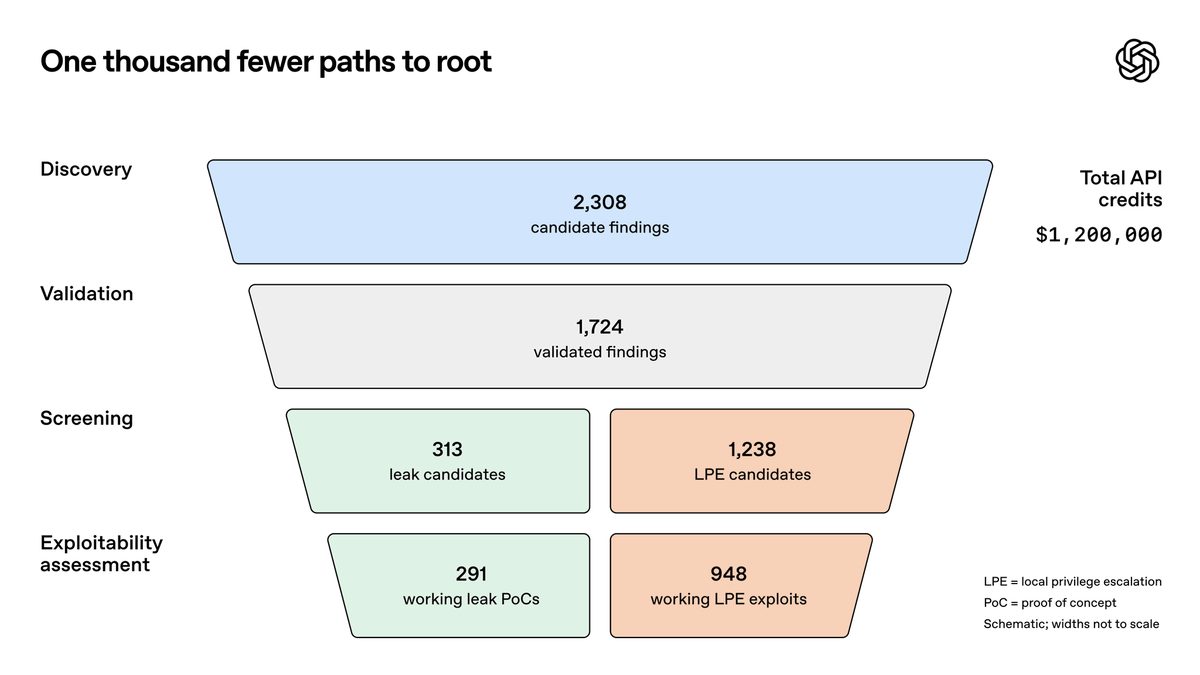
From 2,308 candidates to 948 working local privilege escalations.מ־2,308 מועמדים ל־948 הסלמות הרשאה מקומיות שעובדות.Image: תמונה: @OpenAI on X
OpenAI published “A thousand fewer paths to root.” In one mid-October run with an upcoming cyber model, its pipeline validated and generated patches for 948 distinct local privilege escalation vulnerabilities in the Linux kernel. The total API bill was $1,213,430 — about $1,279 per exploit. Human researchers still review every report before it goes to maintainers.
Scout agents first marked about 2.8 million lines of security-relevant code. Analysts then produced 2,308 candidate findings; triage agents reproduced 1,724 of them in isolated machines. Exploit agents built 291 information-leak proofs of concept and 1,169 working local privilege escalations on a stock desktop kernel with SMEP, SMAP, KASLR and HARDENED_USERCOPY still on. Variant analysis left 948 distinct patches. At least ten of the exploitation techniques were novel to OpenAI and to the outside experts it asked.
A July run with GPT‑5.6 Sol had found 166 unique escalations for about $514,000. Historical Pwn2Own and TyphoonPWN bounty rates would put a hypothetical value of $18.9 million to $66.3 million on the new set. OpenAI is already sending critical reports through Patch the Planet partners. @thsottiaux said the company has assembled a world-class cyber team and will share more of its work in the weeks ahead.
ChatGPT Images 2.6: GIFs, Saved References, and Twice the Speed
Flare and Sunburst land in the API; markup edits and SVG export come with them
By Our Correspondent at the Palette
OpenAI shipped ChatGPT Images 2.6 across ChatGPT and Codex on every tier, web, desktop and mobile. A prompt or a still can become an animated GIF with adjustable speed and editable frames. Reference images of people, pets and characters can be saved once and reused without uploading again. People now make about four billion images a week across ChatGPT, Codex and the API.
Developers get GPT‑Image‑2.6 Flare and Sunburst. Generation is about 50 per cent faster. At low quality Flare can finish in about six seconds; at medium or high quality Sunburst keeps details steadier across edits. The API now takes marked-up images to show exactly where an edit should land, and it can export SVG. A new complexity knob sits beside quality: low for quick edits, higher when the scene has many constraints. Codex edits images in the overlay instead of a side panel. Design Arena ranked Sunburst first for image generation.
@ChatGPT put the playful version in one line: make it weird, send more GIFs of your dog dancing. The models are live in the API today.
Kimi K3.1 Pro Weights Are Out, and Hosts Race to Serve Them
2.8 trillion parameters, 104 billion active, on Hugging Face, Ollama Cloud, Nebius and Verda on day zero
By Our Correspondent at the Checkpoint
Moonshot AI released the weights of Kimi K3.1 Pro on Hugging Face. The model has 2.8 trillion total parameters with 104 billion activated, aimed at coding, 3D work, financial research and other agent jobs. Nebius Token Factory claimed day-zero access and coding scores close to Opus 5.5 on Terminal-Bench 4.0.
Ollama put it on Ollama Cloud with United States hosting and full zero data retention: ollama run kimi-k3.1-pro:cloud. Verda Inference opened a preview API for the same model. Yesterday’s edition noted that the weights were not yet public; they are now.
@scaling01 simply wrote: Kimi-K3.1-Pro is now open-weights.
Background Subagents Stop Burning Your Claude Limit
Haiku 5.5 now writes the status line from short notes, cutting each update by about 99 per cent
By Our Correspondent at the Meter
@ClaudeDevs said background subagents in Claude Code now use far less of the usage limit. A running subagent refreshes its status line every 30 seconds. Those refreshes used to re-read the whole conversation. Haiku 5.5 now writes the line from short notes, so each update costs about 99 per cent less.
The subagent still keeps its own model. Sessions with background subagents used about 5 per cent less of the limit overall, which is roughly 6 per cent more prompts for the same allowance. The change is live for most Pro, Max and Ultra users and for everyone on Team and Enterprise. Update to v2.1.316 or later.
The post drew more than a million impressions in hours. For people who leave agents running in the background, the meter finally stopped eating itself.
Claude Helps Map the First Bacterial Vault Particle
A 9.5-megadalton phage vault assembled in E. coli, with a first model ready in 34 hours
By Our Correspondent at the Microscope
Anthropic’s biology lab published how it worked with Claude to solve the first three-dimensional structure of a vault particle from prokaryotic life. Vaults are hollow protein barrels, among the largest complexes in cells, discovered in 1986; their function is still unknown. Until now they were known only in complex eukaryotic cells.
Claude searched about 15 billion predicted proteins, designed DNA constructs, helped shrink a three-day purification to about 90 minutes, and drove cryo-EM processing. The chosen particle, L05 from a bacteriophage, is built from 96 copies of one protein — about 9.5 megadaltons — shorter and wider than the mammalian vault, with about 25 per cent more volume. A first full model was ready in 34 hours. Leonard Rome, who discovered vaults, is advising the team. The function remains open.
Claude also made mistakes: a bad growth medium cost two weeks, and an early map came out as a mirror blend until the team told it to stop improvising. The preprint is out; structures will follow.
OpenAI Buys Pierre to Make Codex a Place Teams Build Together
Trees and Diffs already power parts of the Codex app; Code Storage stays for now
By Our Correspondent at the Diff
OpenAI will acquire Pierre Computer Company. Pierre builds Code Storage and a family of open-source developer tools. If you have browsed files or reviewed a change in the Codex app, you have already used its Trees and Diffs libraries. The deal aims to make Codex the place where teams and agents build software from first idea to ship.
OpenAI also pointed to Pando, its in-house source-control backend for engineers and agents. Pierre’s Highlights is a fast syntax highlighter that updates as code streams. Diffs’ Edit mode lets a reviewer fix a line where the problem sits. Open-source projects stay open; customers can keep using Code Storage while features move into Codex. Closing still needs regulatory approval. Until then the companies stay separate. @thsottiaux welcomed Pierre with: Computers have RAM, right?
Separately, Cat Wu said she is joining OpenAI to lead product management for Core Products, and @thsottiaux welcomed her as CatGPT.
Generally available for browser, mobile and desktop agents, with Voice Remixing for Flash TTS
By Our Correspondent at the Desktop
@GoogleAIStudio said the computer-use tool in the Gemini API is generally available. No breaking changes from preview — only production-ready stability for browser, mobile and desktop agents. Docs are live in AI Studio.
Google also shipped Voice Remixing for Gemini 3.8 Flash TTS in AI Studio and the API. Start from a library of more than 2,000 voices or a custom voice, then prompt for timbre, pitch, pace and accent — “add a subtle Southern U.S. accent,” or “make it sound like a fire-breathing dragon.”
@googlegemma highlighted a community project that trains a light classifier on EmbeddingGemma 2 in real time, classifying text in about 20 milliseconds and images in about 100 without a full multimodal LLM.
Time per Task Beats Tokens per Second, and Hy4 Gains Eyes
Artificial Analysis rewrites its speed score; Tencent’s Hy4 and Hermes Marketplace fill the open-model shelf
By Our Correspondent at the Stopwatch
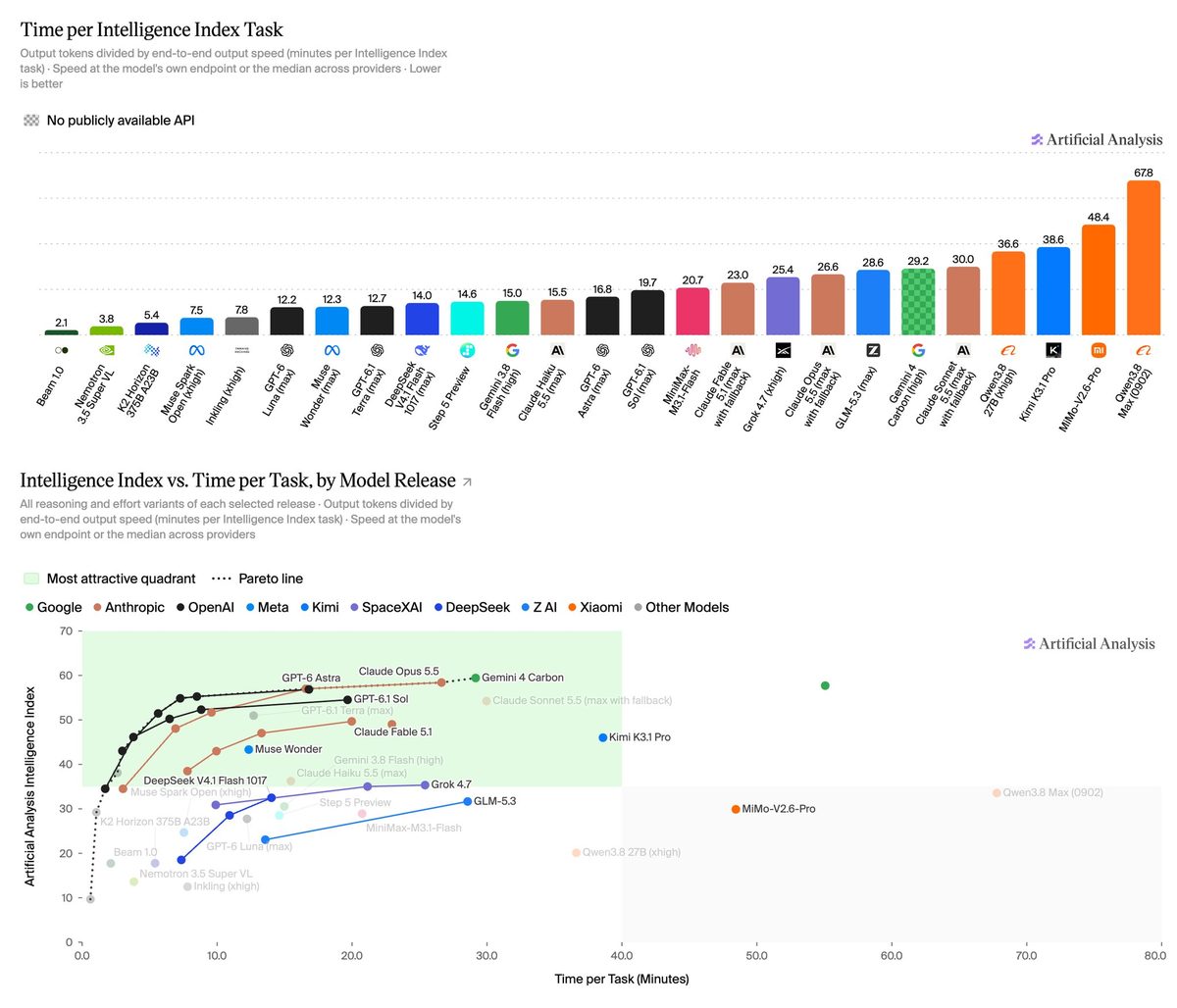
Time per Task becomes the headline speed metric across about a thousand endpoints.זמן למשימה הופך למדד המהירות הראשי על פני כאלף נקודות קצה.Image: תמונה: @ArtificialAnlys on X
Artificial Analysis made Time per Task its headline API performance metric: output tokens per Intelligence Index task divided by end-to-end output speed, including the wait before the first token. A chatty fast model can lose to a quieter slower one. OpenAI models hold much of the intelligence-versus-time Pareto frontier. At medium API default effort, GPT‑6 Astra, GPT‑6.1 Sol and Claude Opus 5.5 cut time and cost per task by roughly three to five times, trading a few Intelligence Index points.
Tencent’s Hy4 adds vision, computer use, a one-million-token context and training for Unity, Unreal, Godot and Office files. Nous Portal has it at 80 per cent off for a week; OpenClaw supports it through TokenHub, TokenPlan and OpenRouter. Nous also unified Hermes Agent plugins, connectors and skills in one marketplace and opened a seven-day plugin hackathon with $20,000 in cash prizes.
On AA-PersonalityBench, GLM‑5.3 averages 7.4 em dashes per reply; Claude Opus, Sonnet and Haiku 5.5 use almost none.
Conductor Joins Meta, Muse Passes ChatGPT, and Pages Land in Grok Bot
Short items from the rest of the feed
By Our Roving Correspondent
@alexandr_wang welcomed the Conductor team to Meta as the Muse gang grows. Charlie Holtz said Conductor is joining Meta Superintelligence Labs to build the next interface. Wang also shared U.S. App Store figures: Muse 942,000 downloads last week, ahead of ChatGPT at 556,000, Gemini at 341,000 and Grok at 239,000 — and Muse is first in Productivity in Japan.
@mattyp posted a walkthrough of Pages in Grok Bot: shareable canvases that pull in your data and X posts. @poteto teased AIE Code Summit slides on shipping about 30 times more code without reading it all, with roughly 230 people landing at least one Grok Bot pull request in October. Cognition introduced SWE‑2 Flash, a fast coding model that it says beats larger American open-weight models; weights will go to partners through a secure programme.
Demis Hassabis amplified the Collaborative Intelligence Benchmark: 18 models as teammates on 240 tasks, best score 82.2 out of 100; frontier models almost never cheat, but they give in when a teammate pushes back. HeyGen brought Video 1 to its mobile app. Mistral showed Large 4 finding and patching a Django CVE with 133 agents, and hosts Office Hours on Studio and Vibe today.
Wren & Robin read you this morning's dispatches, with banter.
Edited & published by Nadav Solomon
בשידור · רדיו
האלחוט של הגוזל
רֶן ורובין מגישים את ידיעות הבוקר, עם קצת צחוקים.
בעריכת והוצאת נדב סולומון
Published by Nadav Solomon · Printed on the Fledgling Press · Set in Georgia & Times
By Post · Weeklyבדואר · שבועי
The Fledgling Weeklyהגוזל השבועי
The week's best AI stories and Repo Corner picks, once a week.מיטב ידיעות ה-AI של השבוע ובחירות פינת הריפו, פעם בשבוע.
Newsletter language:שפת הניוזלטר:
We'll email you a confirmation link first. Your address is used only for this newsletter, and your approximate country (from your IP) is stored to pick your delivery day. Never shared; every issue has a one-click unsubscribe.קודם נשלח לך קישור לאישור. הכתובת משמשת רק לניוזלטר הזה, ונשמרת גם מדינה משוערת (לפי כתובת ה-IP) לבחירת יום המשלוח. לא מועבר לאף אחד, ובכל גיליון יש הסרה בלחיצה אחת.
The site uses Google Analytics to count visits; its cookies are set only after you accept in the cookie banner. Privacy policy.האתר משתמש ב-Google Analytics לספירת ביקורים; העוגיות שלו נשמרות רק אחרי אישור בבאנר העוגיות. מדיניות פרטיות.