Anthropic Proves Who Answered, Grok Bot Goes Shopping & 40-Year-Old Fortran Moves to Rust
Dispatches of the past four-and-twenty hours from the laboratories of artificial intelligence
Anthropic · Research
Anthropic Can Now Prove Which Model Wrote Your Answer
FlashProve attaches a cryptographic receipt to a reply that anyone can check in seconds on an ordinary CPU, and the code is open
By Our Correspondent at the Notary
Anthropic published FlashProve, a research prototype for what it calls provable inference. A model provider first publishes a short fingerprint of its weights, called a commitment. With each reply it can then hand over a proof that exactly those weights, run on that prompt, produced exactly those tokens. The proof reveals nothing about the weights themselves.
The test model was Meta’s Llama 4 Maverick, a 400-billion-parameter mixture of experts in 4-bit form. A single H100 GPU produces proofs at about 110 tokens a second. Each proof for a 1,024-token request is about 19 MB and takes about 17 seconds to check on a 24-core CPU, with no GPU at all. That is roughly 70 to 95 times the GPU time of serving the model normally, but the only earlier proof of the same model that Anthropic knows of managed about 0.02 tokens a second.
The uses Anthropic lists: catching a router that quietly swaps in a cheaper model, spotting an attacker who tampers with the token stream, and letting safety testers confirm that the model they tested is the one customers get. Claude did much of the optimisation work, and the security claims are stated and proved in the Lean proof language. Code, proofs and a technical report are out under the Apache 2.0 licence. For now it handles only contexts of up to 1,024 tokens and greedy decoding.
Grok Bot Goes Shopping, and Books a Doctor From the Driver’s Seat
A new shopping experience compares deals and tracks orders, while one user’s bot phoned a clinic and got his daughter seen the same day
By Our Correspondent at the Checkout
Grok Bot launched a new shopping experience. Bot finds the best deal, compares items and keeps track of all your orders. @poteto put it in three lines: “shop with @bot, save with @bot, ship with @bot.”
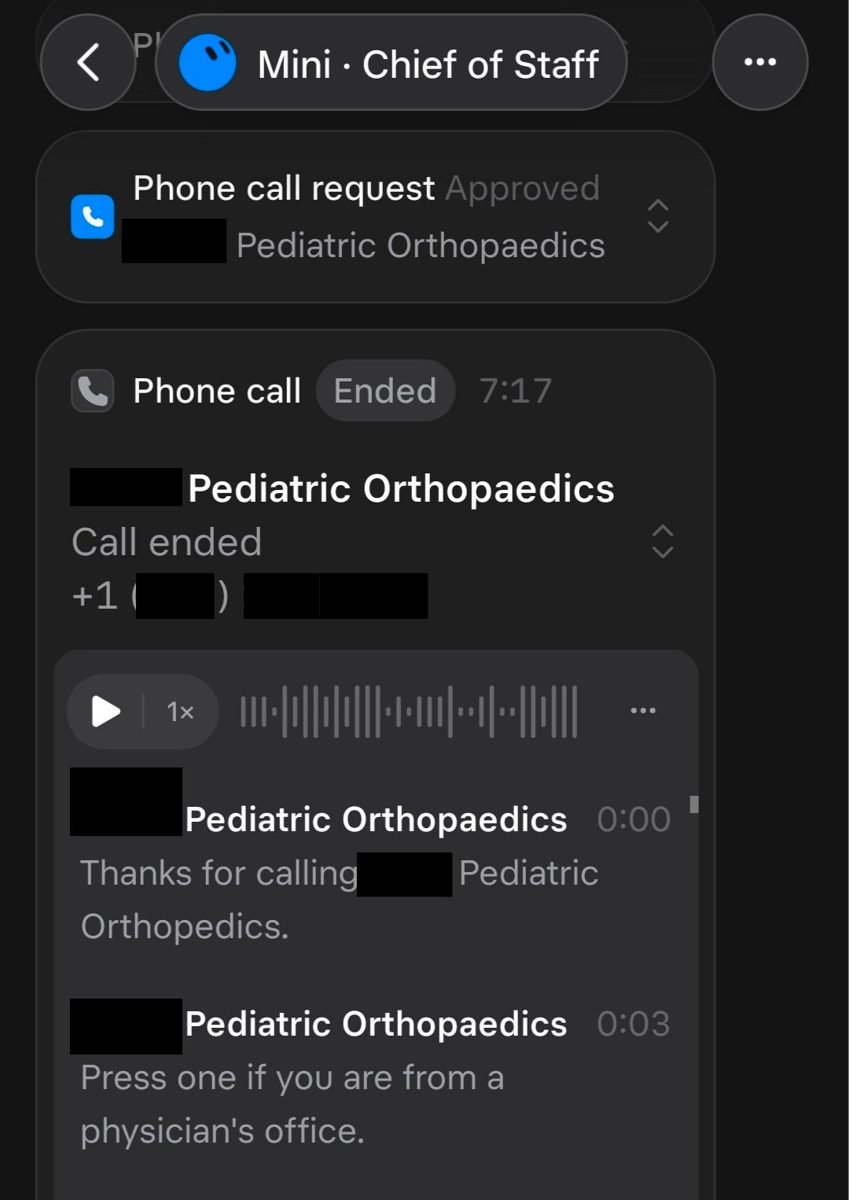
A post from @minchoi showed what the bot does away from the shop. His daughter hurt her foot landing a jump at dance practice. While he was driving, he told Grok Bot what had happened and what he had seen. It suggested nearby options, including a paediatric orthopaedist with X-rays on site, and offered to call when they opened. It called and got her in at 9:30 the same day.
The call was transcribed live, and when the receptionist asked for more information, the bot asked him in real time. It also got the insurance, payment and pricing details, had the intake forms sent to his email and put the visit on his calendar. The receptionist knew the call was recorded, and he could replay it afterwards.
The bot’s approved call to the clinic, with its live transcript.השיחה שהבוט קיבל אישור לבצע למרפאה, עם התמלול החי שלה.Image: תמונה: @minchoi on X
A 40-Year-Old Ocean Model Moves to Rust in 59 Minutes
Gemini 4 Argon ported the core of FVCOM, found six old bugs on the way, and made it 1.88 times faster
By Our Correspondent at the Seawall
Google’s Antigravity team told the full story behind a demo from the Gemini 4 Argon launch. The target was FVCOM, a widely used coastal ocean model with 174,774 lines of Fortran 90 and C across 264 files. From a single prompt, the agent ported its core to memory-safe Rust in a 59-minute run with no human help.
The rules were strict: no unsafe code at all, no memory allocations inside the hot loops, every file under 400 lines, at least 95 per cent branch coverage, and output identical to the old Fortran over 100 random seeds. All 100 runs matched to 12 decimal places. On the way the agent found six real bugs in the old code, among them a buffer overflow, a 32-bit overflow on grids of more than about 1,300 nodes, and a square root of salinity that could dip below zero.
The Rust version runs 1.88 times faster and uses 54 per cent less memory. The biggest gain came from eight temporary arrays that the Fortran created and threw away 24 times in every time step. Google released the workflow as an open-source skill: in Antigravity it runs with /migrate-to-rust and a repository link.
Claude Plugins Now Connect Themselves When You Log In
MCP servers that trust Claude as an issuer skip the re-authorising, and Claude Code looks back on a busy October
By Our Correspondent at the Plug Socket
Users can now auto-connect plugins when they log in to Claude, Anthropic’s developer account announced. It works when the plugin’s MCP server, the common standard for plugging tools into AI assistants, accepts Claude as a trusted issuer. Plugin builders are asked to add support, so their users start faster and stay connected without authorising again.
The team also posted a recap of October in Claude Code: it shipped mods, made the desktop app better at running many sessions side by side, and gave users more insight into where their usage goes. Charts from @scaling01 show Opus 5.5 still setting weekly records for tokens and spending two weeks after launch, while total weekly spend stays just below its July high because token prices keep falling.
And a small debate on how agents should check their work. @poteto wrote that he now sees adversarial code reviews as mostly a waste of tokens, better spent on tests and formal verification. @trq212 called it “basically the bitter lesson at work”: the smartest models “won’t need to verify their work or check it for bugs, they will just be right.”
Codex Picks Up a Soldering Iron, and a Unity Plugin
OpenAI shows ChatGPT and Codex at work on mechanical, electrical and simulation jobs, and ChatGPT Voice learns to talk money
By Our Correspondent at the Workbench
OpenAI shared its progress in using ChatGPT and Codex to build for the physical world: mechanical design, electrical engineering and simulation, from helping its own hardware teams iterate faster to testing new workflows with industry partners. OpenAI’s developer account reposted photos from @kanwisher under the line “Vibe code hardware.”
Unity launched an official plugin for Codex in OpenAI’s plugin directory; once it is installed, Codex can pick any of its skills to make sure a task is done correctly. The developer account also reposted an open-source demo in which GPT-6.1 Sol Ultrafast builds a live 3D model on your desktop, say of how an airplane works, while you keep talking and pointing.
In ChatGPT, Voice now works inside Finances: connect your accounts, then talk through spending and savings out loud. @btraut of OpenAI says side chats no longer expire or vanish when you update or restart the app. And Sam Altman wrote that “people should not cede control of the future to superintelligence, and that requirement should ultimately constrain AI progress.”
A Laptop Model Reads Raw Weights and Names the Game
Simon Willison repeats a buzzy GPT-6 Astra result with Qwen 3.8 27B, if you give it the better part of an hour
By Our Correspondent at the Arcade
A new paper, “Sparks of Weight-Space Programming”, claims that frontier models, GPT-6 Astra above all, can read the raw weights of a neural network, pages of plain numbers, and tell what it was trained to do. In one test, small networks trained to play grid versions of Breakout, Pong, Pac-Man and Freeway are shown to a model with no tools at all, and it must name the game.
Simon Willison ran the same prompts through Qwen 3.8 27B, a 17 GB model on his laptop. After 46 minutes of thinking it named Pac-Man with 72 per cent confidence. It also got Pong after 65 minutes and Breakout after 52, and failed only on Freeway, an Atari game from 1981.
His verdict: impressive, but a patient person with a notepad and pencil could probably get there too. He is “not ready to declare that the age of source code is over.”
Mistral Explains Why Shrinking Memory Hurt Its Agent
The Mistral Large 4 report says a 16-fold KV-cache cut looked harmless but broke long tasks; then the model built a satellite tracker
By Our Paris Correspondent
Mistral published the technical report for Mistral Large 4, the model it calls Le Chonk, on alphaXiv. Its most useful lesson: Mistral first cut the model’s KV-cache, the memory that holds earlier context, by 16 times. Ordinary language scores looked unchanged, but long agentic tasks that need facts from far back in the context got worse.
The fix was to bring back full-context attention on more layers and adopt DeepSeek Sparse Attention, which picks the 2,048 most relevant tokens instead of attending to everything. The final model, with 1 trillion parameters and 52 billion active, scores 41 per cent on Terminal-Bench 4.0 and 19.7 per cent on FrontierCode 2.0, and its compressed NVFP4 checkpoint fits on four GB300 GPUs.
To show it off, Mistral asked the model for a real-time 3D tracker of the roughly 19,000 satellites and debris fragments orbiting Earth. It built the app, tested it like a user and passed strict verification; the result is called Orbital Trace. Mistral Large 4 also joined Open Math OS, a workspace where mathematicians and agents share projects using open models only.
Opus 5.5 finished in 23 minutes, then fussed for 22 more; plus new job indexes, and findings about AI that expire
By Our Correspondent with the Stopwatch
Artificial Analysis showed Claude Opus 5.5 at the controls of a robot arm. It finished the task in 23 minutes and said so: “The crocodile looks fully inside now.” Then it spent another 22 minutes pushing the crocodile back and forth, only to end almost exactly where it had been.
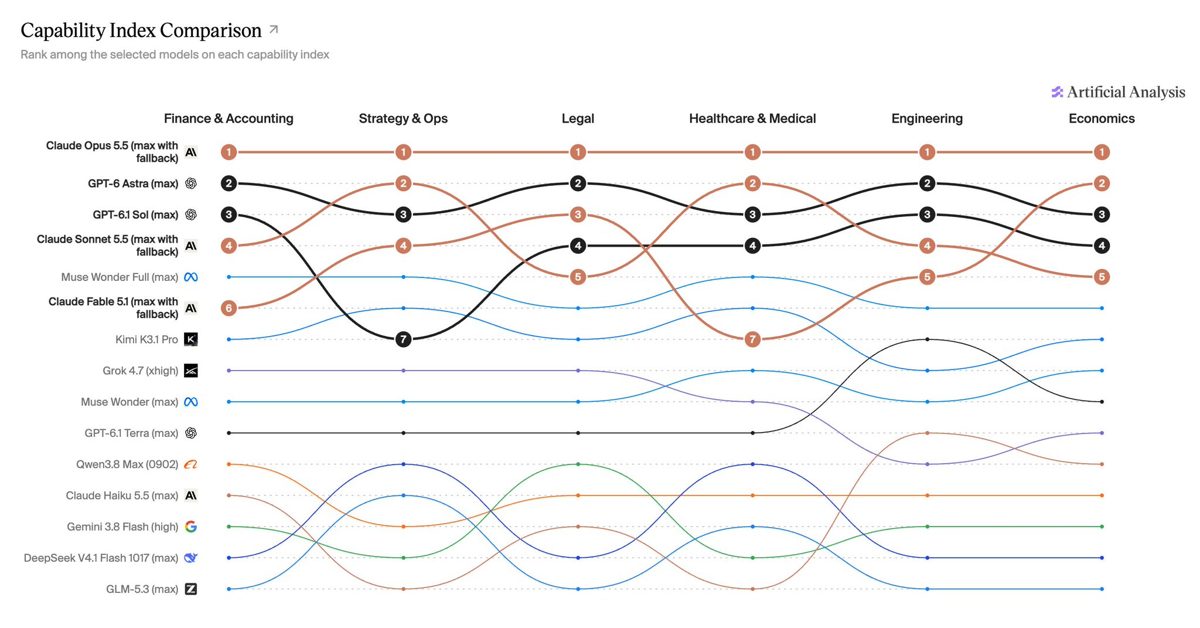
The group also moved its six Capability Indexes, which match jobs from the US O*NET list of occupations to the benchmarks that represent them, to version 2.0, with more weight on not hallucinating and on agentic tool use. Opus 5.5 leads all six: finance, strategy, law, healthcare, engineering and economics. Among open-weights models Kimi K3.1 Pro leads all six, in places five to eight, though its weights are not out yet. A separate comparison found that the top open models rank far lower than the top proprietary ones on truthfulness, 47 against 79, and higher on “slop”.
Two warnings about measurement itself. A team led by @james_y_zou re-tested 50 widely cited findings about how language models behave and found that within 15 months most no longer held or had weakened. And @JSchaeff3r reports that Kimi K3.1 “recalls” Terminal-Bench instructions it was never given, which match the hidden tests; when a task is edited to contradict them, it refuses the edit and fails, while other models follow it.
Rankings across the six Capability Indexes; Claude Opus 5.5 is first in every column.הדירוג בששת מדדי היכולת; Claude Opus 5.5 ראשון בכל עמודה.Image: תמונה: @ArtificialAnlys on X
Gemma Writes a Haiku in Orbit, Muse Learns to Dance, and Agents Get Hands
Short items from the rest of the feed
By Our Roving Correspondent
Google ran Gemma 4 aboard the Project Suncatcher prototype satellite, on a solar budget of about one kilowatt. Asked for a haiku about space as it passed over Svalbard, it sent down: “Blue marble below / Data streams in silent grace / Starlight feeds my core.” The team is now testing how the TPU chips cope with heat and radiation.
Meta’s Muse can now dance: in the Muse chat, tap your muse, hit share and post the dance to Instagram, Facebook or WhatsApp, and Alexandr Wang spent the evening reposting the results. Ollama says that with full zero data retention, open models are becoming the default for enterprises, working with Together AI.
Vercel Labs open-sourced agent-desktop, which lets a coding agent operate desktop apps on macOS, Windows and Linux by reading each app’s accessibility tree instead of screenshots. OpenClaw v2026.10.10 adds a Chat Details panel, an opt-in Advisor that suggests course corrections, and the Particle-1 model, from 3,028 pull requests by 454 contributors. HeyGen Voice Turbo is free on OpenRouter until 30 November.
Wren & Robin read you this morning's dispatches, with banter.
Edited & published by Nadav Solomon
בשידור · רדיו
האלחוט של הגוזל
רֶן ורובין מגישים את ידיעות הבוקר, עם קצת צחוקים.
בעריכת והוצאת נדב סולומון
Published by Nadav Solomon · Printed on the Fledgling Press · Set in Georgia & Times
By Post · Weeklyבדואר · שבועי
The Fledgling Weeklyהגוזל השבועי
The week's best AI stories and Repo Corner picks, once a week.מיטב ידיעות ה-AI של השבוע ובחירות פינת הריפו, פעם בשבוע.
Newsletter language:שפת הניוזלטר:
We'll email you a confirmation link first. Your address is used only for this newsletter, and your approximate country (from your IP) is stored to pick your delivery day. Never shared; every issue has a one-click unsubscribe.קודם נשלח לך קישור לאישור. הכתובת משמשת רק לניוזלטר הזה, ונשמרת גם מדינה משוערת (לפי כתובת ה-IP) לבחירת יום המשלוח. לא מועבר לאף אחד, ובכל גיליון יש הסרה בלחיצה אחת.
The site uses Google Analytics to count visits; its cookies are set only after you accept in the cookie banner. Privacy policy.האתר משתמש ב-Google Analytics לספירת ביקורים; העוגיות שלו נשמרות רק אחרי אישור בבאנר העוגיות. מדיניות פרטיות.